
Autonomous USVs will lead Blue Economy
As the ‘blue economy’ drives the potential of uncrewed surface vessels (USVs) in reducing human labour and improving ocean productivity, Matthew Ratsey, managing director of Zero USV, highlights the untapped potential of USVs, foreseeing their dominance in marine surveys and mapping operations.

With the blue economy projected to reach £3.2 billion (€3.7 billion) by 2050, various industries are racing to implement more efficient ocean monitoring techniques. Offshore renewables, driven by the quest for Net Zero and energy security, are experiencing exponential growth. For instance, global offshore wind capacity is expected to increase tenfold by 2030, requiring extensive and accurate seafloor data for installation, a demand met by the marine survey and mapping industry.
USVs are proving their capability in handling complex tasks and challenging environments, enhancing productivity and safety while reducing costs. Regulatory frameworks and technical innovations are steadily overcoming barriers to USV operations, particularly for offshore surveys.
Zero USV has pioneered fully autonomous USVs, distinct from remotely operated vessels.
Major improvements in GPU (Graphic Processor Unit) technology have enabled AI to function effectively on small, power-efficient devices mounted on the boats. These advances allow USVs to operate independently without constant satellite connectivity. The development of hybrid powertrains further enhances reliability and power optimization.
Autonomous navigation and data collection have become feasible with low earth orbit (LEO) satellites and hybrid connectivity solutions, reducing operational constraints. The Mayflower Autonomous Ship’s successful transatlantic crossing in 2022 exemplifies the viability of autonomous USVs. Oceanus12, equipped with AI and advanced sensors, can navigate and make real-time decisions autonomously, collecting valuable oceanographic data.
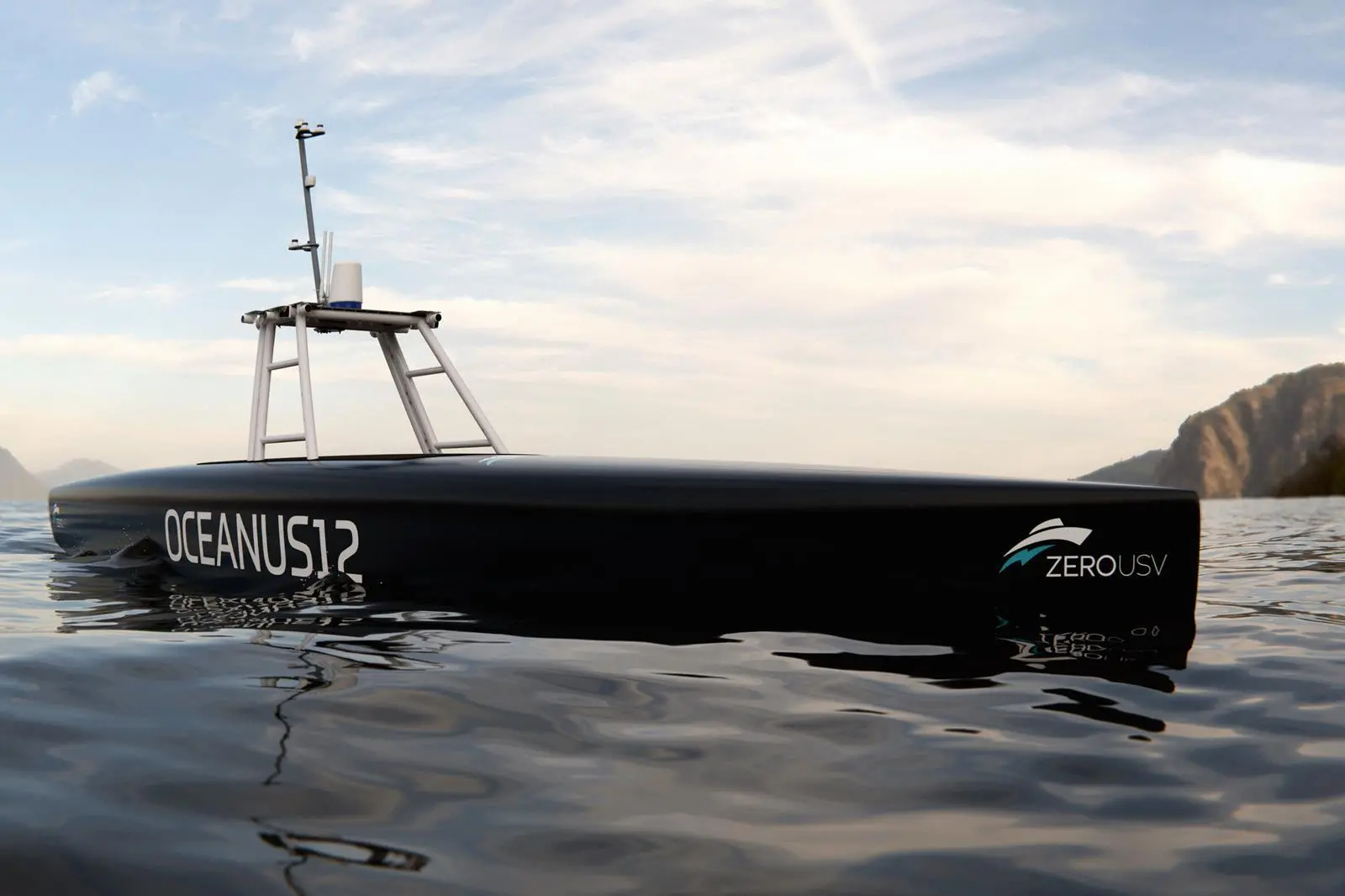
AI enhances survey operations by automating data collection, optimizing routes, and improving operational efficiency, thereby reducing costs and human error. USVs, equipped with advanced sensors like Navtech’s radar offer improved situational awareness. Their lighter payload and reliance on solar energy reduce carbon emissions and extend operational ranges.
As AI continues to advance, the integration of USVs in marine surveys will increase, transforming the industry by improving efficiency, safety, and environmental sustainability. The future of ocean exploration will increasingly involve autonomous vessels operating over the horizon, navigating the furthest corners of our seas.