![MaritimeJournal[Seawork]](https://www.maritimejournal.com/wp-content/uploads/2026/09/MaritimeJournalSeawork.svg)


Higher and heavier for Van Oord’s ‘Svanen’
Dutch marine contractor Van Oord is upgrading its heavy-lift installation vessel Svanen to cope with the ever-increasing size of offshore wind turbines.
The Rotterdam skyline has been dominated recently by the upgrading of the cranes on the wind farm installation vessels Wind Osprey and Wind Orca for Cadeler A/S, which have afforded the spectacular sight of them being jacked-up almost to their full height, ships themselves seeming to hang in the air.
Meanwhile, across the river at the nearby Heysehaven, Van Oord’s equally impressive but quite different Svanen is undergoing a similar upgrade, both projects with the same purpose of responding to demands to install larger offshore turbine components.
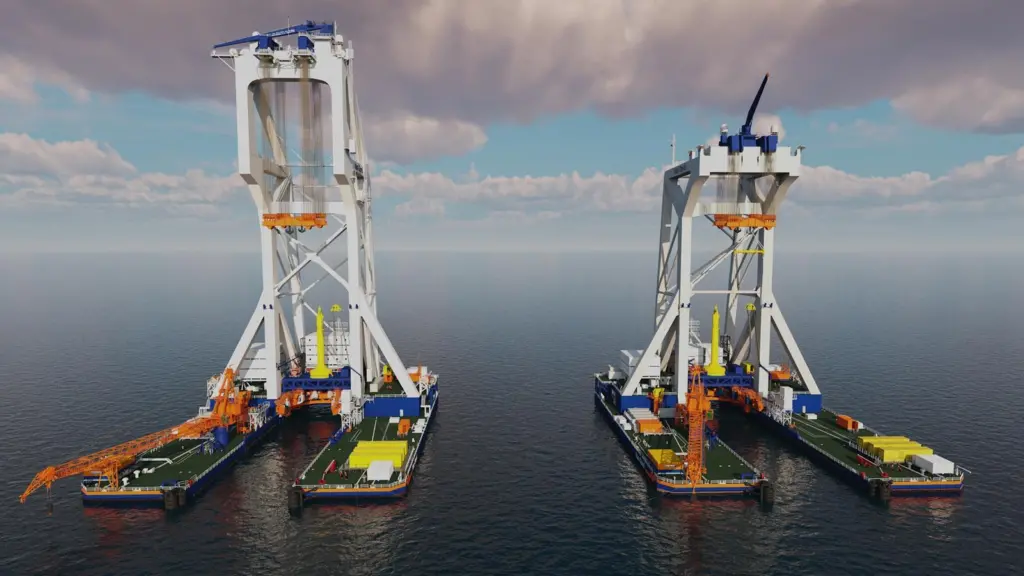
The most eye-catching upgrade will be increasing the crane structure’s height by 25m to handle the next generation of monopiles, while the already significant 3,000t capacity crane will be increased to lift 4,500t via upgraded lifting hooks. Other work includes upgrading the foundation gripper along with the vessel’s structure to handle the latest hammer size.
Modifications will take place at several locations, mainly in the Rotterdam area, with the 1,200t crane extension constructed by Holland Shipyards and installed by a 200m high Mammoet crane.
The work is due for completion in Q3 2024, its first project being the Baltic Power offshore wind farm, which will feature 15MW turbines requiring greater height and lift capacity. Svanen’s low draught means it is well-suited for work in the Baltic, a feature of value elsewhere including the UK’s London Array wind farm in the Thames Estuary, where some turbines were in waters too shallow for conventional installation vessels.
The vessel has already played a leading role in several Baltic Sea projects including Kriegers Flak, Baltic 2, Arkona and Baltic Eagle.
Svanen has an interesting history. While it now has an extensive track record in the offshore wind industry it was originally built in 1991 for the installation of bridges.
Around 2005, it was modified to install monopiles and transition pieces, and since then it has been used to install approximately 700 monopiles and 223 transition pieces.
It had already received a major upgrade in 2017 and Van Oord says that by re-using much of its original construction and machinery it can reduce waste and emissions.