![MaritimeJournal[Seawork]](https://www.maritimejournal.com/wp-content/uploads/2026/09/MaritimeJournalSeawork.svg)




New WTIV has 70m depth capability
Danish wind farm installation specialist Cadeler has taken delivery of a Wind Turbine Installation Vessel (WTIV) that can operate in ocean depths of 70 metres.
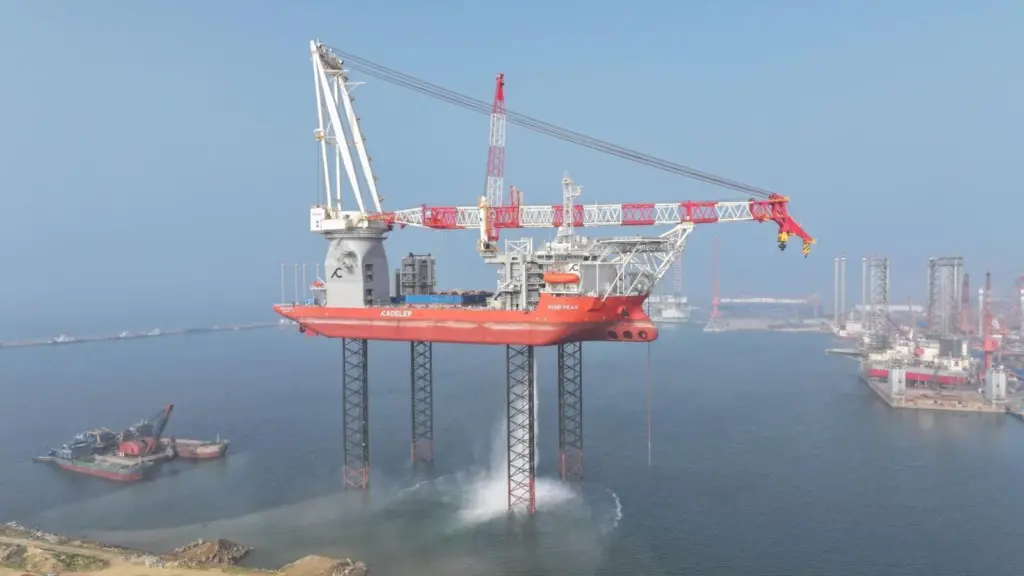
Wind Peak is the first in a seven-vessel series of WTIVs for Cadeler as the sector races to keep up with demand to install ever larger turbines in an ever-expanding global market.
Delivered on time and within budget, Cadeler describes Wind Peak as “the most modern and innovative vessel in the industry, fully designed to cater to the growing needs and demands of future farms in terms of size, scope and complexity.”
The vessel can transport seven complete 15MW turbine sets, or five sets of 20+MW turbines, per load, transit capacity reducing the energy intensity of installation and ultimately lowering the total cost and carbon footprint of installation per turbine.
These P Class vessels will be the largest in Cadeler’s fleet, boasting a deck space of 5,600m2 and payload capacity of more than 17,600 tons, the main crane providing a lifting capacity of more than 2,500 tons at 53m.
Other specifications include LOA 162m and breadth 60m, main power provided by 21.6MW gensets and 5.4MWh batteries delivering a transit speed of 11kn via 4x4MW azimuth thrusters, two 2.2MW retractable thrusters and three 3MW tunnel thrusters.
The DNV-classed vessel can operate in water depths of 70m with four triangular truss-type legs, each 119m in length. The all-important leg jacking system is a floating opposed rack and pinion type.
A helicopter landing deck capable of accommodating Sikorsky S92A and AugustaWestland helicopters is included and each vessel can accommodate 130 crew members and installation technicians.
The series is the result of “close cooperation” with Cadeler’s strategic partners, including COSCO, GustoMSC NOV, Kongsberg, Huisman and MAN Energy, with sister ship Wind Pace scheduled for delivery by COSCO Shipyard in Q2 2025. Both vessels will fly the Danish flag.
Cadeler’s strong position
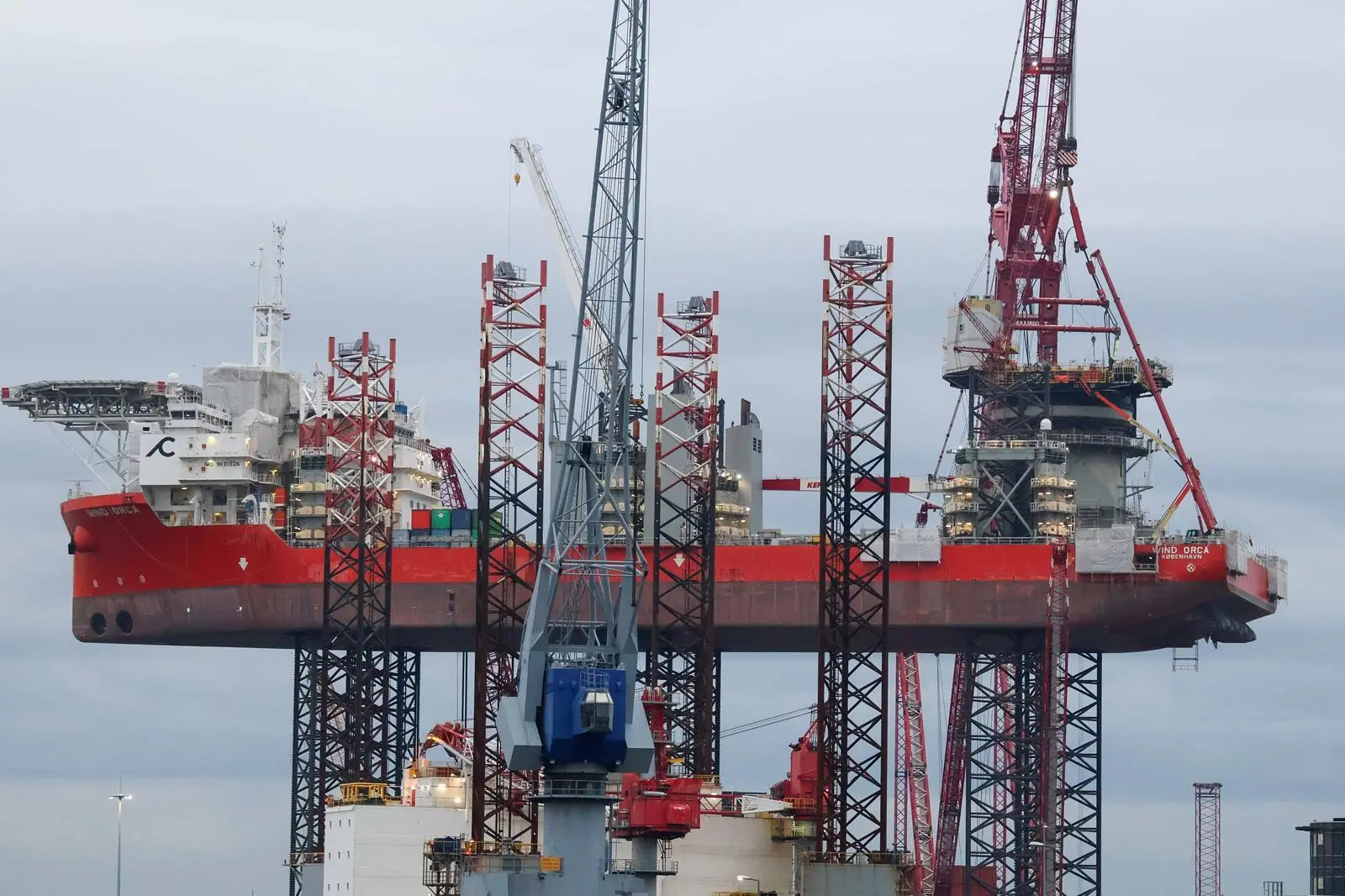
Delivery of Wind Peak by COSCO Shipping Heavy Industry in Qidong, China is but one component of Cadeler’s growing fleet, comprising both new-build and recently acquired second-hand tonnage that now stands at around 12 vessels in total.
A recent indication of where upgrading existing vessels to match demand is seen as a viable option involved Cadeler upgrading the leg-encircling cranes on Wind Orca and Wind Osprey.
Replacement of the 1,200mt cranes with larger 1,600mt versions was carried out on both vessels consecutively at Mammoet’s quayside in Rotterdam.
Delivery of Wind Peak can therefore be considered as one piece of a jigsaw that keeps growing in size with little sign of any let-up in global demand for offshore wind.
This includes the US, where while there is huge potential, developments are slow compared to other regions and mired by political and environmental concerns, not to mention navigating Jones Act regulations when considering the significant variety and number of vessels needed for it to happen.
Ever-expanding sector
A perfect example of the expression ‘economy of scale’ is where wind turbine manufacturers have increased the capacity of their offshore generators. Without the logistical challenges of increasing the size of their onshore counterparts, the sky is virtually the limit when imagining the capabilities of wind farms at sea
The industry’s early days saw 3MW turbines installed in relatively shallow waters close to shore. Fast forward to today and 15MW+ turbines are the typical size specified for new projects as the industry expands globally beyond Europe’s increasingly crowded waters.
As turbines progressively increased in size so too did the associated components: foundations, transition pieces, towers and turbine blades.
The original WTIVs, often converted vessels from other similar sectors, were soon unable to accommodate the increasingly larger loads despite some innovative upgrades, and as the industry matured new-build WTIVs became the chosen option.
Related Articles
 INDUSTRY NEWS
 OTHER NEWS
 MERGERS & ACQUISITIONS