

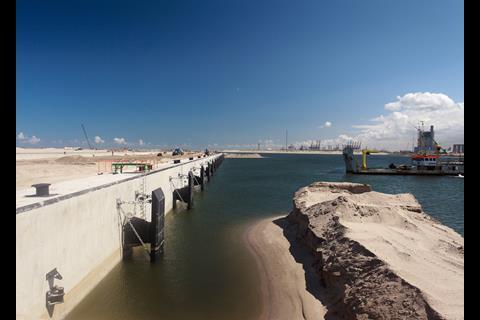
For Port of Rotterdam Authority (PRA) and contractor consortium PUMA, 2012 promises to be a busy year.
They will reach a number of important milestones as the Maasvlakte 2 port development project moves ever closer to seeing the first sea-going ships mooring at the new terminals in 2013, before commercial container operations begin in earnest in 2014.
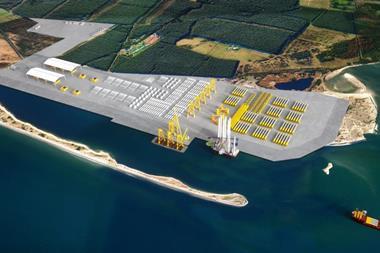
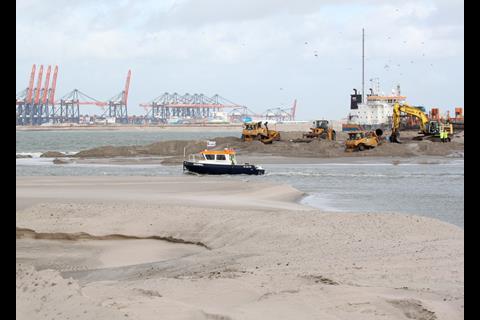
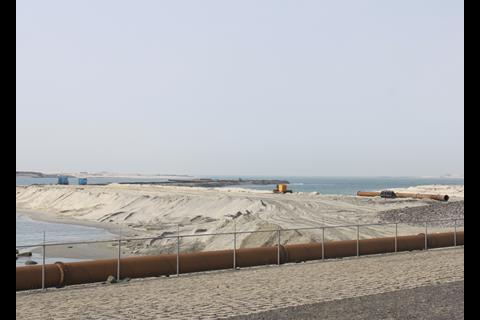
The development, to the west of the existing Maasvlakte port complex at Rotterdam, has seen the shape of the Netherlands coastline change significantly, with maps now having to be redrawn. Eleven kilometres of newly constructed hard and soft seawall now extends into the North Sea, protecting some 2,000ha of new port area, requiring an eventual total of 365 million m³ of dredged sand.
Over time, the area will be developed into terminals for container and chemical industries, along with logistics and distribution parks. Maasvlakte 2 is very much a long term project, with a target date of 2035 for completion. PRA point out however that a phased pace of development will take place, as and when new tenants and operations materialise. The basic structure of Maasvlakte 2 is however now virtually all in place, an analogy being the skeleton is now complete with progress on track gradually adding the flesh as the whole body starts to gather strength.
Closing the sea gap
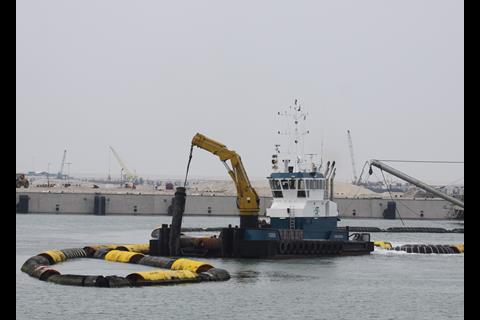
Up until now, a gap has been left in the new outer seawall, allowing sea access for various craft ranging from small survey and crew vessels to trailing suction and cutter suction dredgers bringing in sand dredged from the North Sea and working at attaining the required depths within the port, particularly alongside the berths. Such exposure to the open sea would obviously be impracticable long term, and access will be via the Yangtzehaven at Maasvlakte 1, the head of which will be cut through into the area of Maasvlakte 2. Just a short time frame, coinciding with neap tides in July, is available when the gap in the outer seawall will be filled in. Once complete and allowing time for settlement, the ‘missing link’ in the infrastructure, comprising road, rail and cycle tracks that will become the main land access route to the area, including the businesses to the north of the Yangtzehaven, will be completed.
The new area cannot remain landlocked however. While access will be required for small craft, at the same time, road and rail routes will also have to be maintained to the businesses to the north of the Yangtzehaven, across what will eventually be the new sea access channel to Maasvlakte 2. Temporary bridges have therefore been installed for road and rail traffic, allowing a small waterway to be cut through until the outer seawall access route is available for use. The bridges will then be removed and the remaining sand dredged from the Yangtzehaven to the required width and depth, able to accommodate the largest container ships in the world.
Cooling water from the nearby E.ON power plant is discharged directly under the Europaweg roadway into (what was previously) the open sea, and is now, of course, the port area of Maasvlakte 2. This was another reason to establish an early sea connection via the Yangtzehaven, and for the temporary bridges. To assist the flow of cooling water, a curved dam has been constructed within the new port area to direct the water into the Yangtzehaven.
A temporary sand dam has now been constructed across the entrance to the Prinses Alexiahaven basin in preparation for filling the seawall gap. This will temporarily reduce the mass of water flowing in and out of the whole of Maasvlakte 2 port area with each tide, making it easier to fill the gap in July. The dam will be opened again once the outer seawall gap has been filled.
First ship arrives
The outer seawall infrastructure needs to be operational by the autumn of 2012, allowing the cutting through of the Yangtzehaven to start before the New Year (2013). This timescale is to coincide with the planned arrival of the new container cranes in the spring of 2013. The ship carrying the cranes will therefore be the first sea-going ship to sail into the new entrance to the harbours of Maasvlakte 2.
In January, the last of 19,558 40 tonne concrete blocks, recycled from the old Maasvlakte seawall was laid on what is now the new outer hard seawall protecting the exposed northwest section of Maasvlakte 2. The purpose built crane Blockbuster has been working night and day since April 2011 to position the blocks with an accuracy of 15cm.
PRA have gone to considerable lengths to ensure that nature and the environment are not a long term loser with Maasvlakte 2. A 25,000ha seabed protection area has been established southwest of the land reclamation, along with creation of a 35ha dune compensation area near Delfland to the north.
The old Maasvlakte seawall is now some distance inland, and no longer available as a recreational area. The new seawall is however around twice as long. The northern part will be of interest to surfers, kite-surfers and bird watchers. Construction progress on the new seawall has allowed the public to imminently have access to this area for all of the above, including provision of 1,500 car parking spaces. The southern part of the beach is suitable for swimming and sunbathing and will provide space for a naturist beach. Also, this more lively part of the beach has toilets and catering facilities.
Terminals take shape
The first two tenants at Maasvlakte 2 have announced details of some of the container handling equipment to be deployed, both operations featuring high productivity levels and using the safest and most advanced equipment of its kind in the world. To the north of the development, ECT is planning to extend its existing Euromax Terminal operation of the Yangtzehaven into Maasvlakte 2.
The deep water berths for both Rotterdam World Gateway (RWG) and APM Terminals (APM) will be dredged to a depth of 20m and the barge/feeder quays to 14m, both in line with other similar berths throughout the port, allowing accommodation of the largest container ships currently in operation.
The 1,250m of deepwater and 650m of barge/feeder quays for Rotterdam World Gateways (RWG) in the Prinses Amaliahaven are now complete, allowing preparation work to begin with the terminal area itself. The RWG terminal will be fully automated, featuring Super Post-Panamax cranes and, like APM Terminals, will include fully automated transfer of containers to and from temporary storage stacks. The rubber wheeled gantries for RWG are reported to have now been delivered for phase 1, covering 100ha, with operations in the port to commence in the second half of 2013 and full capacity capability being reached in 2014.
Improved productivity
After consulting customers, and studying ports worldwide, APM recognised that quayside crane productivity is often hampered by container yard activity being unable to keep pace. Designers have had to work around the non-negotiable factors of ever increasing container ship sizes, demands for higher productivity and service level consistency, all in a safe and environmentally friendly way. A 25% to 50% productivity improvement for customers over conventional terminal designs is expected by APM at Maasvlakte 2.
APM will use an innovative, fully automated system where once lifted off the vessel, a Lift Automated Guided Vehicle (AGV) will shuttle containers, two at a time, to the container yard using an onboard navigation system following a transponder grid. Containers are then loaded, independently of each other, into a series of storage racks. An Automated Rail-Mounted Gantry crane then transfers them to the next designated destination such as the rail terminal, a truck or to another storage area. Düsseldorf based Gottwald Port Technology will supply 36 Lift AGVs and 128 storage racks to APM for the first phase of their Maasvlakte 2 terminal. The suppliers of the gantry and ship to shore cranes are yet to be announced.
With green and safe being standard requirements nowadays, the Lift AGVs for APM will be diesel-electric powered, the designers also studying the feasibility of making them 100% electric powered. They will only operate in fenced off areas, excluded from pedestrian and vehicle traffic, operations being halted if the automated area is entered.
RPA are expecting to hand the terminal over to APM in June this year, when civil construction activities will commence. The first quarter of 2013 will see the arrival of the first Lift AGVs and the first phase is expected to see APM handle an annual capacity of 2.7m TEUs by 2014, rising to a total of 3.4m TEUs.
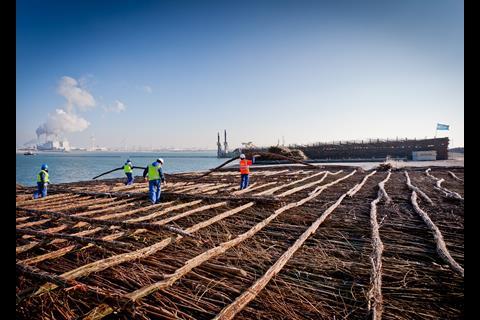
An environmentally friendly system of controlling the movement of sand that dates back over 100 years has been adopted for the quay walls of RWG. The Van Aalsburg Company has constructed seven fascine mats, woven together from traditional willow branches. Each mat is around 200m to 300m long, covering an area of around 5,000m² and takes two days to produce. In an operation taking just half a day, tugs then take each mat to the location alongside the quay where they are weighted down by stones. The mats prevent container ships propeller wash from moving sand over the seabed and the same method will be used for APM Terminals.
By Peter Barker