

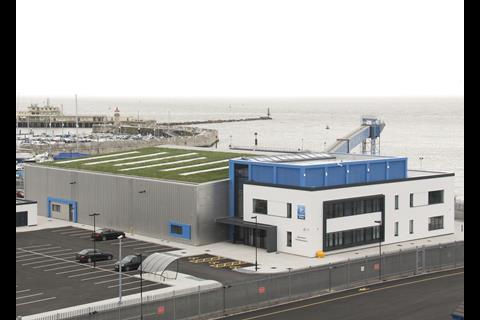
London Array Ltd recently hosted the opening ceremony for their eco-friendly operations and maintenance base at Ramsgate UK, to become the long term hub for their offshore windfarm in the outer Thames estuary.
The occasion was a timely reminder to the gathered audience of the scale of the project, and provided the opportunity to review progress both offshore and onshore, in particular the significant effect offshore wind has had for ports such as Ramsgate, for which the implications could hardly have been imagined just a decade ago.
The eyes of the world are on London Array, seen as a dress rehearsal for the UK’s Round 3 ambitions, and the industry’s preparedness for projects of such a scale. It is situated some 15km (at the closest point) from the Kent and Essex coasts. DONG Energy, E.ON and Masdar are development partners for phase one of London Array, comprising 175, 3.6MW Siemens turbines and two offshore substations. Four export cables will transfer energy to an onshore substation at Cleve Hill on the north Kent coast.
The 630MW total capacity will bring with it the accolade of world’s largest offshore windfarm, a title that will be held for at least a few years to come. Numbers alone however cannot paint a representative picture of the degree of activity during the construction phase and the scale of supply chain involvement, including that of many hundreds of people at every level from the person at the top to local business communities serving the projects’ everyday needs.
Port Renaissance
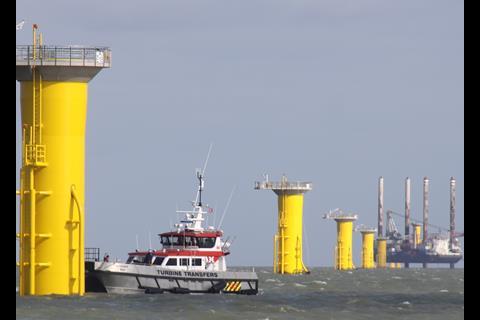
Ramsgate is typical of a number of European ports experiencing significant growth in activity on the back of the offshore wind industry. Ramsgate, Harwich and Sheerness are principle UK ports for London Array, Harwich being a load-out port for some of the major components. Larger ports however, may not always be best suited to handle the large number of small support craft, including the plethora of crew boats and various multicats, tugs and barges that support the larger turbine and cable installation vessels offshore.
Ramsgate has carved out a niche in this sector, and can now rightly claim to be something of a renewable energy hub for offshore wind following commitments from two projects off the Kent coast. A factor in London Array’s developers selecting Ramsgate for their O&M base was the earlier decision by neighbours Vattenfall to site their own O&M base at the Kent port for the now operational Thanet Offshore Windfarm (TOW), which until recently held the ‘world’s largest’ title.
Aberdeen is well known as a major hub for the offshore oil and gas industry, and while of course on a vastly different scale, in Ramsgate and the surrounding area of east Kent, the seeds are being sown in gradually developing a small cluster of businesses and individuals, diversifying from traditional areas of activity to feed the requirements of this relatively young industry. Support boats are emerging from yards on a regular basis, and Ramsgate is a popular re-fuelling stop on their passages around the coast. There has been some evidence of ‘spot market’ type activity, with boats picking up the occasional one-off charter serving the Thames estuary wind farms which now number five, not including planned extensions.
Council owned Ramsgate harbour has had to adapt to accommodate the additional demand while still satisfying the needs of existing customers, including inshore fishing vessels, a roro freight service to Ostend and, particularly during the summer, a thriving marina.
Two main areas of Ramsgate are used by the offshore wind energy sector. The Royal Harbour provides ‘parking space’ for vessels, with additional pontoons now installed to cope with the increase in demand. Meanwhile, the adjacent Ramsgate Port area is home to the O&M bases (along with a maintenance base for Siemens). Along with new pontoons and fuelling facilities currently being installed for London Array, TOW and Siemens, it serves as the working area for day to day movements, currently an around the clock operation, with boats transferring personnel on a 24/7 shift basis.
Marine coordinators at London Array oversee operations offshore, boats working as much with them as with the harbours’ own port control, which oversees movements within its area of jurisdiction. The working pattern typically involves boats moving to berths adjacent to the O&M bases at the start of each working day (or night), picking up passengers and cargo before leaving for the site. Upon return the reverse happens.
An air traffic control type operation is evident at present, with the adoption of a berthing slot system at the O&M area to enhance safety during busy periods. Currently, during construction and commissioning, more than 25 small vessels are operating at London Array. Over 150 different vessels have been recorded as being involved in various operations so far.
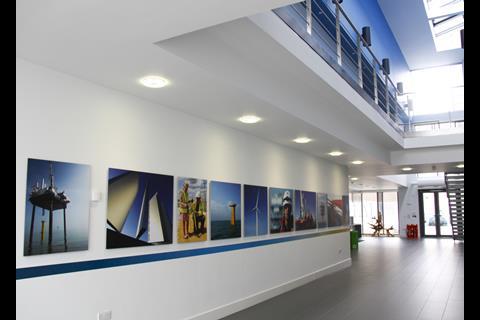
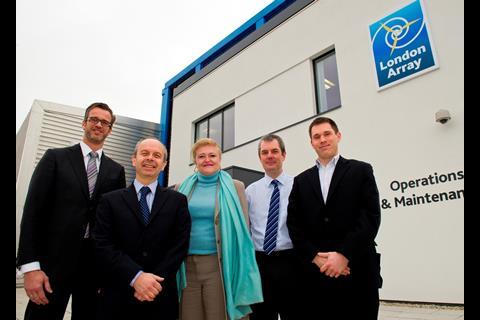
The £4.2m London Array O&M building itself is built to high environmental standards, including a grass covered ‘nature roof’. It was opened by Laura Sandys, MP for South Thanet, also a member of the Energy and Climate Change Select Committee. When asked by the leader of Thanet council, Clive Hart, what attracted them to Ramsgate, Matt Britton, London Array commercial and operations manager, included proximity to the site, a non-tidal harbour, and adequate shore side areas as being important factors. Communication links to the area include the high-speed rail link to London, the East Kent Access road link and Kent International Airport just five miles away, all important considerations for major international companies. Siemens has now commissioned a weekly scheduled air service, to be operated by a subsidiary of British Airways, between Kent International Airport and Denmark. Siemens says this will allow its staff to be home in Denmark within two hours of coming ashore at Ramsgate.
Benefits for the area go beyond the involvement of the principle contractors, with around £10m worth of contracts placed with 100 local businesses. Ramsgate Harbour Slipways Ltd is an example of a local business benefiting from wind farm associated work, regularly accommodating vessels for routine and not so routine maintenance work. Non-marine businesses are also benefiting, including the main contractors purchasing local properties to accommodate their workforce. One sea front hotel is affectionately known as the ‘Siemens Mission’, reflecting increased demand during the construction phase.
Progress Offshore
Construction offshore is progressing at a steady pace, with first electricity generation expected imminently. At the time of writing, 118 foundations and 27 turbines had been placed by installation vessels Sea Worker, MPI Adventureand MPI Discovery.
Stemat Spirithas now completed installation of the second of four export cables, with array cable installation progressing well, involving among others cable-lay barges,Stemat 82,Stemat Oslo, Pontra Maris and the offshore support vessel Normand Flower.
Progress has not been without problems, not unexpected perhaps given the scale of the project. Unexploded ordnance, wrecks and seabed conditions required re-location of a number of foundations. The route of the export cables has also had to take into consideration existing cables, including the BritNed interconnector and the Kentish Flats windfarm export cables.
In 2009, design issues arose at other windfarms, relating to failures of the grouting connections between monopiles and transition pieces. London Array has now adopted a conical foundation design, in compliance with revised DNV standards. Resultant early delays were overcome with the provision of extra production capacity by contractors and suppliers.
A feature at London Array is the extremes of water depths ranging from zero at LW to around 25m. This resulted in deployment of the HLV Svanenfor installation of a number of heavier foundations in shallow water. Particular features of the location also required a rethink of the method of installation for the array cables.
A question often asked by communities involved with such developments is, how many jobs will be created both short and long-term? London Array provided some interesting information at the opening of the O&M building. Activity is reaching a peak as turbine installation and commissioning progresses and currently over 500 people are working on London Array, 56% of whom are British. Two offshore accommodation vessels are currently employed. Wind Ambition, owned by the Netherlands based C-bed Floating Hotels, is contracted to Siemens, while cable contractor VSMC is using the services of Florida based International Shipping Partners cruise vessel Sea Discoverer.
Almost 100 people are based at and operating from the Ramsgate construction office, 86% of who are British, with 46% from the local area. Once construction is complete and the windfarm operational, activity will of course reduce and up to 90 long term jobs will be created at Ramsgate over the 20+ year life of the windfarm.
Siemens has been awarded the maintenance contract for the first five years of operation, and will also supply support and monitoring for a further five year period beyond. At the recent opening, Richard Luijendijk, director Siemens Energy Service Renewables, stated however that his company is in favour of lifecycle contracts for maintenance work.
A minimum of five support vessels will provide crew and cargo transfer services for the wind farm’s lifespan. DONG Energy is main O&M service provider for London Array and the 70 anticipated long term maintenance jobs are to be split equally between Siemens and DONG, the latter having taken on nine apprentices to be trained as wind turbine technicians. The remaining 20 jobs will be taken by support staff at the O&M base, which will contain computerised monitoring and control facilities, a workshop, offices and storage facilities.
By Peter Barker