![MaritimeJournal[Seawork]](https://www.maritimejournal.com/wp-content/uploads/2026/09/MaritimeJournalSeawork.svg)


Two new tugs’ interesting journey to the water
The physical size of tugs compared with deepsea ships allows flexibility in the location of the construction yard but of course they still need transporting to their natural environment.
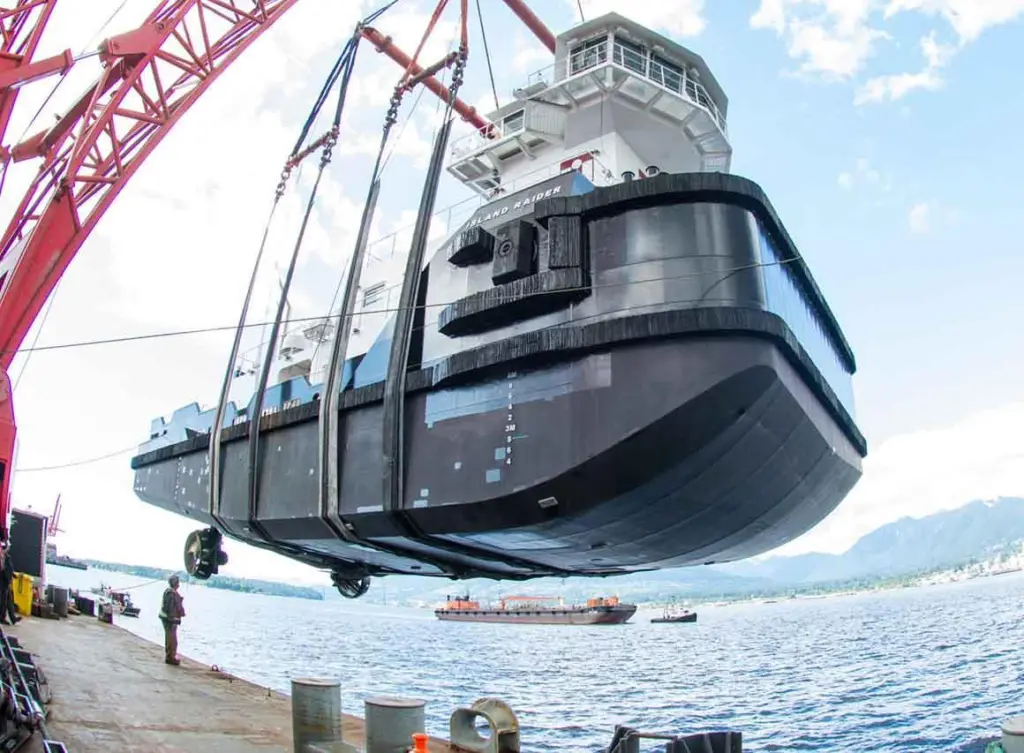
MJ has previously reported on the order for two articulated tug/barge units at the Fraser River facility of Island Tug & Barge, now known as Island Tug with its purchase by US parent company Tidewater Inc. Completion of the second vessel has shed light on elements of the story perhaps otherwise overlooked with traditional spectacular slipway launching of ships from adjacent assembly buildings.
The tugs were built in a warehouse on the Fraser River and with no launching facility nearby and a railway track between the yard and the steep bank of the river some innovative heavylift planning was required.
Self-Propelled Modular Transporters (SPMTs) are regularly employed moving tugs and ship modules around shipyards and Vancouver-based Dynamic Heavy Lift along with Schiedam, the Netherlands-based Mammoet were given the responsibility of moving the two tugs onto Dynamic’s 330’ long barge Dynamic Beast using a ro-lo method (roll on, lift off). The barge is equipped with two Manitowoc revolving crawler cranes of 900 and 230 tons lift capacity.
The SPMTs were positioned beneath the tugs which together then moved over wooden beams laid over the railway tracks and on to the barge moored in the river. The operation was completed over a weekend and the barge, with the tugs on deck towed downriver to the Port of Vancouver for launching.
Lifting the 384-ton tugs from the barge to the water again called for precise planning involving three layers of heavy spreader beams each at right angles to the one above and supporting four double-slings positioned beneath each tug’s hull. Once lowered into the water, but still connected to the crane the shipyard team who had been given the day off to watch the operation, boarded each tug to check the internal compartments before being lowered to its marks and towed to the owner’s dock for completion prior to sea trials.
The 24.9m long push-tugs are powered by Cummins V-12, Tier II compliant main engines each developing 850hp at 1,800rpm and powering Rolls-Royce US105-P9 Z-drives. A raised forecastle contains coupling pins manufactured by Taisei Engineering Consultants under the name Articouple.
By Peter Barker

Related Articles
 SPECIAL REPORTS
 TUGS & SALVAGE
 EQUIPMENT