

Diesel outboards: Twice the price but half the cost
Testing the OXE Diesel 200hp on the water, Jake Frith finds its main appeal is the cost graphs he sees back on dry land.
It’s fair to say that the leisure marine market will be largely unmoved by the OXE Diesel outboard range. At approximately £39000 for the 200hp model, for light use, fair weather boaters, a four stroke petrol engine from one of the Big Four, at nearer £17k would always make more sense.
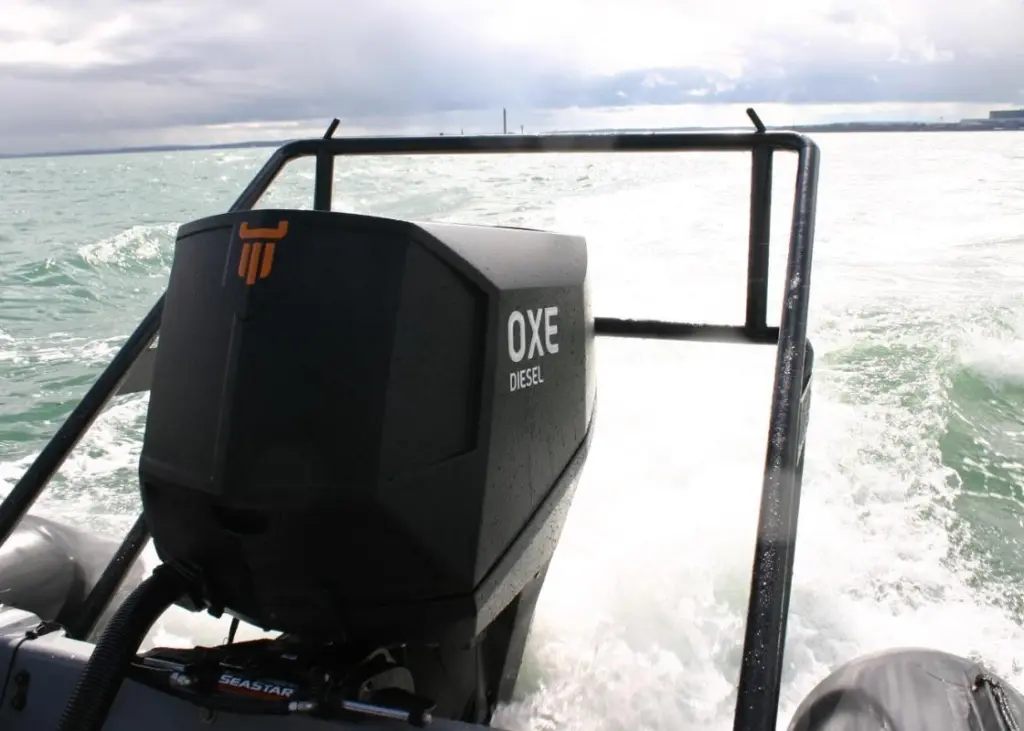
But for high use, commercial marine scenarios, diesel wins out almost every time. We took a 7.8m JBT RIB out on a chilly day in Southampton Water, and have little to report in terms of the engine’s ‘performance’. From the commercial marine viewpoint that is a good thing. That is to say, the engine sat on the back of the boat, smoothly and quietly going about its business while using surprisingly little fuel. In terms of the refinement and smoothness that you might expect it to fall short on, it’s a bit like comparing a modern diesel car to a modern petrol one- once you are underway, it’s hard to tell the difference. Sure, it doesn’t offer a fruity, racebred six cylinder petrol howl, but that sort of thing becomes tiresome after half an hour, even sooner if you’re the one paying to pour fuel down its throat.
Built by Cimco in Sweden, the 200 model packs a four cylinder turbodiesel (derived from a GM car engine), which when given wide open throttle offers a smooth, very torquey pickup, accompanied by a muted whistle from the turbo. Proteum (the UK and Ireland distributor) have found that for the boat type we were using, a five bladed prop offers a reasonable compromise of top speed versus pickup out of the turns. It limited the boat’s top speed by a couple of knots, but it made it a very safe feeling package as a working platform.
Speaking to Neil Taylor, Proteum’s Sales Manager, back at their offices at Hamble Point, I was surprised just how quickly the cost numbers on the OXE Diesel engine would begin to beat the petrol powered competition.
A number of commercial operators in multiple industries from fishing, to aquaculture to RIB charter, have shared their numbers with Proteum. Now that the OXE diesel engines have been around for coming up to 4 years, and operators have moved over, (according to Proteum, there are currently about 200 of these engines in daily commercial use), there is plenty of data comparing costs with their former petrol-engined operations.
COMPARING THE NUMBERS
Proteum has developed a TCO (Total Cost of Ownership) Info Tool, that graphically presents these comparisons and it makes for very interesting reading.
The first key factor I was not aware of was how frequently heavy commercial users were replacing their petrol engines. It makes the cost curve of the petrol engine scenario rise as a staircase with each step being the time an engine is replaced. It’s not because the petrol engines were going wrong, more about the prices achievable for selling the used engines on into the leisure market. It’s hard to sell a petrol engine with more than about 1000 hours on it, and beyond this level, the value drops off very sharply, so regular replacement was the norm.
The total lifetime of the OXE Diesel is not yet known, Proteum says there are multiple models out there with 3000-4000 hours on them still going strong, but it’s still early days to make a guess at total life-span. It’s cooled by a fresh water circuit thanks to a pretty standard pump situated with its conventional strainer on the front of the motor- accessible from inside the boat- afloat. If you suck up a carrier bag, you can clear the strainer or change the pump impeller in the powerhead in a few minutes (there is no impeller to worry about in the engine’s lower drive unit). Another bonus of this setup is that cooling water can feed into a cabin heating circuit. It’s clear that this is better for longevity than a raw water cooled petrol outboard setup, with hot salt water going through all those cooling galleries from day one.
Conventional lower unit gearboxes with dog clutches are a weak point on many petrol outboards, especially when rushed commercial skippers crash them too quickly between forward and reverse, but the OXE has a much more robust hydraulic clutch that cannot crunch gears. In many ways, the more time I spent with the OXE 200 the more I came to think of it as an inboard diesel, just one that happened to be an outboard!
With fuel prices being what they are though, it’s the 45% lower fuel burn rate that really tips the balance to diesel for commercial users. It’s often not just a matter of the fuel burn rate though. More than one operator we heard about was really struggling to get hold of petrol anywhere near where their boats were operating. One RIB charter company was having to run its petrol boats back to a marina 20 miles away every time they needed refuelling, so incurring all those fuel and skipper time costs on top, but the increased range of the diesel outboards took this pain away for them.
One of the scenarios we looked at showed the total cost of ownership of the OXE and a petrol equivalent over 5 years. The stunning headline figures I took away were £259000 for the petrol engines and £159000 for the OXE.
Proteum has also launched a finance package that takes the initial outlay sting out, effectively promising to take one of the downsides away.
TIME FOR DIESEL?
It all seems very rosy for the OXE, so why has the world not gone to diesel outboards yet? There are a few reasons for this, in my view. First, marine items are working in an environment where failure can be costly, not just financially but also, ultimately in life and limb. So outboard engine buyers are a conservative bunch with brand preferences built up over many decades’ experience. The OXE range is still relatively new. With them having been on the market 3-4 years, 200 in operation and the most heavily used at 4000 hours, it’s all looking good, but for some prospective buyers the jury is still out.
For some, weight or bulk could be an issue. These engines are larger and heavier than their petrol equivalents. Sure, there’s lots more torque, but torque is not the whole story. For boats that depend on their engines’ power to weight ratio, there could be issues. Those TCO savings might not look so great if an operator’s planing hulls won’t get on the plane anymore, or the weight increase means a like for like replacement on power means the boats they go onto just don’t have the necessary volume aft and a fleet of hulls needs replacing too. None of this is beyond the realms of calculation beforehand, it just all needs bearing in mind, and it’s worth noting that swapping from petrol to an OXE diesel is not necessarily as simple as swapping from one brand of petrol motor to another. The TCO figures I quote above are Proteum’s, and all usage scenarios are different. Prospective buyers would need to work out their own numbers on that too, but my view is it’s well worth looking at for any commercial user.
Some might argue that the VW diesel emissions scandal and the overall sentiment change towards diesel vehicles might have cooled demand a little, but that’s unlikely as petrol outboards are generally pretty poor on emissions compared with road vehicles. Diesel is still the defacto fuel for sub IMO sized commercial boats, and likely to remain so for some time yet.
A six cylinder OXE 300hp variant is due out next year. It will use a BMW six cylinder twin turbo diesel, which unlike the GM unit is all aluminium. It’s also more compact for its output, so the 300 model will have a similar all-up weight to the 200, and be physically not much more bulky. As the 200 gearbox and lower unit was engineered with more power in mind, the 300 will use the same lower leg castings- just with a slightly wider main drive belt inside.
The competition in the shape of the Cox Powertrain CXO300 diesel outboard will also be on the market by then, so the 300 isn’t going to be entering the same competition free market place that the OXE products are currently enjoying. Competition will bring improvement, and I look forward to seeing an already impressive product going from strength to strength. To put my findings more starkly, I’m not expecting to see many petrol outboards on the back of commercial boats in ten years time.
Visit Proteum at Seawork International 2019 on stand PO12