

Natalia: prototype hybrid barge
The first sightseeing barge of its kind has proved that if designed with care, hybrid systems are not just cleaner and greener, but can equal or surpass their traditional counterparts for reliability.
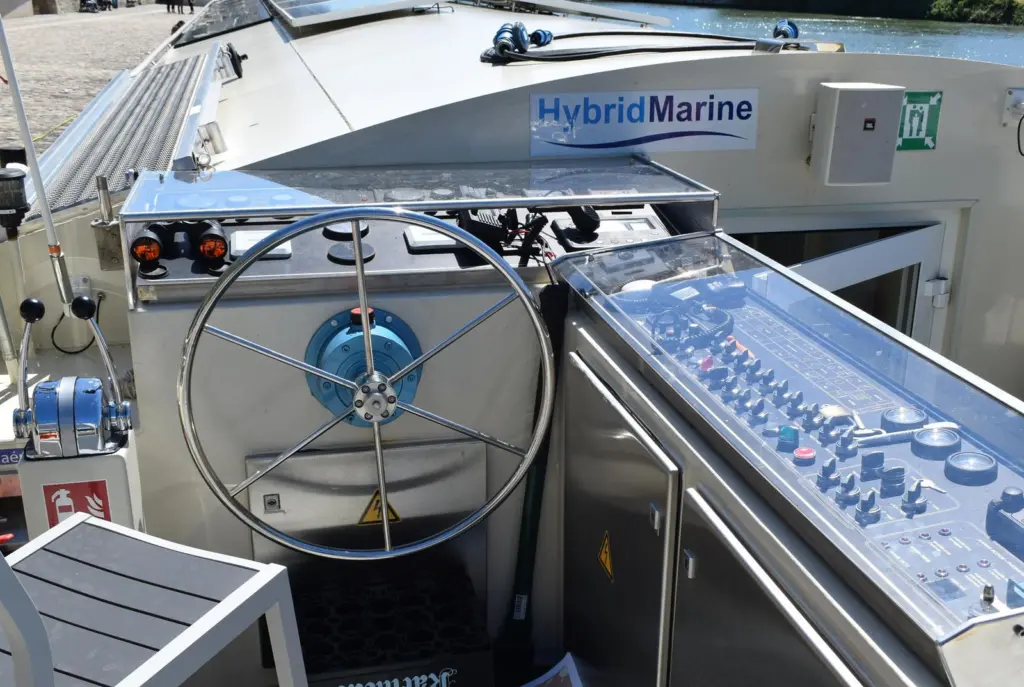
As skipper Peter Jenner of Backwater Tours commented, “Natalia hit the water and went straight into service without trouble”. “That’s almost unheard of for what’s basically a prototype,” added system integrator and specialist Graeme Hawksley of Hybrid Marine.
More, on a sunny day, it can keep up its usual sedate 2km/h to 4km/h pace powered almost entirely by the 6kW solar panels fitted to the roof with minimal depletion of the battery bank. The electrical drive can also pick up its pace and deliver 9km/h on slack water, the four-cylinder, 3.8l diesel engines cutting in to push that up to 15km/h on the rare occasions it’s necessary to run against a heavy flow.
In fact, after a year of stress-free running, owner Backwater Tours has seen enough take up that it’s just in the process of ordering two more.
So, how has it achieved it?
To answer this, Hawksley took MJ on a tour of the twin engine rooms as the boat paused on the Seine, just south of Paris.
“Our philosophy is not to put anything extra on the drive chain that can fail.” He explains that while there are parallel hybrid configurations that connect the motor generator between the engine and the gearbox, this means that “to go to electric running you have to disconnect the engine … and that means putting another clutch in the line”.
Instead, Natalia has a pair of 20kW motor/generators sitting on top of the gearbox, connecting to the shaft in parallel with the engines, “which means you can simply move to hybrid drive by putting the gearbox in neutral”, he said. “This way, you have maximum redundancy. Even given multiple hybrid failures, you’d still have the engine able to turn the shaft.”
However, it has flexibility on its side as well. A 49kVa generator can charge the battery bank when shore power is not available: it can also propel the barge entirely or partly drive the boat and route the excess to charge the batteries. “The electrical consumers hang off the central DC bus, the three-phase output being handled by a 60kVA inverter bank,” explained Hawksley.
Despite all this, in Jenner’s opinion running Natalia is fairly “straightforward”, and gave a short demonstration of turning the boat, mid-river without engaging the engines.
However, it should be noted that onshore charging supplies most of the power. This, said Hawksley, “is provided by standard industrial three-phase points”; an appealing option for local authorities as it only requires extending a typical, industrial supply through to the waterside. Further, other hybrids could use the same infrastructure: a strategy which stands to avoid compatibility issues over the longer term.
The next two boats will, however, have a few modifications “as we are cutting the battery bank in half, down to 150kWh” explained Hawksley. This will result in a faster, more effective charging profile, the cut down weight – which accounts presently for two-thirds of the ballast – will allow moving the bank nearer to the propulsion, minimising some of the long DC bus links. And of course, it should be a little cheaper as well.
At time of writing Backwater are in advanced discussions with the original yard for the next build, said regional manager Craig Jenner. He added that the company’s vision is to have over 20 of these boats, “after all, we have 10,000km of waterways to play on”.
It’s also interesting that Backwater Tours are intent on environmentally sensitive tourism in areas that may have fallen by the wayside “so the boat is travelling into places that haven’t been opened up for many years” said the younger Jenner. He added that Natalia was “the first vessel to call into the Somme port of Arras in 13 years, making a double page spread in the local papers”.
Related Articles
 POWER & PROPULSION
 VESSELS
 POWER & PROPULSION