
Hybrid power system for small commercial vessels
Rising to the challenge of a post-carbon age, there is a moral imperative to develop alternative energy usage in the marine environment writes Graeme Ewens.
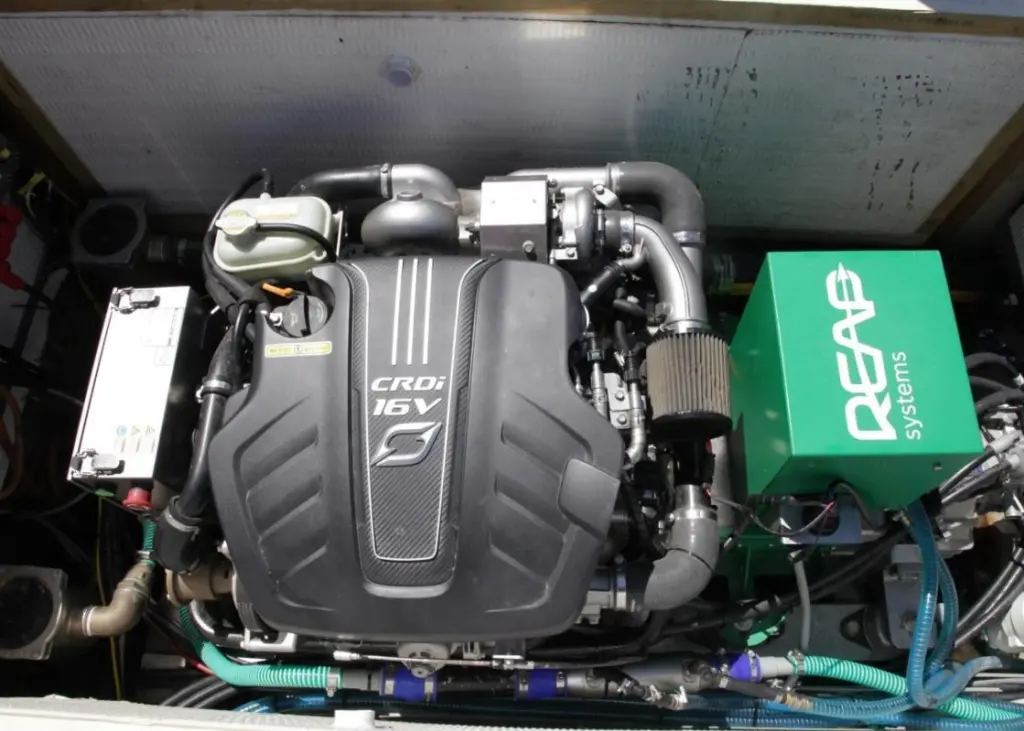
Such developments must match those taking place in the automotive sector, according to Tim Light of Cornwall Ferries (Fal River), who recently introduced the Hevima System at the National Maritime Museum in Falmouth. One of his fleet, the 80-year-old, 50ft passenger boat Kingsley ll has been retrofitted with a modular hybrid power system to be used as a demonstration vessel for appraisal in a working environment.
HEVIMA, the Hybrid Electric Vessel with Integrated Motor Assist is the brainchild of Dennis Doerffel, of REAP Systems (Renewable Energy and Advanced Propulsion) and Project Lead of this collaboration involving a range of academic, technical, commercial and regulatory partners. Doerffel gave the keynote address on the HEVIMA project at the Hybrid Seawork Commercial Marine Conference 2019 on Wednesday 12th June.
It is a modular system integrating the electric integrated motor, modular battery system and open energy management and control systems. Diesel engine, drive train mechanicals and electricals are all interchangeable. For most operational maintenance the mechanic’s spanner and hammer have been replaced by the laptop. The computer control unit runs on Linux operating system monitored on a 7inch touchscreen display unit, with a back-up button to switch off electronics to run on diesel if the operating system needs rebooting.
SMALL COMMERCIAL
The power system being demonstrated is designed for small commercial vessels of up to 250Kw but once successfully proven it could be applied to thousands of working vessels from workboats to tourist boats, windfarm crew transfer vessels, pilot boats, shorthaul ferries and up to 15,000 inland waterways craft in mainland Europe. Eventually, larger vessels such as fishing boats, survey craft, bunker barges, superyachts and tugs will be making use of hybrid power systems.
Battery safety follows automotive practice which is much better developed than in the marine sector. Powerful but lightweight lithium ion batteries can be used to start up in sub zero or extremely high temperatures. The weight of the test vessel is the same as with its old Perkins engine but the balance is better, especially as the batteries can be split up to redistribute weight. Hybrid power allows extended maintenance periods and means there is no need to run generators to power ‘hotel’ systems. The economic benefits have yet to be evaluated but the current appraisal is more about environmental concerns than fuel costs.
REAP has been working on this system since 2013 and is now collaborating with the University of Southampton, Lloyds Register, Babcock International and Mainstay, supported by Marine South East and Defence Science and Technology Laboratory (dstl), funded in part by Innovate UK with additional private funding and no public money.
RICHER EXPERIENCE
The Cornwall boat follows after a Venice water taxi was converted by REAP, which needed to function at low speeds of 2 knots beneath the canal bridges and up to 35 knots in the Venice lagoon. The demo boat, Kingsley ll, provided by Cornwall Ferries (Fal River), is the ex-Kindly Light, built by Mitchell in 1934, which had previously worked in the Isles of Scilly. Garrick Royle of Cornwall Ferries explains that customer expectations are for a richer experience; demonstrating responsibility for the environment, presenting a ‘Green image’ along with lower emissions, noise and vibration. The vessel is planned to travel up the River Fal from St Mawes to Trellisick gardens. In the narrow, tree-lined upriver sections it will run in electric drive mode allowing passengers to enjoy silent observation of nature and wildlife.
Globally, environmental concerns have reached a tipping point and we can expect to see legislation at ports to combat pollution. For example, in the middle of London, where road traffic is strictly controlled, the river Thames carries a huge number of diesel-powered sightseeing boats, ferries, workboats, civil engineering support vessels, launches etc. As also publicised at this year’s Seawork, the PLA have just taken delivery of their first hybrid-powered pilot boat, built by Goodchild Marine, which is expected to reach up to 15 knots under hybrid power.