![MaritimeJournal[Seawork]](https://www.maritimejournal.com/wp-content/uploads/2026/09/MaritimeJournalSeawork.svg)


Rebirth of the compact anchor-handling tug
Dutch ship designer OSD-IMT has rekindled memories of its history with a new design of compact anchor-handling tug.
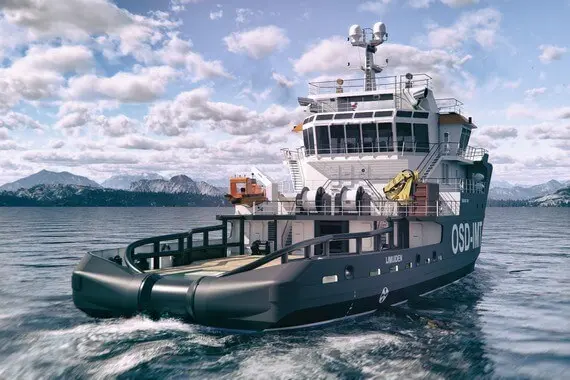
Anchor-handling tug supply vessels (AHTS) can trace their history back to the early days of offshore oil and gas, a class of vessel that grew in size and power to meet the demands of hostile regions such as the North Sea. They provided conventional towing along with other specialist functions including a cargo carrying capability.
Sitting between the conventional tug and AHTS was the anchor-handling tug (AHT) recognisable by a slightly shorter hull (no large cargo tanks below deck) with the 1976-built sister vessels Tempest and Typhoon designed in-house by Wijsmuller Engineering for Wijsmuller Offshore & Towage well-known typical examples together with six similar designs for various owners.
OSD-IMT originates from Wijsmuller Engineering and has now identified a void at the lower end of the market versus the large powerful AHTS designs and project design number 7501 introduces a vessel 51m in length and maximum bollard pull of 120 tonnes, described as a “modern interpretation of the Tempest and Typhoon” and aimed at O&G and renewables installation and decommissioning markets.
The OSD-IMT7501 aims to keep things simple and effective, and to enhance onboard safety the working deck freeboard is higher than on similar sized vessels providing a dryer aft deck and improving stability. Technical and workspaces are laid out to provide a safe working environment and easy access to equipment with a large and comfortable accommodation providing a home for 14 to 20 persons.
The design includes OSD-IMT’s S-bow, the transverse profile of which can be amended to suit specific performance requirements. A fine waterline entry angle offers smooth vessel motions and flares outwards sufficiently towards the top to provide additional reserve buoyancy. At the aft and midships sections a knuckle has been introduced at the waterline resulting in a narrower waterline beam for reduced resistance while also providing reserve buoyancy and added stability for anchor-handling operations or in case of heeling.
The design can be tailored to suit specific client requirements including alternative layouts and power generation systems along with a hybrid arrangement and OSD-IMT offers the basis for the customers’ choice of equipment and system suppliers and of course the all-important selection of shipyard.
By Peter Barker

Related Articles
 SPECIAL REPORTS
 TUGS & SALVAGE
 EQUIPMENT