![MaritimeJournal[Seawork]](https://www.maritimejournal.com/wp-content/uploads/2026/09/MaritimeJournalSeawork.svg)


Tug deliveries and design round-up
This month’s round-up includes a European theme with three deliveries and a design proposal for the world’s first LNG-powered shallow-water push boat.
Sanmar Shipyards has delivered another of its Delİçay class tractor tugs to Genoa-based Rimorchiatori Riuniti. Built as Delİçay VI the RAL-designed TRAktor Z2500SX tug was renamed Italia and follows the 2014-delivered RAmparts 2400SX ASD of the same name for Riuniti now renamed Turchia.
With a LOA of 25m Italia can be considered a modern compact design but one that boasts 70tbp from Caterpillar 3516C main engines developing 4,200kW in total driving Kongsberg (formerly Rolls-Royce) US 255 FP thrusters. It has been modified to meet Italian flag rules and Riuniti’s operational requirements.
An interesting comment from Alberto Dellepiane, Rimorchiatori Riuniti MD includes: “The tugboat that has just been delivered to us by Sanmar Shipyards marks the return of the group to tractor tug type boats like the ones we ordered in the 90s, before the azimuth stern drive tug took hold on the market.”
Sanmar Shipyards appears again with the blessing of two 2015-built tugs deployed by Ocean J. Towing Inc for a 10-year contract with Jamaica Port Authority. Ocean Kingston Pride is an RAL RAmparts 2400SX Sanmar-exclusive model providing 80tbp from Caterpillar 3516C main engines and equipped with fifi1 capabilities.
The second similar compact tug for the Jamaican contract comes from Damen’s ways, Ocean Tallawah an ASD 2411 tug that previously carried the names Njouori and Djouori while under Damen ownership. Like its companion, Ocean Tallawah is fifi1 equipped with in this case Caterpillar C4.4 main engines delivering 4,200kW in total and a bollard pull of 73 tons.
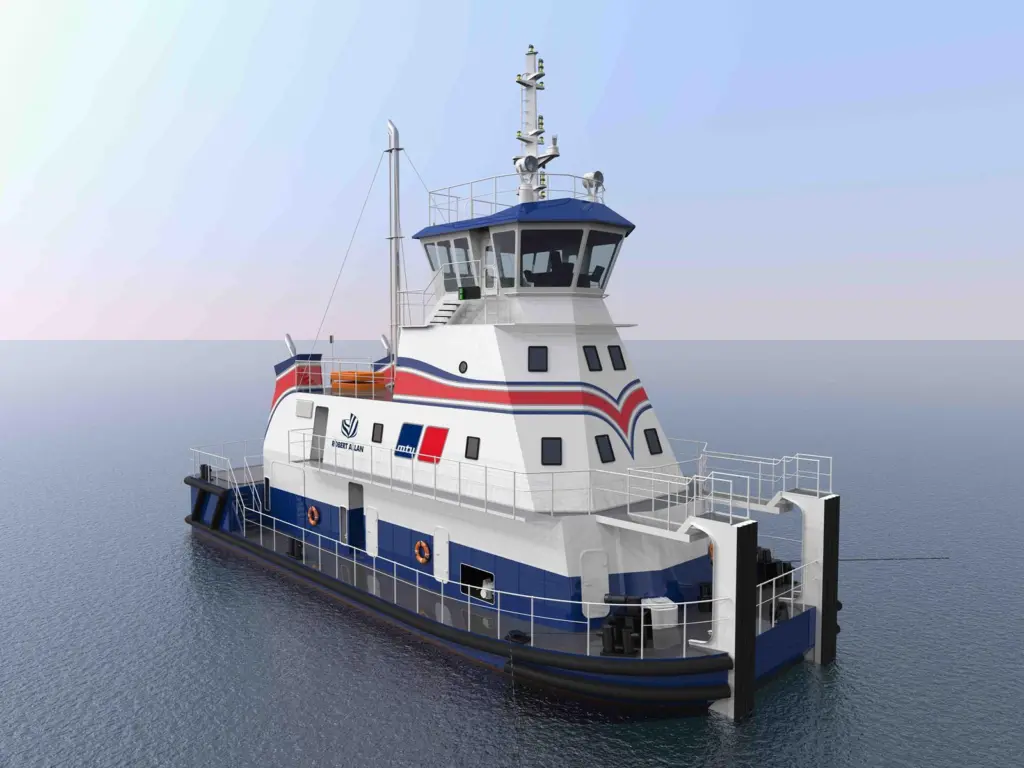
Turning to two interesting items of news concerning design proposals, Robert Allan Ltd and Rolls-Royce have teamed up to present the world’s first LNG-powered shallow-water push boat.
Whether referred to as ‘push boats’ or ‘pusher tugs’ vessels that push their charges rather than pull are still considered tugs as such, indeed many will be equipped to operate at either end, pulling or pushing. While there are examples of ocean-going pusher tug/barge combinations it is inland waterways where such techniques are most popular, the closely coupled arrangement making a more manoeuvrable single unit suited for narrow winding channels and within lock systems for example in Europe.
In areas including the river Amazon, challenges include stretches of shallow water and the growing demands for environmentally friendly operations in inland waters and the Rolls-Royce/RAL joint development aims to address both issues.
Classification society DNV-GL has granted “Approval in Principle” to the design for which Rolls-Royce will supply MTU 8V 4000 M55RN natural-gas engines. The vessel is based on RAL’s RApide 2800-Z2 which is already in use on some diesel-powered vessels on the Amazon river, the design modified for LNG including Tier III emission control systems with Rolls-Royce supplying the entire LNG supply system as well as gas control, safety and vessel control systems.
The hull was redesigned internally to accommodate the 70m3 gas tank to provide a “pleasant working environment” for the crew with lower deck cabins, saloon and galley raised one level and the deckhouse enlarged. Basic dimensions include: LOA 28m, beam 10.05m and draught 2.5m.
In what can be seen as a significant announcement Abu Dhabi Ports has reported a collaboration with Robert Allan Ltd to develop “the world’s first fully unmanned autonomous commercial marine tugs” that will join SAFEEN, Abu Dhabi Ports’ maritime services division once completed.
One of the primary advantages stated for the design is greater capability through the shifting of the human element from onboard to onshore allowing operation in far more adverse weather conditions and in turn increasing efficiency and enhancing operational safety.
Mike Fitzpatrick, president and CEO, Robert Allan ltd said: “We are excited to cooperate with Abu Dhabi Ports in this initiative, which provides us with an optimal opportunity to develop the world’s first fleet of remotely-operated tugboats for the commercial sector.”
At industry conferences, experts point out that the required technology for remote tug operation in the form of digitisation and connectivity is now well developed and in use daily. Taking the major step of actually dispensing with the human element on board will be the ultimate expression of faith, this development must bring that day a little closer.
By Peter Barker

Related Articles
 SPECIAL REPORTS
 TUGS & SALVAGE
 EQUIPMENT