![MaritimeJournal[Seawork]](https://www.maritimejournal.com/wp-content/uploads/2026/09/MaritimeJournalSeawork.svg)




Portugal enters the offshore race
The ‘door is wide open for Portugal’ to become a global leader in offshore wind, says one of the bosses of energy technology company Principle Power.
Speaking at the ‘Paving the Way for Large Scale Offshore Wind Deployment’ conference in Libson, Principle Power’s chief commercial officer Aaron Smith said Portugal has an enormous opportunity to capitalise on its natural advantages.
It comes just weeks after Portugal kicked off the preparatory process for its first offshore wind auction with ambitions to lease 10 GW through a total investment of 30-40 billion euros by 2030.
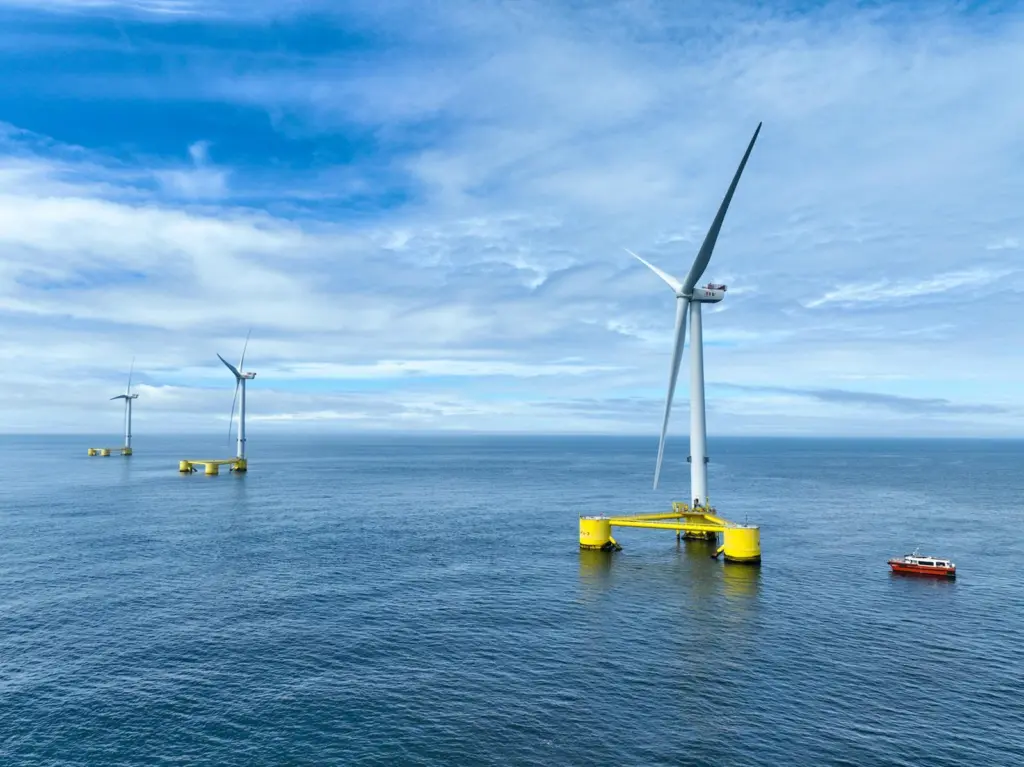
Principle Power is responsible for delivering the first floating windfarm in continental Europe, and Portugal’s first offshore wind initiative, as part of the WindPlus consortium. Situated 20km off the coast of Viana do Castelo, WindFloat Atlantic’s three giant wind turbines stand 185m above the ocean surface.
The project delivered first power in 2020 ushering in several world records, including the first full-scale project to use semi-submersible technology, and the first floating wind farm to secure bank financing. WindFloat Atlantic is now powering 25,000 homes with renewable energy. Principle Power has built a 50-strong team in Portugal, which Smith describes as the company’s spiritual home.
“The door is wide open for Portugal,” he said. “How can it capitalise on the opportunity? First is to realise the drivers of project schedules – these are typically long-term projects, with many potential obstacles between initial auctions and construction.
“Learning from the 20 plus years’ experience of the highly skilled and knowledgeable Netherland’s administration, having a staged auction process is the right approach. It’s absolutely critical to tackle long-lead items – like grid connection, permitting and port infrastructure – from the outset.
“With this, there needs to be a framework to keep those things moving. We need that certainty and timing. Moreover, there needs to be recognition that these projects are of national interest.”
Ricardo Rocha, technical director offshore wind at BayWa r.e. said if Portugal can build a sustainable base of experience, it will form a solid foundation for competitive future projects. “This will be incredibly beneficial to a country like Portugal which is blessed by its location, facing the US market, while also being entrenched in the European market not only in the Atlantic but also the Mediterranean,” he said.
“If Portugal gets a successful industry moving here, catalysed through its own domestic market, the benefits from a supply chain and economic development perspective will be huge.”
Marcel Deurhof, project director of offshore energies at Madoqua Renewables, said the seminar provided an opportunity to connect with a broad range of industry experts looking to develop export-import value chain hubs with production roots in Portugal. “There is no doubting the scale of Portugal’s offshore wind potential,” he said.
“If it manages to effectively harness this opportunity, it could transform the country, firing up supply chains and supporting new industries in the process, including the production of hydrogen and hydrogen related derivatives.”
The event was staged by WavEC Offshore Renewables, in collaboration with the Embassy of the Netherlands in Portugal.
Key themes covered during panel discussion included ‘Offshore Wind Policy – lessons learned and looking ahead’, ‘Industry Overlook on the Portuguese Opportunity’, ‘Port Infrastructures Enabling Offshore Renewable Energies and Hydrogen Expansion’, ‘Mitigating Risks and Developing Supply Chain’ and ‘Sustainable Seas: A Deep Dive into Multi-Use Marine Energies and Aquaculture’.
Portugal’s Ministry of Environment and Climate Action is beginning discussions with companies interested in developing offshore wind projects in the region.
In this first auction round, the government intends to proceed with the developments in Viana do Castelo, Leixões, and Figueira da Foz, reaching up to 3.5 GW of total capacity.

Related Articles
 ENVIRONMENT
 DREDGING & FLOOD DEFENCE
 ENVIRONMENT