

Propulsion system for breakthrough wind farm ship
Germany&rsquo
With a development which raced from original idea to a contract signature in only 18 months,
has found a new marine mainstay with the development of Voith Radial Propellers (VRP). Rated at 5.5MW, they enable Voith to enter new territory with ventures into the market for self propelled vessels capable of moving and positioning oil platforms and offshore windfarms as well as for drillships and other specialised vessels.
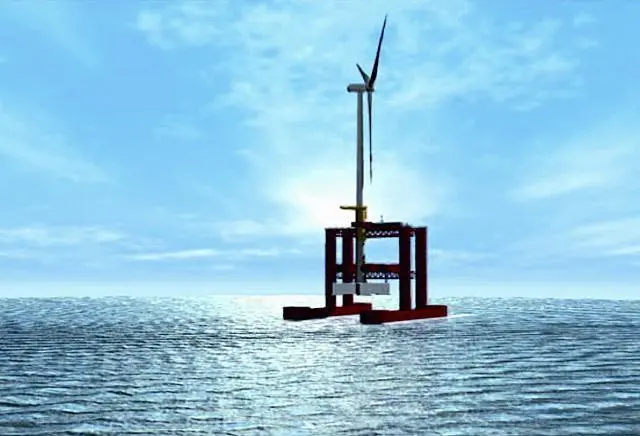
A contract signed last week covers the delivery of five propellers for a specialised vessel that will be capable of transporting wind turbines, including their concrete foundations, all weighing over 7,000 tons and positioning them with high precision directly in the open sea. The wind turbines will be lowered onto the seabed by a special crane.
Weighing over 80 tons and measuring approximately 8m high, the Voith Radial Propellers will enable the specialised vessel to sail at approximately 10 knots with a full load. The propeller’s 360 degree steering will allow highly accurate positioning even in difficult sea conditions for a vessel which has a design resembling that of a drilling platform.
European construction giant STRABAG SE, which employs 76,000 people and had a turnover of €13.7bn last year, has ordered five such Voith Radial Propellers for the vessel. Four will be installed on the vessel, with another kept as replacement unit. The five VRPs will be delivered by February 2011 and later that year the Cuxhaven based vessel is due to enter service.
The groundbreaking for a trial gravity foundation for offshore wind farms took place in Cuxhaven last week. The project is a step toward the realisation of planned wind farms in the North Sea.
Given the German government’s re-election last week and its professed intention of promoting North Sea wind farms on a grand scale, STRABAG SE has declared the development and production of concrete foundations and the construction of wind energy facilities to be an important business field for the future.
As a first step, STRABAG SE will build a trial gravity foundation based on a solution developed by STRABAG subsidiary Ed. Züblin AG. Roland Jurecka, member of the management board of Austria based STRABAG SE, which will set up a production site for such foundations in the years to come, stressed the importance of the first prototype in original size, which will provide important insights and data for the planned production in series.
In series production, the 7,000 ton gravity foundations will be produced near the shore and transported by the specialised Voith propelled ship to their final location, where they will be lowered to the seafloor. The entire installation will be shipped as a single unit, the steel mast as well as the rotor blades being mounted to the gravity foundation on land in an industrial series production process. This reduces the amount of weather dependent offshore installation works in comparison to all other concepts. The concrete foundations will be developed and produced by STRABAG Offshore Wind GmbH.
In choosing the location for the trial gravity foundation, which is to be built in ground water, it was important that the characteristics of the site be as similar as possible to those of the future offshore wind facilities in the North Sea. The size and dimensions of the trial gravity foundation are close to those of the production-series foundations to be produced in Cuxhaven. The trial foundation is a cross-shaped box girder construction with exterior dimensions of 40m and will be equipped with extensive measuring systems. A load testing device consisting of steel wires will realistically simulate wind and wave stress during data measuring in long intervals.
Completion of the trial gravity foundation is planned for spring 2010. Series production is scheduled to begin in autumn of next year. Starting in 2011, the first wind turbines for the offshore wind power plant GlobalTech I are to be set up from Cuxhaven.
Related Articles
 POWER & PROPULSION
 VESSELS
 POWER & PROPULSION