



Bergs of a feather work together
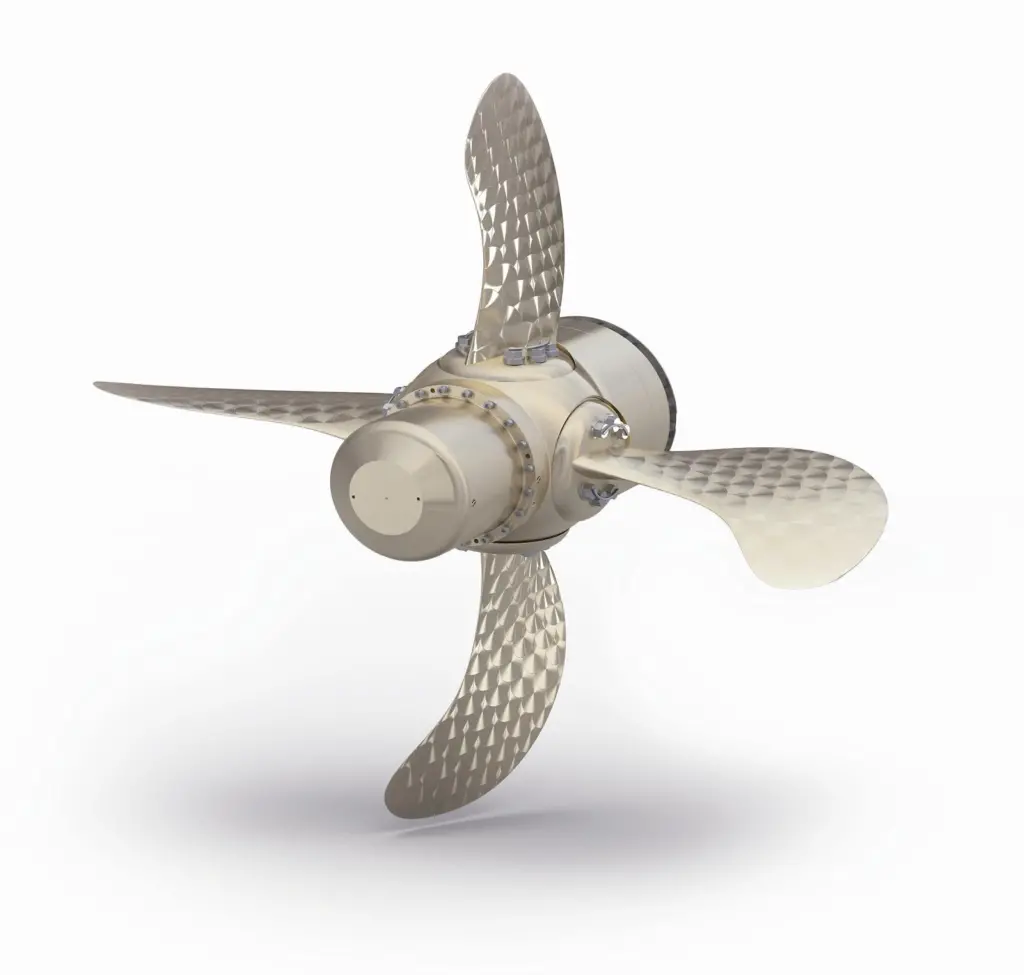
Sweden’ s Berg Propulsion is to deliver the first examples of the newly launched Berg Controllable Pitch Propeller (BCP) with feathering capability, with separate orders for installations on board two 100m chemical tankers under construction at the Dingheng (Jiangsu) Shipbuilding Co in China and an 85.5m long ferry being built at Eastern Shipbuilding Group of Panama City in Florida.
The inherent flexibility, redundancy and better manoeuvrability offered by twin screw operations when compared to single screw solutions have increasingly been accepted across the shipping industry. A single engine driving a single propeller achieves maximum efficiency at a fixed level in the design condition. At lower power, whether working in combination with fixed pitch or controllable pitch propellers, engine working pressure decreases and engine efficiency is lost.
Greater flexibility can be achieved by operating two smaller engines driving two propellers because, at lower speeds, the ship’s Master has the option to operate on one engine alone, working at its optimum efficiency. Furthermore, the greater propulsion area covered by two smaller propellers is reckoned to equate to about a 10% efficiency gain when compared to a single screw solution.
The concept of feathering one of two propellers at lower speeds, so that the other can run at higher output, closer to optimum efficiency, is by no means new. Developed as a more efficient alternative to locking or clutching out an unneeded shaft line, ‘feathering’ sees the propeller blades rotated through 90 degrees so that they are in parallel to flow. Putting a propeller in the feathered position during an emergency or at low speed minimises drag, with consequent fuel savings.
However, feathering techniques to date have featured a complex and often cumbersome mechanical solution, or hubs that cannot offer astern pitch due to their internal mechanical limits. Thus the attractions of feathered hubs have been limited to ships operating within complicated mission profiles.
Berg says that its new BCP design offers the capability to feather propeller blades within its standard hydraulic hub. The result is an expansion in the propeller’s operating pitch range. A patent application on this aspect of the design is currently pending.
‘We saw it as critical that we developed a solution that could match Berg’s hub core standards for performance, efficiency and reliability, said Berg Propulsion Technology product manager Linus Ideskog. ‘Using the Berg BCP Feathering hub means that pitch can range from full astern, via full ahead, to full feathering. For the ship owner, this means that the feathering concept can fit in with any type of ship operating with more than one propeller that demands flexibility in the driving mode, while also bringing fuel savings and environmental benefits.”’
The Dingheng built tankers will be constructed to Germanischer Lloyd Ice Class E3, and will feature two 3,600mm diameter BCP950 propellers apiece, driven by 1,600kW engines at 136.1rpm. Meanwhile, the US built ferry will be built to Lloyd’s Register Ice Class 1D, and will incorporate larger 2,600mm, BCP760 propellers, driven by 2,240kW engines operating at 277.7rpm.
Berg Propulsion said that the feathering option is now available across its complete range of BCP hubs.
Related Articles
 POWER & PROPULSION
 VESSELS
 POWER & PROPULSION