


£10m boost for marine energy research
South West England’ s ambition to be a global centre for harnessing energy from the sea received a major boost last month with the announcement of a £ 10.3 million investment in marine energy research.
The Peninsula Research Institute for Marine Renewable Energy (PRIMaRE), set up two years ago by the Universities of Exeter and Plymouth with funding from the South West RDA (Regional Development Agency), will use the cash to support its team of academics and researchers, buy new equipment and collaborate with business.
The bulk of the investment, £5.3 million, has come from the ERDF (European Regional Development Fund) Convergence Programme in Cornwall (£4.2m) and the ERDF Competiveness Programme (£1.1m) in the rest of the South West.
The South West RDA is contributing £4.3 million with a further £200,000 from the University of Plymouth and £466,000 from the University of Exeter.
The funding will support PRIMaRE’s 15 academic staff, 60 researchers and a dedicated technology transfer team that works with businesses to support high quality job creation across the South West.
There will be substantial investment in new equipment including wave and tidal measuring devices, wave making facilities, subsea electrical equipment, collision avoidance and monitoring equipment and research into the environmental impact and benefits of marine renewable energy.
PRIMaRE will support and complement the South West RDA’s pioneering Wave Hub project, which will create the world’s largest wave energy farm 10 miles of the Cornish coast and is on course to be built next year.
Stephen Peacock, Enterprise and Innovation Director at the South West RDA, which plans to invest around £70 million in low carbon activities by 2012 said, ‘PRIMaRE and Wave Hub are central planks in the RDA’s drive towards a low carbon economy in South West England. We want our region to be one of the best places in the world to build a low carbon business and a global leader in the development of environmental and renewable energy technologies.’
Nigel Howells, Head of Competiveness in the South West, said ‘Climate change presents many challenges but there are also great opportunities for new low carbon goods, services and energy production. It is only through investment in top quality scientific research and knowledge transfer to businesses that we will successfully tap these new markets. This ERDF Competiveness and Convergence investment will stimulate the creation of a whole new industry and related business opportunities.’
Professor Wendy Purcell, University of Plymouth Chief Executive and Vice-Chancellor added, ‘This new funding recognises the very substantial expertise in marine energy, research, development and innovation now present in the South West and provides additional support for engaging business with world-class research for the benefit of our region and the wider environment.
‘In partnership with the University of Exeter, we will generate important new marine knowledge to inform the emerging renewable energy sector, positioning the region at the forefront of marine science and technology expertise.’
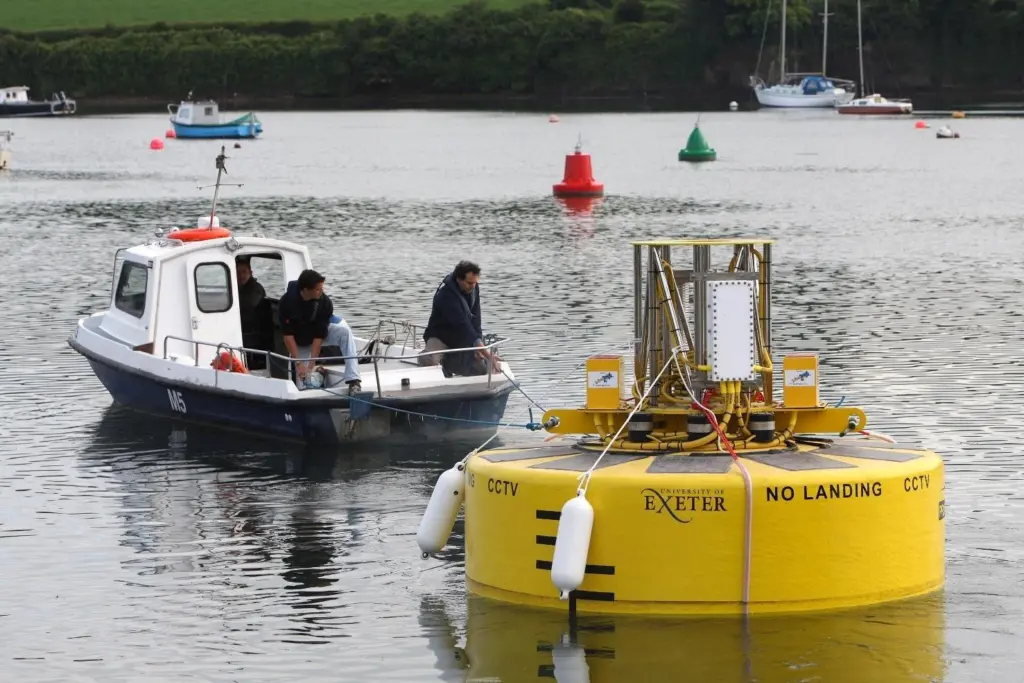
Accompanying the announcement, local businesses viewed the South West Mooring Test Facility (SWMTF) buoy at an event at Falmouth’s Maritime Museum. Developed by the University of Exeter’s PRIMaRE team, the buoy has been designed with unique features so it can obtain very detailed data to show how moored structures respond to changes in wind, wave, current and tide. Using this information, developers will be able to model and test mooring designs and components for their marine energy devices as they convert wave movement into energy.