

Soil reinforcement keeps U-Boat afloat
The new site for a WWII German U-boat, U-534, planned as a new tourist attraction on Merseyside in the UK, was reinforced by the swift installation of Tensar’ s TriAx geogrid to prevent the exhibit from sinking into the Mersey mud. Adopting this solution also saved the considerable cost and time penalties involved in conventional piled and reinforced concrete alternatives.
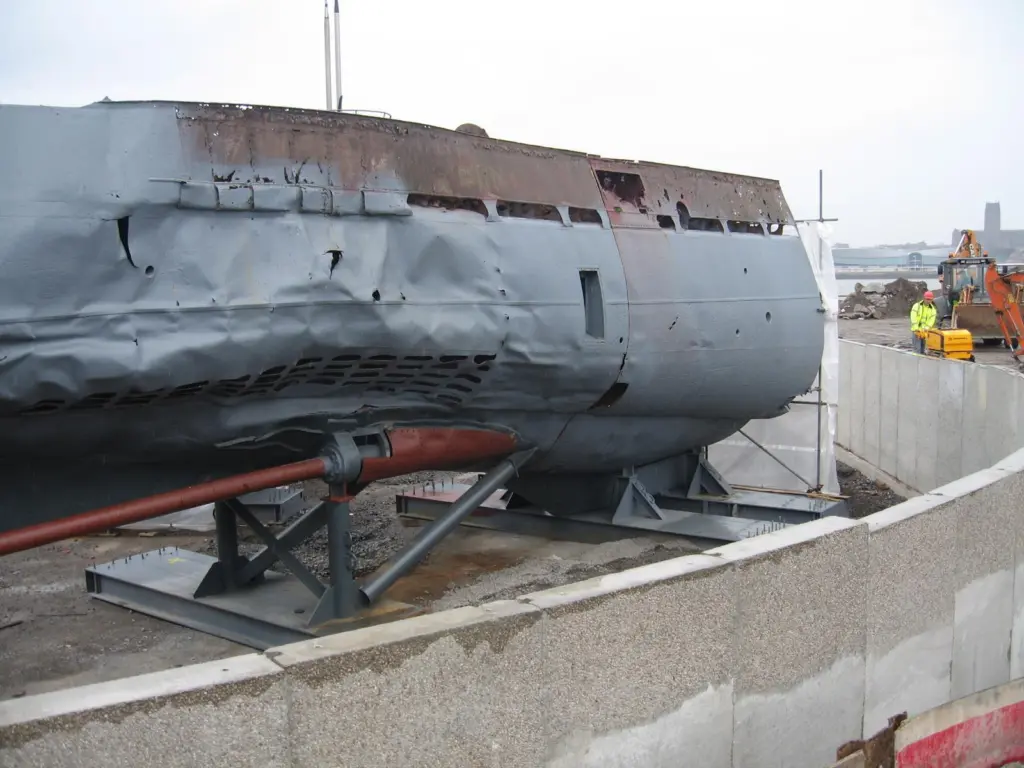
Civil engineers Mott MacDonald contacted Tensar in January of this year, when the planned site for the submarine on the banks of the Mersey, next to the Woodside Ferry Terminal, was found to be too saturated after more than two weeks of heavy rain to bear the vessel’s weight. Various options including geogrids were considered and Tensar’s TriAx solution was found to be the best to meet the tight timescales.
U-534, reportedly one of only four U-boats remaining from WWII, had been kept since 1996 at the Nautilus Museum, Birkenhead. Following the closure of the Museum in 2006, ferry owners Merseytravel purchased the submarine to act as a tourist attraction and promote ferry travel. An associated exhibition will feature objects found on the submarine and information on submarine warfare.
The 240 ton U-boat was cut into 5 sections using a diamond wire saw, and the sections, weighing up to 180 tons, were transported by a giant floating crane to the new site. Each open end of a section will be protected by giant glazed panels, to allow visitors to admire the interior from a viewing platform.
Mott MacDonald’s concerns over the bearing capacity of the soft founding soil at the new site following the heavy rain included the possibility of differential settlement. Solutions considered for the submarine sections included a reinforced concrete base over mini-piles or over vibro stone columns. However, both of these options were costly, and would have increased the time required for the project.
After a geogrid solution was suggested, Tensar were contacted and the Tensar design team proposed load bearing geogrid technology comprising 6F1 mineral aggregate, multi-layered with TriAx geogrid to form a mechanically stabilised reinforced granular mattress. As the unique triangular structure of TriAx ensures virtually the same stiffness over 360º, the installation offers excellent control over potentially unpredictable differential settlement.
The TriAx geogrid solution was rapidly installed without requiring the heavy plant needed for reinforced concrete and piled methods, so provided a more sustainable as well as cost effective solution.
Neil Scales, Chief Executive and Director General of Merseytravel, which owns and operates the Mersey Ferries, said, ‘The Mersey Ferries are already the most popular paid for attraction in our region and our exhibition developments will reaffirm that position. The £2.5m U Boat exhibition at Woodside, opening this year, will also complement both the Resurgum, the world’s first submarine, a full scale model of which is located on the north side of the ferry terminal, as well the historic connection between the Mersey Ferries and U Boats through the 1918 Zeebrugge raid.’
The new exhibition is being supported by a £550,000 grant from European Objective One, which has already funded successful tourist attractions at other Mersey Ferry Terminals.
Related Articles
 MARINE CONSTRUCTION
 EQUIPMENT
 MARINE CONSTRUCTION