


Peter beats brother in Hamburg power stakes
One of the most powerful tugs in the port of Hamburg has just celebrated its 10th anniversary, along with the MaK VRT engine technology that has been part of its equipment since it went into service.
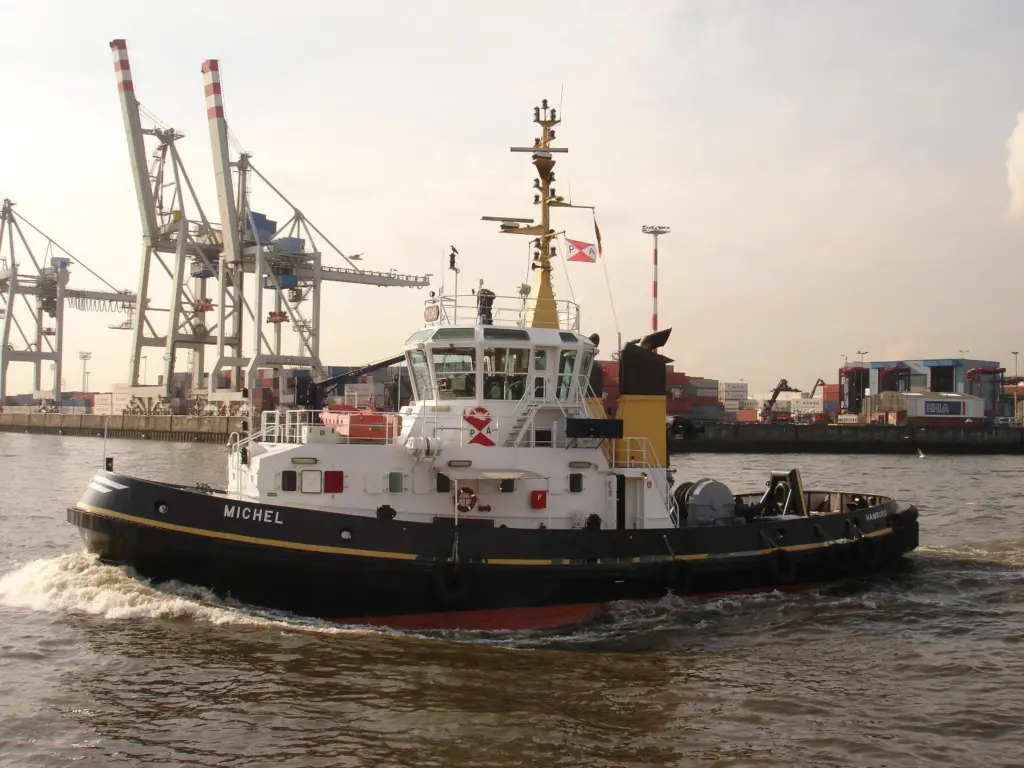
The harbour tug
Michel,
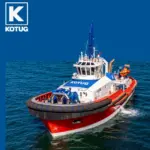
owned by Petersen & Alpers, was commissioned in 1998. Its twin engine propulsion plant consists of two medium speed MaK 8 M 20 engines adjusted to 1,520 kW at 1,000 rpm and equipped with a Variable Radial Turbine (VRT).
The capacity of marine diesel engines has increased steadily over the years. One of the methods chosen to achieve this was to continuously raise mean effective pressures. Unfortunately, the high efficiency turbochargers used to do this cannot always sufficiently cover the air requirement of the engine in the part load range, which in turn results in torque losses and thermal overload. Torque weakness has a particularly negative effect on towage since tugs are often equipped with fixed pitch propeller plants running at continually changing speeds.
MaK came up with a solution actually adjusting the engine’s turbine during operation as early as the 1980s. Called Variable Multi Pulse (VMP) technology, it was used in the MaK M 332 C engine with an axial turbine, particularly on tugs. When the new MaK long stroke generation was launched from 1992, VMP technology was developed into VRT technology and adjusted to the KBB turbocharger models with radial turbine used for the M 20 and M 25 engine series.
The basic principle of VRT is simple. The nozzle ring in the turbocharger consists of two parts with different cross sections (full load ring and part load ring). Depending on the engine load, either one or the other ring can be activated. The changeover between the two is fully automatic and affected by means of compressed air depending on engine speed and charging pressure. The nozzle ring simultaneously acts as an air cylinder, which eliminates the need for a complex adjusting mechanism.
After Michel became the first vessel to be equipped with this technology in 1998, many other tugs were provided with MaK engines types 8 M 20 and 8 M 25 that included the VRT technology. Daily use fully confirmed the expected improvements in torque characteristics and ramp-up behaviour. Further advantages are low thermal load on the engine, reduced exhaust emissions and low fuel consumption. The heavy fuel compatibility of VRT technology has also been proven in practice.
Michel is no longer the strongest conventionally driven tug in Hamburg, despite its optimal MaK engine technology. The ‘brother’ ship Peter arrived in September of last year with two high speed Cat 3516B engines installed, each rated 2,090kW at 1,600rpm.
Related Articles
 POWER & PROPULSION
 VESSELS
 POWER & PROPULSION