

Green tugs will get a substantial boost in 2009
The subject of achieving a true ‘ Green’ tug is one that has been studied and discussed with increasing frequency over the past couple of years and the year 2009 will see the very first tangible result.
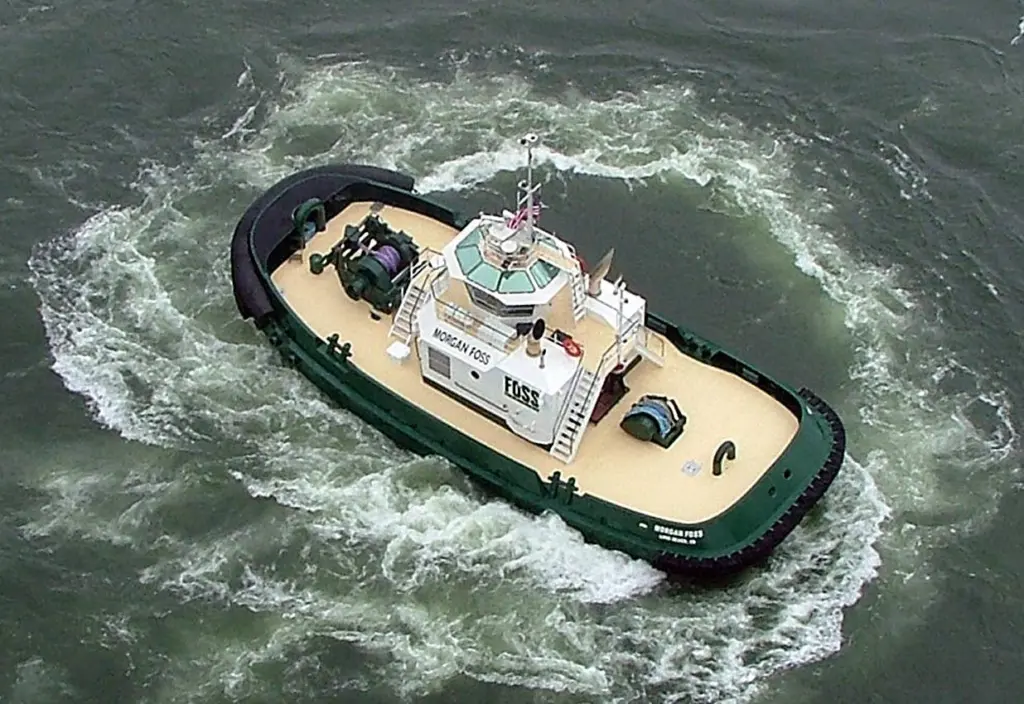
There is nothing like seeing and touching the ‘hardware’ to really bring new technology to life. The first few weeks of the coming year should see the new Foss hybrid tug running trials on the west coast of the USA.
Already dubbed ‘the Prius of tugboats’ by the Los Angeles Times, the tug has been constructed in the Foss Rainier shipyard in Oregon and will be the world’s first true hybrid tug, a ‘green’ vessel that will significantly reduce harmful nitrogen oxide, particulate matter, sulphur dioxide and carbon emissions. It will also consume less fuel and be quieter than its conventional predecessors. The world’s first ‘hybrid’ will be based on the highly successful ‘Dolphin’ class already employed by Foss in several locations. Designed by Robert Allan, the 23.77m ASD tugs are powered by Caterpillar main engines producing a total of 5,080bhp.
The hybrid tug project received a major boost at an early stage when the Port of Los Angeles pledged $850,000 to the project, in association with the South Coast Air Quality Management District. The Long Beach Board of Harbour Commissioners also approved a $500,000 contribution to the vessel’s construction. In exchange for funding, Foss agreed to base the new hybrid tug in Southern California for five years. Once completed the 5,000 horsepower hybrid tug will be primarily used for shiphandling duties, working with tankers and container ships in the Californian ports.
From the outside the new vessel will look almost identical to the ‘Dolphin’ class tugs already in service but will be powered by a true ‘hybrid’ propulsion system. The new concept is based on the tug’s unique diesel-battery-electric propulsion system. Two fully azimuthing propulsion units are powered by batteries, diesel generators and/or two diesel main engines. A modified engine room accommodates two battery packs, producing the equivalent of 670hp, and two 335hp diesel generators. The main engines will be smaller and considerably less powerful that those in the existing ‘Dolphin’ class tugs.
An essential ingredient is the power management system required to produce a ‘seamless’ transition from one power source to another depending on the duties the tug is undertaking and the demand for power. In its various modes of operation the new tug will employ battery power for low speeds and light running, and a combination of battery and generators for medium power operation. When full power is required, the diesel main engines will be started and coupled to the drive system in addition to the electric motors. Any surplus power generated at any stage will be used to recharge the battery packs. Although the main engines in the hybrid tug have a lower horsepower rating than those of existing vessels, the same total horsepower will be available and the same 65 tons bollard pull.
Even before the vessel has been completed and subjected to what will undoubtedly be extensive trials, the design has been awarded the Environmental Protection Agency’s 2008 Clean Air Excellence Award for Clean Air Technology. Foss has also contracted with Lloyd’s Register North America, Inc. to obtain a Green Passport certification for the low emission Hybrid Tug. This will make the vessel the first tug in North America with a Green Passport certification. The first Hybrid Tug may not be lonely for long: Foss claim the technology can also be used to adapt existing tugs for cleaner and more fuel efficient operations.
In the meantime many other designers, owners, specialist shipbuilders and propulsion system manufacturers are amassing data, carrying out studies and producing concept plans. The proposals are as diverse as Hybrid Tugs using hydrogen fuel cells to modern tug designs retaining diesel power but using LNG in a dual-fuel system. The basis of virtually all of this research revolves around studies into tug operating cycles and modes of operation. It is generally accepted that most tugs engaged in shiphandling use the maximum power available for only a very small percentage of their daily operating cycle. Likewise in many fleets the main engines may be left idling on ‘standby’ for long periods of time. It is factors such as these that any new propulsion system must address, whilst tackling the problems of emission control, running costs and noise levels without sacrificing the power and agility now seen as essential in the modern tug.
Related Articles
 TUGS & SALVAGE
 EQUIPMENT
 MARINE CONSTRUCTION