![MaritimeJournal[Seawork]](https://www.maritimejournal.com/wp-content/uploads/2026/09/MaritimeJournalSeawork.svg)


A New Tug Fleet at Marchwood
There is a growing use of scale model tugs to aid training and simulation in shiphandling and pilotage. Southampton Institute has recently added a tug to their inventory at the Manned Model Shiphandling Facility at Marchwood. The unmanned radio controlled scale model of an ASD tug is fully functional with a scale 52-tons bollard pull. It will operate with the centres fleet of model ships that include tankers ranging from 40,000 to 300,000 tons deadweight.
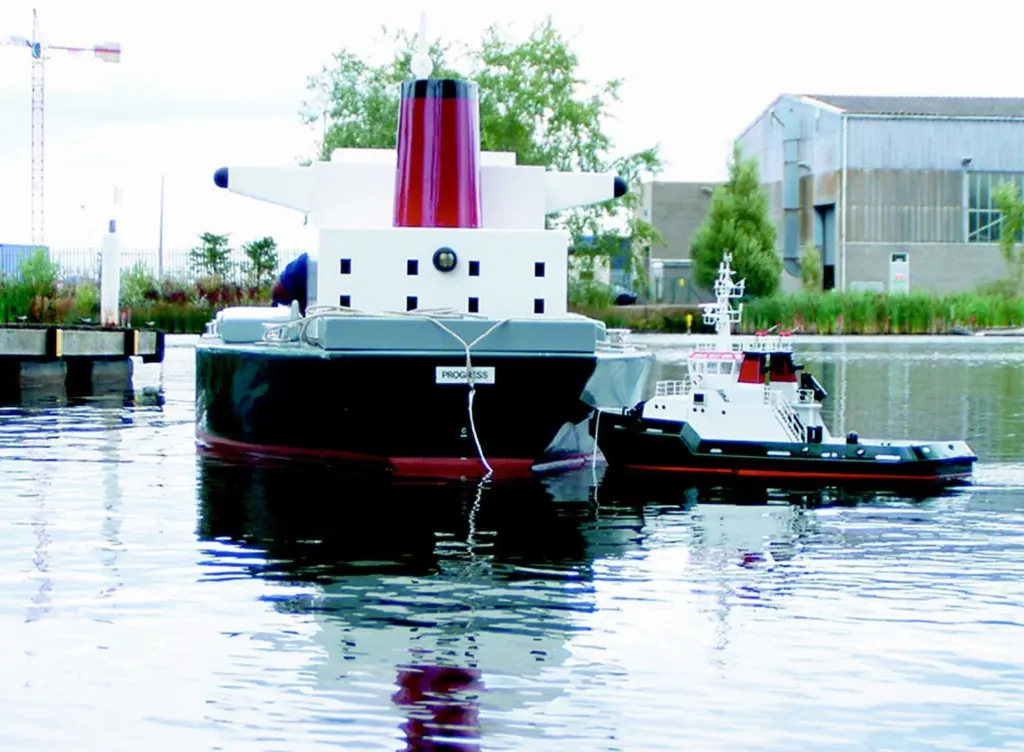
The model tug is used to demonstrate various aspects of tug operations for both experienced and trainee pilots and ship’s officers attending the shiphandling courses. Exercises are carried out on the lake at Marchwood, giving them the opportunity to try out various techniques for themselves and observe the effectiveness of their decisions. They are then able to gauge the consequence of the tug’s action on the model ships.
The exercises are set at a level appropriate to their backgrounds and experience.
Chris Clarke, from the Manned Model Shiphandling Centre, comments: ‘The introduction of model tugs will expand the capabilities of the facility to provide advanced professional development facilities for experienced pilots, with particular reference to their own sphere of operations. It will give senior officers and masters the opportunity to understand and demonstrate what they can expect from a tug when manoeuvring and berthing their ships while they investigate the best way to optimise its capability. By using the model ships, safe and effective practices can be identified and developed, without risk to personnel, assets or the environment, which can then be transferred to full sized operations.’
This first model was built by the facility’s own technicians and took about six months to complete as a parallel task to their other duties. Unlike models intended mainly for exhibition purposes, the tug had to be specially strengthened and adapted for its purpose. As far as the centre is concerned it is a working tug and will be put to fairly strenuous use. A second vessel with Voith Schneider propulsion is under construction and will join the existing tug on completion.
In Canada, the USA and Europe there are now many examples of tug models, constructed with modern advanced propulsion technology, being used by naval architects, research organisations and training establishments.
Such vessels are designed to accurately replicate the handling characteristics and performance of their full-size brothers, features not possible until recently.

Related Articles
 SPECIAL REPORTS
 TUGS & SALVAGE
 EQUIPMENT