


Work In Progress: Rosyth refurbishment fit for a Queen
Hugely impressive but temporary engineering achievements will be only footnotes to the successful completion of ongoing works at Rosyth Dockyard in Scotland.
The Babcock owned facility on the Firth of Forth won the contract to assemble the two new QE class of aircraft carriers for the UK Ministry of Defence from modular sections being built at six shipyards around the UK, which will be towed by tug and barge to Rosyth. The largest warships ever built in Britain, the new QE class carrier is so big that the footprint of two previous Invincible class carriers would fit on its flight deck with room left over for nine tennis courts.
The 65,000 ton HMS Queen Elizabeth and sister ship HMS Prince of Wales will be 284m long, 74m wide, and 56m high, too big to be assembled in Rosyth’s existing No 1 Dock as it was. Built between 1907 and 1916, when warships tended to have ‘V’ shaped hulls, the massive facility did not have the profile required to accommodate the flat bottom, slab sided aircraft carriers.
Contractor BAM Nuttall won a £35m contract to both modify No 1 Dock so that it could accommodate the vessel assembly and also to widen the Direct Entrance to the Rosyth main basin. Work began in May 2008 on Number 1 Dock, its completion followed by works on the direct entrance.
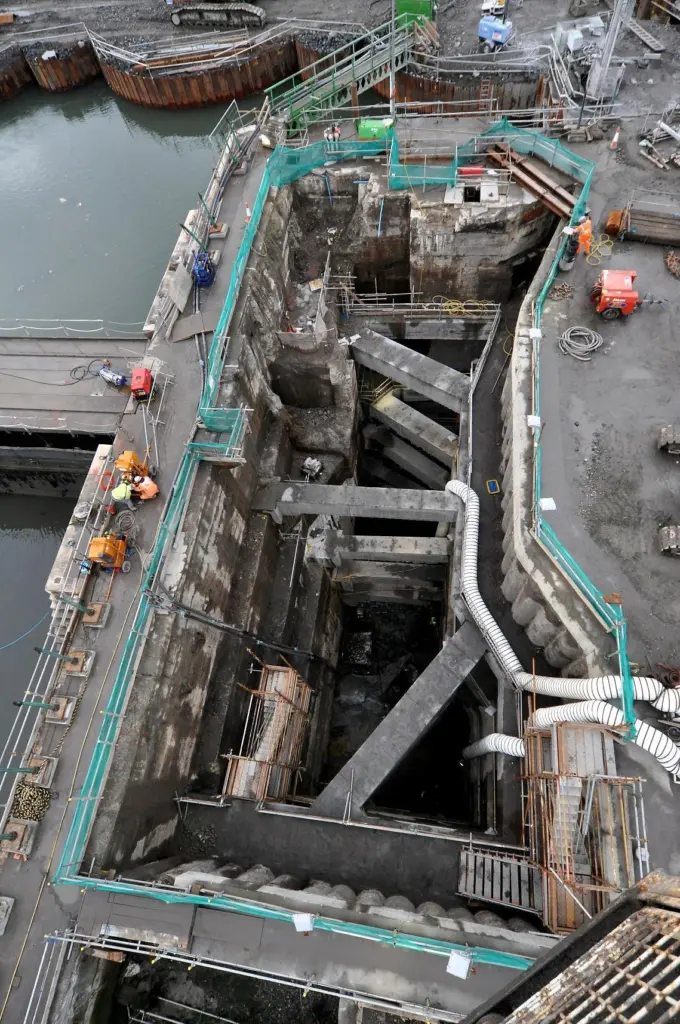
Both parts of the project required an innovative and massive cofferdam to be installed so that the working areas could be dewatered. Five large circular cells, each 18.5m in diameter, sit on the bed of the basin to a depth of 11m, linked by connecting arcs. The cells are constructed of 500mm wide steel sheet piles linked together and vibrated into the floor of the basin. When completed, they are backfilled with some 8,000 tons of granular material into each cell. In a clever nod to both cost and environmental considerations, the entire cofferdam was removed following completion of works in No 1 Dock and re-used to dewater the Direct Entrance.
The Works in No 1 Dock consisted of removing stepped granite altars along its length to increase its width by some 9m across its base and upwards. Specialist rock cutting plant was deployed to cut through the granite blocks. However, the stepped altars were structurally important and BAM Nuttall had to compensate for their removal by installing 150 rock anchors up to 21m into the sides of the dock. These works were undertaken by geotechnical services sister company BAM Ritchies, which also installed pilings to support a huge 1,000 ton capacity ‘Goliath’ gantry crane spanning 120m which will work over the length of the dock moving aircraft carrier sections into position.
Aircraft carrier sections are being built by Babcock Marine at Appledore and Rosyth, BVT in Portsmouth and Govan on the Clyde, A&P on the Tyne, and Cammell Laird on Merseyside. These sections will be transported to Rosyth by Anchor Marine starting in 2011. No 1 Dock can be divided into two sections by a gate, which allows the innermost half to remain dry while the outer half is flooded to allow sections to be floated in.
Following completion of works on No 1 Dock, the Direct Entrance was taken out of commission last July for works due for completion in October of this year. The entrance needs to be widened from 38.1m to 42.1m in order that the completed vessels can leave Rosyth and return for maintenance. Four metres must be added to the south side of the entrance while 8m is demolished and removed on the north side, to be replaced by new structure.
Cofferdams are required on the main basin side and the Forth estuary side for these works. Other temporary works include long sheet piling into bedrock, the placement of large semi-circular steel box section waling and concrete waling below bed level, with walings installed onto existing strengthened concrete piers, with the north pier to be demolished below water after construction of the entrance is complete. The north side existing wall is used to prop the new wall. A staged excavation to bedrock at a depth of 25m had been made when MJ visited the site, all to be backfilled with concrete. As with so much of this massively impressive multi-year project, it is another ingenious and complex piece of marine civil engineering which most in attendance will be unaware of when HMS Queen Elizabeth sails through into open waters in 2015.
Related Articles
 MARINE CONSTRUCTION
 EQUIPMENT
 MARINE CONSTRUCTION