![MaritimeJournal[Seawork]](https://www.maritimejournal.com/wp-content/uploads/2026/09/MaritimeJournalSeawork.svg)




DMS Osprey evolved from a flexible design – by Jack Gaston
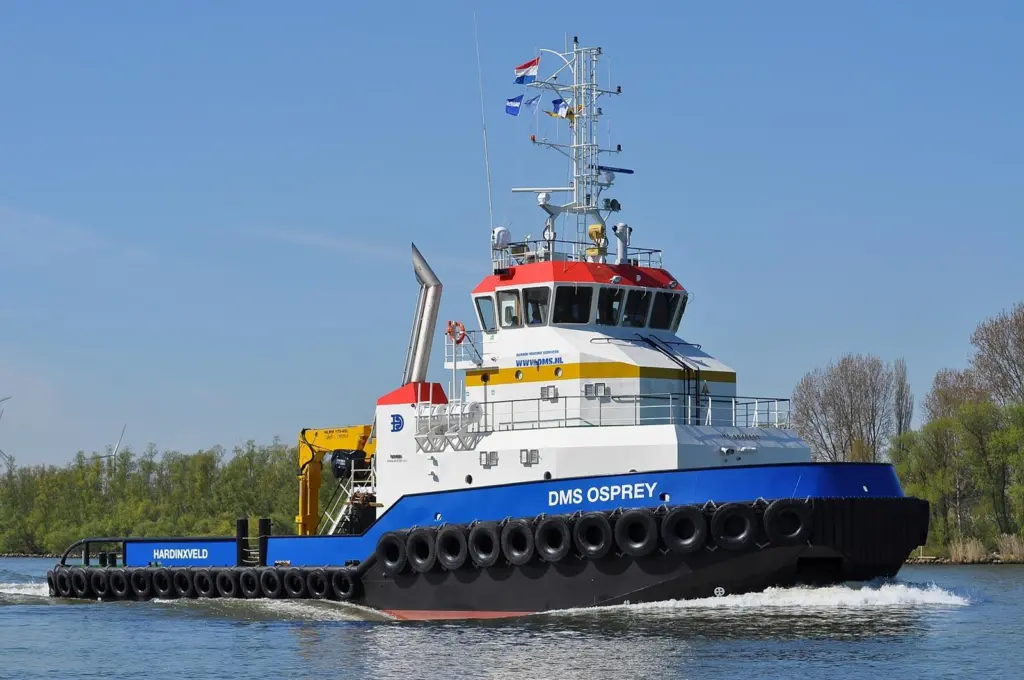
On 27 April Damen Marine Services took delivery of the new tug ‘DMS Osprey’ and ‘DMS Pelican’, a Multicat 2409. The ‘DMS Osprey’ has a striking resemblance to the ‘Pushbuster’ class of tugs introduced in 2008 but bears the designation Shoalbuster 3511. The explanation lies in some slick redesign and careful use of resources.
Back in November 2008 Maritime Journal featured the introduction of the first of a potential series of unique pusher tugs constructed by Damen Shipyard Hardinxveld for associate company Damen Marine Services. DMS, the operating and chartering arm of the Damen Group had plans to build up to five more vessels of the same design to fulfil a commitment in the Middle East. The vessel concerned, DMS Blackbird , and two sister ships were delivered and were matched to purpose built hopper barges to form an Articulated Tug and Barge (ATB) unit.
Due to the recession it was necessary to cancel the remaining orders. It was however decided to complete one of the hulls as a Shoalbuster, a relatively straightforward process. The ‘Pushbuster’ design was developed from larger vessels in the Shoalbuster series and embodied many of its attributes, such as hull form, propulsion system, deck machinery and much of the accommodation. It also retained the ability to carry out normal towage operations over the stern, anchor handling operations, and lifting and transportation duties on site.
DMS Osprey is a large vessel with a length overall of 35.08m, a beam of 11.6m and depth (at the sides) of 5.25m. The tug is classed by Bureau Veritas with the notations; I 3/3 +Hull + MACH+ Tug Unrestricted Navigation, AUT,UMS.
A double chine hull form is similar to that of a large ‘Shoalbuster’, incorporating two fixed nozzles set in shallow tunnels. A smaller forward skeg has been added to house a bow thruster but not the familial full depth push knee. The bow fender and protection on the sides and stern are designed to withstand the normal contacts encountered while barge handling and work on site. A substantial raised forecastle is excellent for seagoing operations and large capacity internal tanks can accommodate 380cu/m of fuel oil and 45cu/m of fresh water.
DMS Osprey is an imposing vessel in spite of having one complete deck from the original Pushbuster superstructure removed. From the wheelhouse there is an exceptional view of the afterdeck, winches, crane and rescue boat. The after deck follows the familiar Shoalbuster layout, incorporating similar bulwarks, a stern roller, and a work area protected with the usual timber covering.
DMS Osprey is powered by two Caterpillar 3516 BTA main engines, generating a total of 5,150bhp at their maximum continuous rating. Power is transmitted via Reintjes reverse-reduction gearboxes to a pair of five blade, high performance propellers of 2,700mm diameter, rotating within high performance ‘Optima’ fixed nozzles. The steering system includes four high lift rudders, two located aft of each nozzle. A 400hp hydraulically driven bow thruster is also installed as previously described.
On trials the bollard pull achieved at maximum power was 70 tons and a free running speed of 11.6 knots.
Electrical power is supplied by two auxiliary generating sets powered by Caterpillar C-9 TA diesels driving 150kVA alternators producing 230/240v at 50Hz.
Deck equipment includes a large Ridderinkhof ‘waterfall’ style twin drum hydraulic towing and anchor handling winch, mounted with the lower (anchor handling) drum forward. The anchor handling drum can generate a maximum line pull of 100 tons at 5m per minute and accommodates 600m of 52mm diameter steel wire rope (SWR). For towing, the upper drum has a maximum line pull of 50 tons at 10m per minute and carries a 48mm diameter SWR towline 700m in length. Other items of deck equipment include a stern roller, a single set of towing pins and a tugger winch with a pull of 10 tons.
A prominent feature on the afterdeck is the Heila 170-4S-L hydraulically operated deck crane with a four piece telescopic jib. The 170tons/metre crane is mounted on a high pedestal forming part of the usual winch fairlead and towing bits.
Fully airconditioned accommodation aboard DMS Blackbird can accommodate up to 10 persons in a variety of cabins, with the Captain and Chief Engineer housed in the superstructure. Facilities include the usual well fitted galley, provision store and sanitary facilities. The wheelhouse contains all of the usual controls and instrumentation one would expect to find on a twin screw tug of this size on a console arranged in a ‘U’ configuration. A further, simplified aft control station is positioned close to the rear windows with an excellent view of the after deck. DMS Osprey has entered service with DMS and is now operating on a wind farm construction project off the coast of East Anglia.

Related Articles
 SPECIAL REPORTS
 TUGS & SALVAGE
 EQUIPMENT