




It’s academic for Schottel, as success shows at SMM
Germany’s Schottel Group was in good spirits at the SMM Exhibition in Hamburg last month, the manufacturer of propulsion and steering systems reporting a record year in 2009, with €270m in turnover.
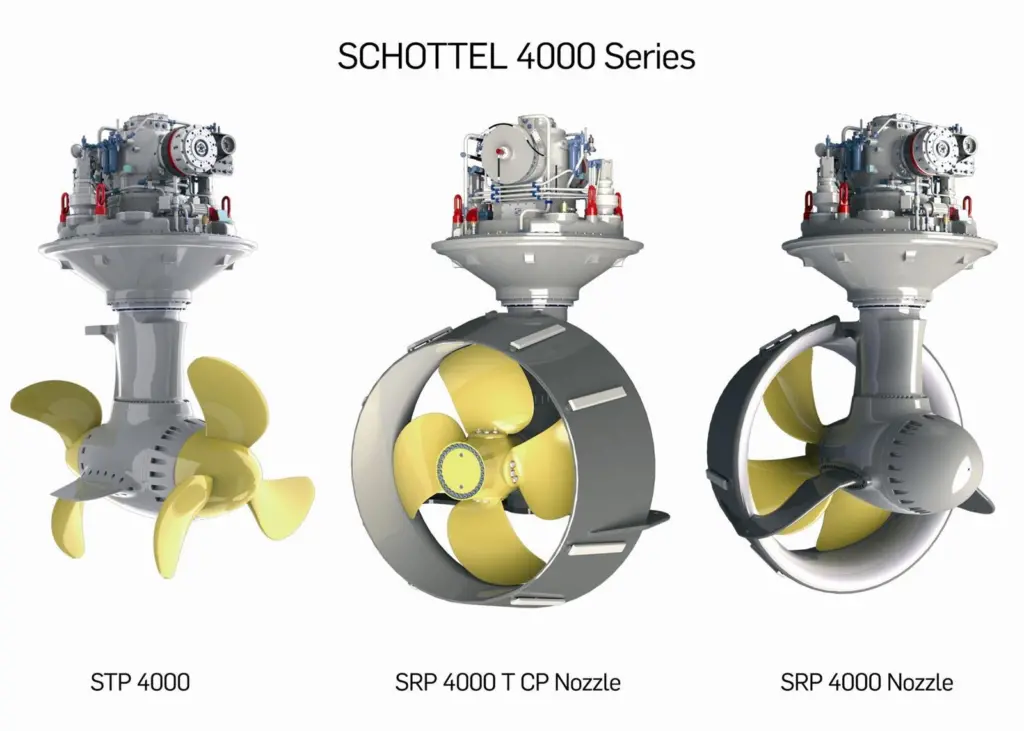
The first six months of 2010 have confirmed this trend, with sales of €120 million. The balance of completed systems was also looking positive, with production figures for smaller azimuth thrusters remaining at an almost constant high level in comparison to the previous year. Increases of around 6% were recorded for the larger azimuth propulsion systems.
A large proportion of the Sshottel Group’s overall turnover came from the special thrusters for Platform Supply Vessels (PSV), Offshore Support Vessels (OSV), Anchor Handling Tugs (AHTS), jack-up platforms and other special purpose vessels.
In addition to the high demands placed on thrusters with regard to economic efficiency, availability and robustness, this market segment is also characterized by requirements relating to the emission values of the propulsion system, high operational reliability with regard to prevention of oil leakages and the resulting damage to the environment.
Due to the high complexity of these special vessels, diesel-electric drive concepts are the main players in this market segment. With the Schottel Combi Drive (SCD), Schottel offers a high efficiency, compact, extremely robust thruster which completely fulfils all of these new requirements.
The year 2010 marks the founding of the Schottel Academy and the Josef Becker Research Centre as well as the opening of the new spare parts logistics centre close to the group’s headquarters in Spay/Rhine, Germany. With the new warehouse facility, Schottel is separating the spare parts logistics for customer support from the production logistics for the manufacture of new systems.
For both institutions, the Schottel Academy and the Josef Becker Research Centre, a modern training and office building is currently under construction at Spay/Rhine, the shell of which should be completed by the end of this year.
Part of the new building will house the Josef Becker Research Centre. The centre is named after the founder of the present-day Schottel Group, one of whose inventions was the Rudderpropeller. The aim of the research centre is to foster the development of further innovative power solutions.
Engineers from a wide range of disciplines are working on new solutions in this think tank. The research centre is staffed by Schottel’s experienced, regular personnel, supplemented with new technicians who have already acquired knowledge in the field of shipbuilding.
With the ever growing demands on ship propulsion and steering systems and their ability to communicate with other on board systems, and as shipyard tasks become more and more complex, it is becoming increasingly vital that staff are properly instructed and trained.
In the Schottel Academy, customers, masters, on board personnel, external service engineers, sales partners and Schottel employees receive specific training from around 30 instructors in how to operate and service the company’s products. Approximately 150 training modules have been developed, which can be customized according to the level of knowledge of the target groups and used for individual or group training courses.
Related Articles
 POWER & PROPULSION
 VESSELS
 POWER & PROPULSION