

There is more to ETVs than just salvage
The British Government decision to terminate the contract to operate the four Emergency Towing Vessels (ETVs), stationed in strategic locations around the UK coastline, has been met with horror and disbelief by pundits from the shipping industry, emergency services and local authorities.
Making the announcement, the Department for Transport stated that cancelling it would save £32.5m over the period of the comprehensive spending review. It said: ‘The Maritime & Coastguard Agency (MCA) will no longer provide ETVs at taxpayers’ expense from September 2011. Emergency towing vessels are mainly deployed when vessels break down. The government believes state provision of ETVs does not represent a correct use of taxpayers’ money and that ship salvage should be a commercial matter between a ship’s operator and the salvor. Removing ETVs will save £32.5m over the spending review period.’
Many believe that the British Government has totally misunderstood the function and importance of the ETV service in protecting the coastal areas around Britain. The current service is the result of a decade and a half of development, resulting from recommendations made by Lord Donaldson in 1994 in his report ‘Safer Ships, Cleaner Seas’. That report was issued following his enquiry into the ‘Braer’ tanker disaster off the coast of Shetland in 1993 and accepted in its entirety by the government of the day.
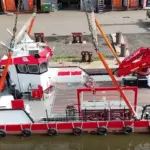
The current contract for the operation of four ETVs was awarded to Klyne Tugs (Lowestoft) Ltd (now JP Knight (Lowestoft) Ltd) in 1999. Since then the four ETVs; Anglian Monarch, Anglian Prince, Anglian Princess and Anglian Sovereign have been on station on a 24/7 basis at Dover, Falmouth, the west coast of Scotland and Shetland. Three of the vessels are
purpose built offshore tugs and the fourth a powerful deepsea tug. The company also operates a fifth vessel, the offshore tug Anglian Earl, which meets the same basic specification and is used as a relief to cover dry dockings etc.
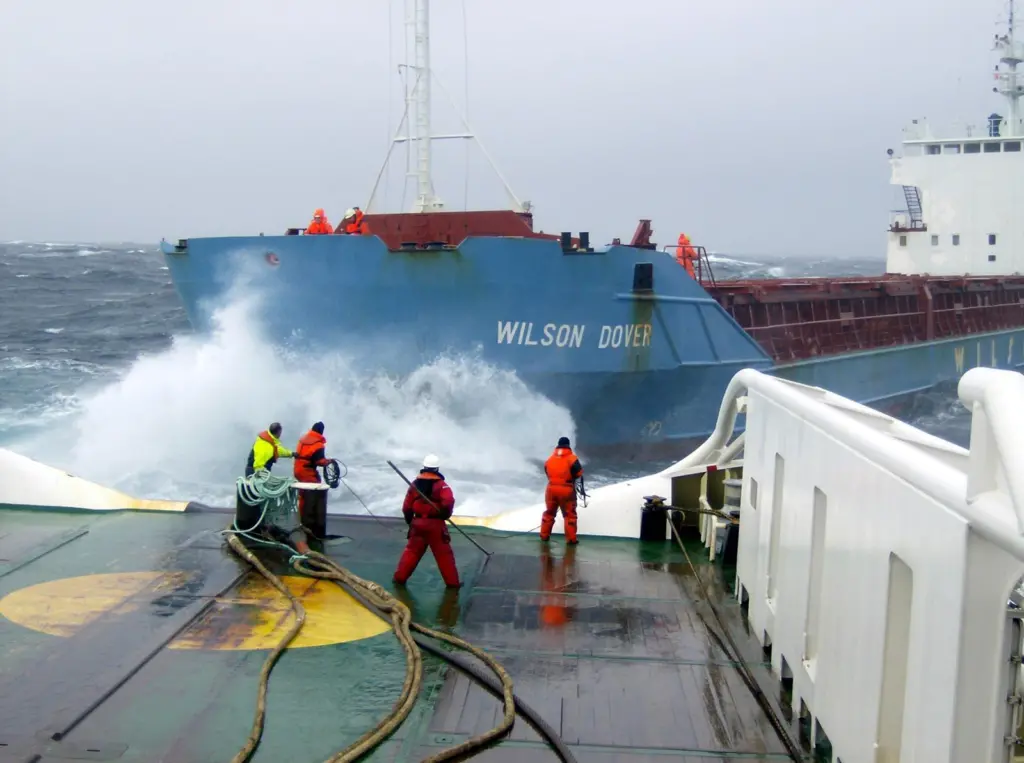
An important feature of the present service is that the ETVs are available to respond in any weather to an emergency at sea which potentially threatens the UK coastline when tasked by the Coastguard. Ships in trouble in territorial waters cannot rely on the availability of commercial tugs or salvors in the first instance. ETVs are equipped for rescue towing, fire fighting, pollution control and, if necessary, the evacuation of large numbers of personnel. The captains and crews are highly skilled and experienced seafarers who train regularly with the Coastguard, RNLI, and teams from the Fire Brigade Maritime Incident Response Group (MIRG). During the period of the present contract the ETV personnel have won several awards and commendations for their work.
The ETVs play an important role in the National Contingency Plan for Marine Pollution from Shipping and Offshore Installations and can be used by the Secretary of State’s Representative for Maritime Salvage & Intervention (SOSREP) to intervene during an incident. In simple terms, under the SOSREP’s powers a ship can be directed to take a tow or leave UK waters if it poses a threat of pollution to the coastline and/or is in danger of grounding. If a suitable tug cannot be engaged in time to avert a serious incident, an ETV can be ordered to intervene as a protective measure.
News of the British Government’s decision has been met with disbelief by some ETV operators in Europe, where the majority of the UK’s neighbours are strengthening their emergency response capability.
France has a fleet of ETVs operating on their Atlantic and Mediterranean coasts, operated by contractors Les Abeille. This fleet includes two highly sophisticated purpose built vessels operating in the Western Approaches to the English Channel, which when necessary exercise and operate alongside the UK ETV based in Falmouth. All three worked together in 2007 to avert a major catastrophe in mid-Channel when the container ship MSC Napoli was seriously damaged by heavy seas. In the busy sea-lanes of the English Channel the services of the UK ETV Anglian Monarch are shared, operationally and financially, by the British MCA and the French Prefecture Maritime.
Germany, Sweden and Norway are investing heavily in new ETVs. All three countries recognise the need to provide ‘first line’ protection at a time when very large tankers, container ships and, more recently, Liquid Natural Gas (LNG) carriers are using their coastal waters. Coastal states face a particularly difficult challenge if and when large container ships are in trouble. A very large bunker capacity and the massive numbers of containers carried can be very difficult to deal with in heavy weather and early intervention is critical. ETV operators in those countries are also equipping a number of ETVs to operate in the hazardous atmospheric conditions likely to be faced when dealing with LNG and other chemical cargoes.
There is a growing consensus of opinion the believes, using the Governments own figures, the £8m annual cost for the operation of four ETVs is a small price to help guard against major pollution incidents that can cost many time that figure to clean up. A well used phrase in the emergency response business is ‘Keep the oil in the ship’. To achieve that, early intervention is vital.
Related Articles
 EQUIPMENT
 MARINE CONSTRUCTION
 FEATURES & VIDEOS