


Smit Siyanda is delivered for SPM support duties
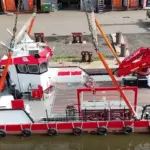
Smit Siyanda, an extremely versatile offshore support tug, was delivered to owners Smit Shipping Singapore Pte Ltd in October of this year.
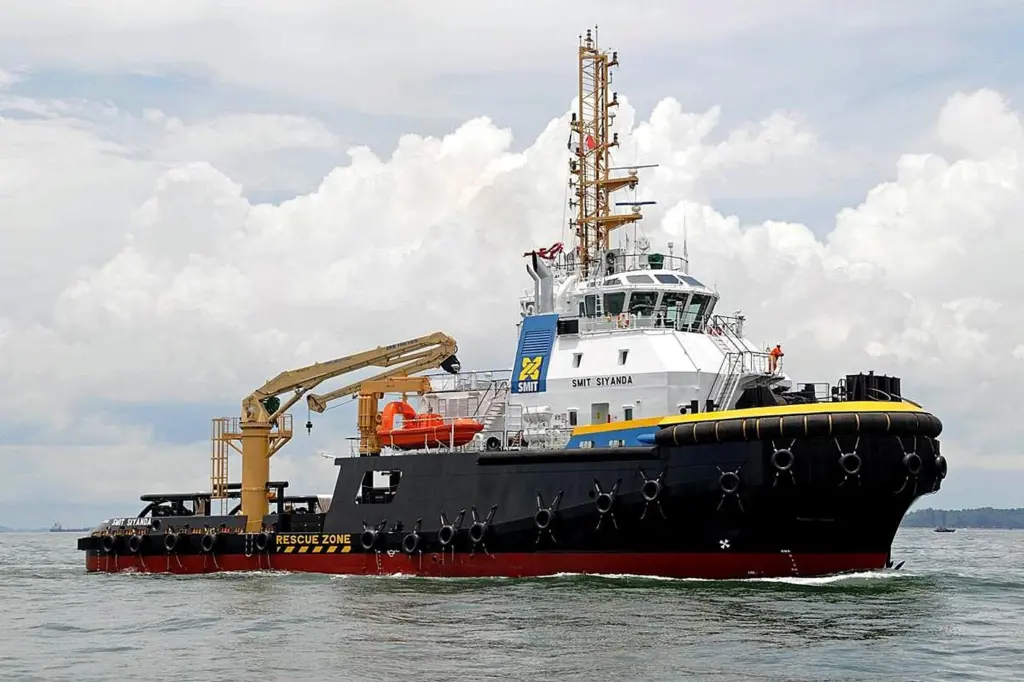
The vessel will be operated by Smit Amandla Marine (Pty) Ltd of South Africa and has arrived at its home port of Durban. Among activities undertaken by Smit Amandla Marine is the operation and maintenance of Single Point Moorings (SPMs) and Conventional Buoy Moorings (CBMs) off the coasts of Durban and Mossel Bay, using their own vessels and personnel.
Smit Siyanda was built by the Keppel Nantong Shipyard Co Ltd of China to a design by Robert Allan Ltd, naval architects of Vancouver, BC. It is based on the now well proven RAmpage 5000 series of offshore tug designs.
This new vessel has, however, to fulfil a much larger range of tasks than its predecessors. Smit Siyanda was designed primarily to provide assistance at an SPM buoy operation, with a range of duties including static towing over the bow, hose handling, hose flushing, dive support, fire-fighting operations, general maintenance of the SPM buoy, anchor handling, and chain replacement operations on the mooring itself.
The tug was built to comply with the Bureau Veritas class notation; 1 +Hull, +MACH, Tug, Fire-Fighting Ship 1 with Water Spray, Unrestricted Navigation, AUT-UMS, Oil Recovery. Smit Siyanda measures 49.50m in length overall, with a moulded beam of 15.00m, a moulded depth of 6.75m and an operating draft of 6.20m.
This multi-purpose vessel is of rugged all welded steel construction incorporating an extended forecastle deck with a heavily raked two- evel superstructure, surmounted by a spacious wheelhouse providing maximum all round visibility. A major and unusual feature in a vessel of this size is a 3.3m by 3.1m moonpool located on the centreline between the winch and winch fairlead structure. Adjacent to the winch is a side launching gantry for a diving bell, etc. Located in the superstructure, directly above the moonpool is a dive control room, dive machinery room and an emergency generator. A divers’ decompression unit is housed nearby at main deck level.
With such a versatile vessel, designing the deck to accommodate the extensive outfit of essential equipment was a major design challenge, with many major items competing for the same critical space. The after deck is configured for heavy duty anchor handling, with a 2.20m diameter stern roller, rated 200 tons SWL, and a Karm fork and tow-pins rated at 300 tons SWL. The main towing winch is a ‘waterfall style’ Rolls-Royce model TW 1500/1500 F. Both the main towing drum and the upper anchor handling drum are fitted with 1,000m of 64mm steel wire rope (SWR). The winch has a brake capacity of 300 tons and a light line recovery speed of 49m/minute.
A rig chain locker is fitted to enable SPM buoy chain replacement and maintenance. Two aft anchors with winches are provided to position the tug during subsea operations. Cargo rails extend the length of the working deck. A massive HS Marine model AKB 190/18/5 deck crane is rated at 90 tons/m and rated for personnel riding operations with a two ton capacity.
A large double drum Rolls-Royce winch of model TW 2500/500/40 F, mounted on the forecastle, is equipped for ship handling, with 600m of 60mm SWR on each drum.
The tug is equipped to carry 200 tons of cargo, 576 cu/mof fuel and 128 cu/m of fresh water, in addition to provision for 116 cu/m of recovered oil, 23 cu/m of fire-fighting foam and 26 cu/m of chemical dispersants.
Smit Siyanda has an ASD propulsion system powered by two Wärtsilä 8L26 diesel main engines, each rated 2,720 kW at 1,000 rpm to generate a total of approximately 7,400bhp. Each engine drives a Rolls-Royce US305 CPP propulsion unit incorporating a 3,200mm diameter propeller. On trials this combination delivered a certified, sustained bollard pull of 97.8 tons and a free running speed of 14.9 knots. Manoeuvrability is enhanced by an electrically powered controllable pitch bow thruster producing eight tons of thrust.
Electrical power is supplied by a combination of independent diesel generators and two shaft generators driven by the main engines. The diesel generators are Caterpillar 3406C, each rated at 2,60kW and the shaft generators 700 kW. A harbour/emergency generator, rated at 250kW, is located at forecastle deck level.
The tug has a Fi-Fi 1 standard fire-fighting system comprising two fire pumps, each rated 1,500 cu/m/hour, driven by the main engines. Two 1,200 cu/m/hour water/foam monitors are mounted above the wheelhouse, in addition to a complete deluge protection system.
For FPSO hose handling and servicing, a hose drain sump is recessed into the main deck, along with a 350mm hose flushing connection, served by the fire-fighting pumps.
The vessel is certified as an oil recovery vessel, and is fitted with two deep tanks with a total Rec-Oil capacity of 135 cu/m. An Ayles-Fernie dispersant spray system has a 7m outreach on each side, and a spray rate of 40 cu/m/hr of diluted or 4 cu/m/hr of neat dispersant.
As one would expect in such a vessel, the accommodation is equally comprehensive. Fully air conditioned accommodation includes seven single cabins for the captain, chief engineer, company representative and four officers; a double cabin for two dive supervisors; two double and one four berth cabin for eight divers; a well equipped galley, a large combined mess/lounge, a ships office, a sick bay and extensive storage facilities. The wheelhouse is equipped with a large split style console forward for control of the majority of vessel operations, supplemented by an aft control station.
Related Articles
 EQUIPMENT
 MARINE CONSTRUCTION
 FEATURES & VIDEOS