

Damen complete the 29 vessel order for Serco with a tug
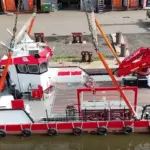
A huge three year, 29 vessel contract came to an end on 3 December 2010 when Damen Shipyards delivered the tug SD Deborah to Serco Marine Services.
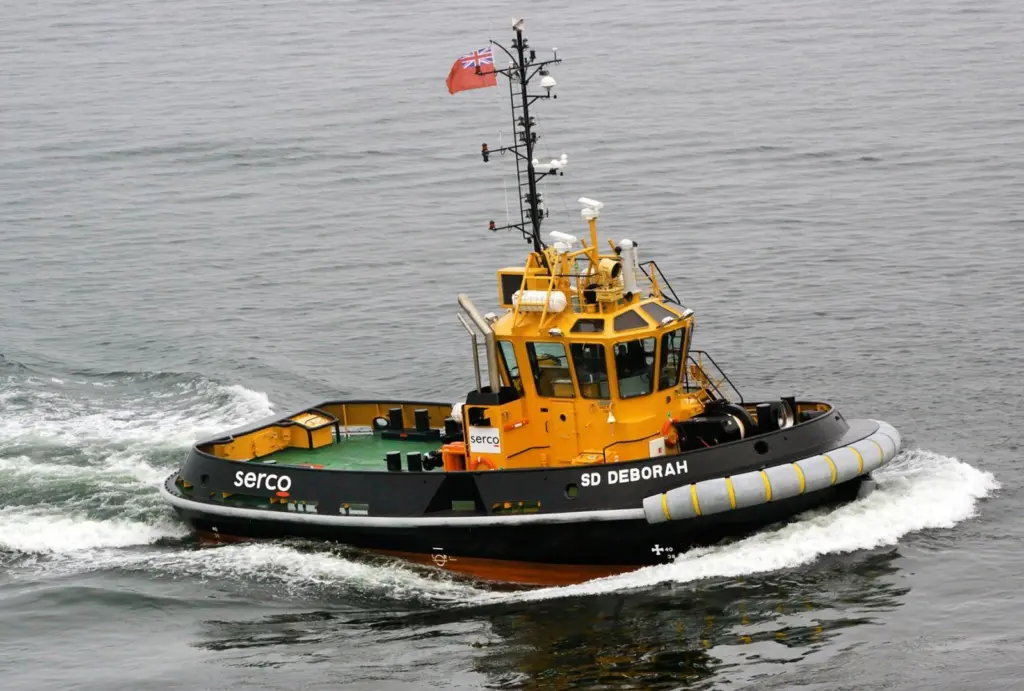
The conclusion of the massive project, completed on time and on budget, was celebrated at the naming of this last vessel at Damen’s Gorinchem, Netherlands headquarters.
The contact was signed in December 2007 between Serco Marine Services Ltd and the Damen Shipyards Group covering the development and delivery of the 29 vessel package valued at €146m. Included in the package were vessels of 16 different designs, ranging in size between 12m and 86m, including pilot boats, tugs, barges, multipurpose work vessels, a fast crew boat and a worldwide support ship. Within that total were 16 tugs and tug/workboats, some selected from Damen’s standard range and customised to suit the client’s needs, while others were purpose designed.
In every case the vessels had to meet the precise requirements needed by Serco Marine Services to service their support contract with the Royal Navy at HM Naval Bases in Portsmouth, Devonport and the Clyde. Three distinct Damen project areas were involved and eleven production centres within the Group including Damen owned shipyards in the Netherlands, Poland and Romania.
The contract was handled by SD Marine Services, a procurement company within Serco, under a Private Finance Initiative (PFI) contract with the British Ministry of Defence. This is believed to be the first PFI ever carried out in the marine industry. When Serco was awarded the 15 year contract by the UK Ministry of Defence it owned and operated 110 vessels in the three naval ports and outstations. Most of the 29 new vessels are being used to replace older tonnage and many of the old vessels have been offered for sale through the Damen subsidiary, Damen Trading.
Henk Grunstra, Damen project director for the Serco project said, ‘We are very proud that this contract, which had a very tight deadline, has seen all the vessels delivered on time and on budget.’
One of the reasons Serco chose Damen for such a large contract was because everything can be managed from one location, he stressed. ‘All of the supervision, inspections, etc, were all handled through one single channel. This saved Serco a lot of time and money and made handling such a big contract very efficient.’
‘Around 50 people (out of a total Damen engineering staff of 150) have worked on the engineering side but Serco only needed to have two to three project engineers assigned for the supervision because the process is easily controllable. Everything can be streamlined through one location. Being able to offer all of the services and support centrally was also very important in the five year preparation period before building got underway’, emphasised Mr Grunstra.
Every vessel was tailor made to be a perfect fit for the demands of the naval contract and SD Deborah is an excellent example. The tug is one of a new class of four azimuthing stern-drive (ASD) tugs designed specifically for Serco and designated ASD Tug 2009, the smallest tug of its type yet produced by Damen.
Designed as a highly manoeuvrable vessel for operation in relatively confined spaces, the tug is equipped with two Rolls-Royce US 155CP fully steerable propulsion units and a bow thruster. The propulsion units have controllable pitch propellers offering precise control during all towing and pushing operations. Two Caterpillar 3508B diesel main engines generate a total of 2,000 bhp to give the tug a bollard pull of 23.8 tons towing ahead, 21.6 tons towing astern and a maximum free running speed of 11.5 knots.
SD Deborah measures just 21m long, with a beam of 8.83m and draft of 3.66m. In spite its small size the vessel is capable of assisting both surface vessels and submarines. In common with all of the tugs delivered to Serco for use with naval vessels, special grey fendering is used to prevent marking the grey paintwork of their clients. Fendering is also fitted below the waterline to prevent damage when working with submarines. Provision is made to transport up to12 passengers, carry some cargo, transfer fresh water, and provide fire fighting and water spraying facilities.
The naming ceremony for this final vessel in the Serco order was carried out by Mrs Lynda White, wife of Frank White, a tugmaster with Serco in Devonport. To make the naming occasions extra special, each of the 29 naming ceremonies conducted by Damen has been followed by a cultural visit. Following the naming ceremony of SD Deborah, the guests were taken on a visit to the Netherlands National Glass Museum in Leerdam.
SD Deborah will form part of the Serco fleet at the Devonport Naval base and follows into service sister ships, SD Eileen, SD Christina and SD Suzanne, deployed among the three main naval facilities.
Related Articles
 EQUIPMENT
 MARINE CONSTRUCTION
 FEATURES & VIDEOS