


Damen build four big ‘Cats’ for Lamnalco
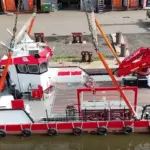
Damen Shipyards is close to completing a series of four powerful terminal tugs for the Lamnalco Group.
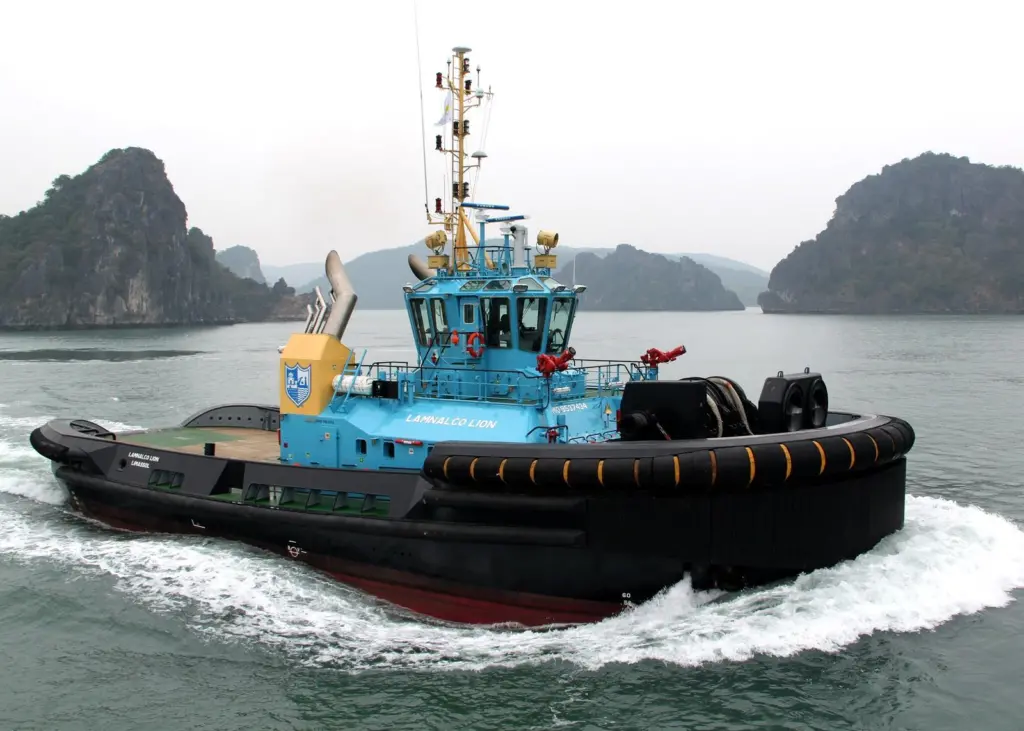
The tugs are further examples of the Damen ASD Tug 3213 design, built and fitted out specifically for towing, mooring, escorting and fire fighting operations. As yet no firm decision has been taken regarding the deployment of these new vessels. In the meantime Lamnalco Leopard and Lamnalco Lion have been working on the spot market in the Far East.
This quartet was constructed by Damen Shipyards in its Song Cam yard in Vietnam, which to date has been the centre for the production for this particular tug design. The hull and general configuration for this series is identical to those of the standard Damen ASD Tug 3213 design but Lamnalco has specified its own preferences with regard to propulsion machinery, towing gear and accommodation.
Lamnalco Leopard and its sisters have an overall length of 32.14m with a beam of 13.29m, a depth of 5.50m and draft (aft) of 6.07m. The hull form, developed as a result of the MARIN ‘Safetug’ joint industry project, features an increased volume forward, a raised forecastle, deep box keel and a pronounced sheer aft increasing freeboard at the open stern. This additional freeboard aft enhances the tugs’ performance while running astern and reduces the ingress of water on deck.
In this four tug series the propulsion system for each vessel comprises, a pair of Bergen C25:33L8P main engines generating a total of 6,530 bhp (4,800 bkW) at 1,000 rpm, coupled to Rolls-Royce US 255 CP fully azimuthing propulsion units. The units incorporate controllable pitch propellers of 2,800mm diameter.
On trials in Vietnam the first tug of the series, Lamnalco Leopard, achieved a bollard pull towing ahead of 77.1 tons and 70.1 tons towing astern. In common with other examples of the class, the performance when running free was almost equal in both directions, recording 14.2 knots ahead and 13.7 knots astern.
Two hydraulic towing winches are fitted, one combined double drum winch and anchor windlass on the fore deck for escort work and shiphandling, and a single drum winch aft for towing over the stern. The forward winch has a maximum brake holding capacity of 250 tons and each drum can accommodate 130m of 96mm diameter synthetic rope, plus a 20m pennant of 112mm rope. The winch has two speeds, giving a line pull of 60 tons at 27.4m/minute or 44 tons at 54.8m/min.
The aft winch has a maximum brake load brake of 250 tons and the single drum is equipped with spooling gear. This winch also has two speeds, giving a line pull of 50 tons at 10.7m/minute or 15 tons at 30m/min. The drum carries a 1,000m towline of 60mm diameter steel wire rope.
Also located on the after deck is a 5 ton electrically powered capstan, a Mampaey quick release towhook with a safe working load (SWL) of 100 tons, and in the open stern a 1,200mm diameter, 126 ton SWL stern roller. Mounted on the starboard column of the bitts aft of the winch is a Heila HLM 10-25 hydraulic knuckle-boom crane capable of lifting 1,100kg at a radius of 7.84m.
All four tugs will also be equipped for fire fighting to Fi Fi 1 standard. The fire fighting system comprises two remotely operated Alco short barrel monitors, each capable of delivering 1,200 cu/m of water/foam per hour, plus self protection spray nozzles and hose connections on deck. Both monitors are mounted on the forward superstructure at bridge deck level. Water pressure is supplied to the system by two Kvaerner fire pumps, one driven from the front end of each main engine via Kumera Norgear step-up gearboxes.
Fully air conditioned and heated accommodation is provided for up to nine persons in three single and three double berth cabins. There is also a large mess room, a well equipped galley, sanitary spaces, washing facilities and stores for dry and frozen supplies. The accommodation is constructed with floating floors and insulated linings and ceilings to reduce sound levels to 60-65 dBA throughout, including the wheelhouse.
A spacious, well equipped wheelhouse has two control stations, one forward and one aft, designed to give the tugmaster easy access to either from a captain’s chair mounted on a central track. The forward console is built to standard design common to all Damen modern ASD tugs. The wheelhouse has large windows ensuring good all-round vision. A comprehensive outfit of navigational and communications electronics meets the standards for GMDSS Area 3. Included in the package are two radars, a Satellite compass, GPS, Echo sounder, Auto-pilot, speed log, two Inmarsat C terminals, one Fleet broadband terminal, Navtex, two VHF and one single sideband radio.
The first four tugs of the ASD Tug 3213 design to be delivered are in service with Smit and the fifth with Multraship. This latest order will bring the total number built and sold to nine. One further tug is being completed for ‘stock’. A detailed account of Smit Panther, one of the first of the ‘big cat’ class to enter service appears in the October issue 2009 of Maritime Journal.
Related Articles
 EQUIPMENT
 MARINE CONSTRUCTION
 FEATURES & VIDEOS