



Twin Sails Bridge nearing completion
Work on the much needed second harbour crossing at Poole UK is gathering pace with the new Twin Sails Bridge set to open to the public early next year.
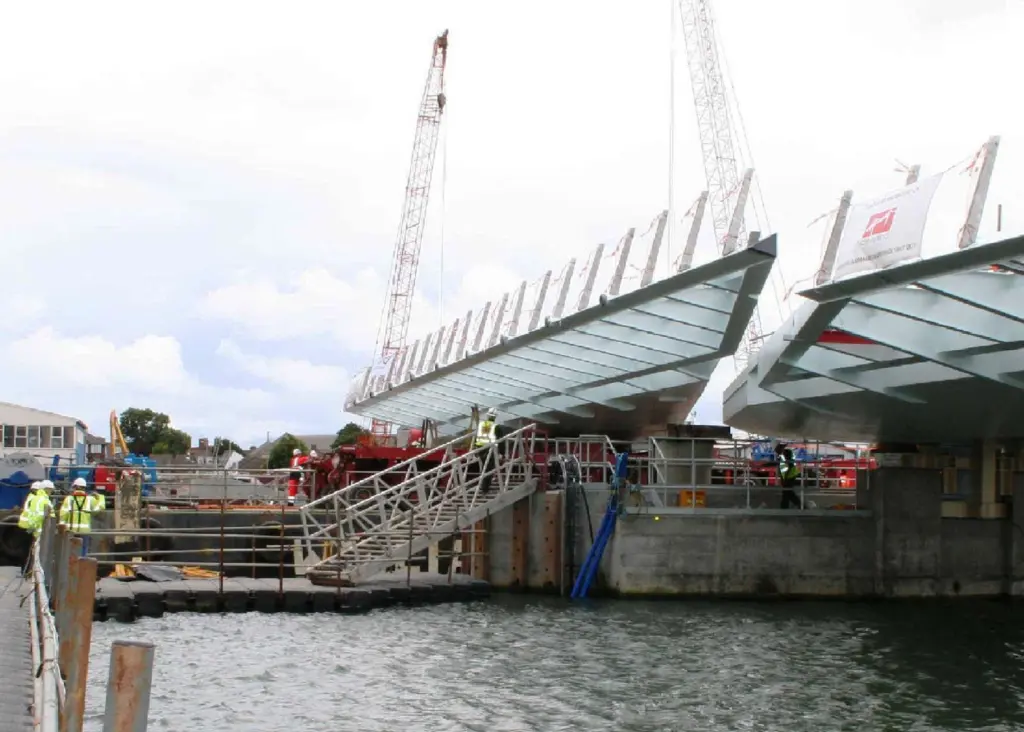
The Twin Sails Bridge was the winning entry in an international design competition in 2001/2. Following its 20 month construction period, it will be the first bridge of its type in the world to be built, a bascule lifting bridge with twin triangular shaped lifting leaves which symbolise the sails of a yacht.
The design was chosen to symbolise the aspirations of the town, which is proud of its maritime and industrial heritage.
The design team comprises Gifford, part of Ramboll, as lead consultants working with Wilkinson Eyre as the architect, MG Bennett and Associates (now part of the Atkins Group) as the mechanical engineer and Speirs & Major Associates as lighting architect. Hochtief (UK) Construction Ltd is the main contractor and Cleveland Bridge UK, the largest of Hochtief’s sub contractors, is manufacturing the steel deck and lifting leaves. Jenkins Marine has provided boats and platforms for the construction process.
The foundations for all four supports in the Backwater Channel are complete and work has commenced on constructing the final pier to support the bridge deck.
A temporary navigation channel has been created to allow marine traffic to access Holes Bay while work progresses on the final bridge pier which is due to be completed by September.
The abutments and piers sit on top of 53 foundation piles which are mostly 1.2m in diameter. The concrete piles have been drilled down 32m into the channel bed, roughly the same height as Barclays House in the town centre.
The bridge deck and sails are made up of 41 sections of steel which were manufactured by Cleveland Bridge UK in Darlington, which was also involved in the construction of Poole Bridge in 1926. The company has also worked on projects around the world including Sydney Harbour Bridge and the Humber Bridge.
The steel is delivered in giant sections and welded together on site. When finally assembled, the bridge deck and lifting leaves will be lifted onto a barge using self propelled mobile transporters before being floated along the Backwater Channel.
Once in place, the sections will be lowered into permanent position onto the bridge support structures using a combination of jacks, the barge’s buoyancy and movement of the tides.
The bridge comprises a 10.8m wide carriageway providing two traffic lanes and 1.5m wide cycleways along both edges of the carriageway. The bridge also carries two 2.5m wide pedestrian footpaths separated from the carriageway. The total width of the bridge is approximately 19m. It is designed to carry road traffic appropriate for its use as a primary route to the Port of Poole, which is classified as a part of the Trans European Network.
The bridge comprises five spans, with an overall length of approximately 140m. The approaches comprise two spans of approximately 27m. The central opening span provides a 19m wide navigation channel with no vessel height restriction when the bridge is open. This span is formed by two triangular shaped lifting leaves. To permit the unrestricted passage of shipping through the navigation channel the lift spans are pivoted through 88 degrees by two hydraulic rams on each leaf. In the event of ram failure or during periods of maintenance, the leaves can be lifted by a single ram.
The Twin Sails Bridge provides critical infrastructure required to unlock 26 hectares of brownfield land, one of the largest regeneration areas in the South West UK.
Related Articles
 MARINE CONSTRUCTION
 EQUIPMENT
 MARINE CONSTRUCTION