



Gondan deliver LNG Guardian
Spanish shipbuilder Astilleros Gondan delivered the 75 ton bollard pull standby vessel LNG Guardian to its Italian tug owner Fratelli Neri SpA on 12 January.
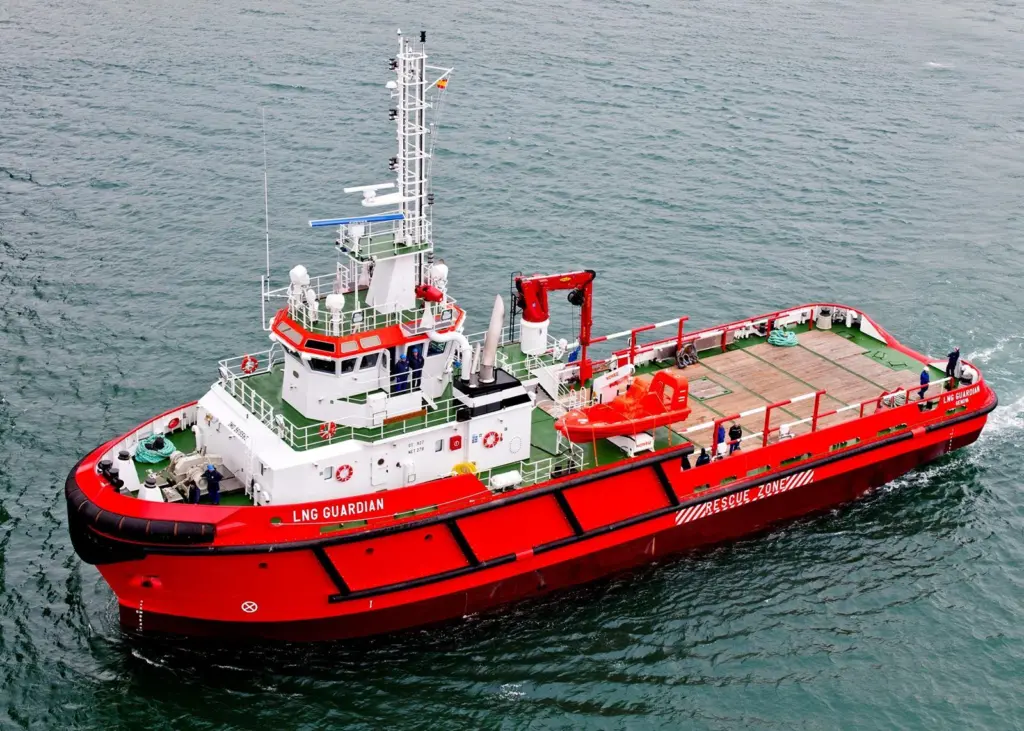
This vessel is the third to be built for Fratelli Neri at Gondan Shipyard in recent years, the previous order being a pair of ASD terminal tugs. LNG Guardian is designed to operate a support ship for a Floating Regasification Storage Unit (FRSU) situated offshore, 12 miles from the Italian port of Livorno.
The design for this highly specialised and quite exceptional vessel was developed by Cintranaval-Defcar, working closely with Gondán Ingeniería, which undertook the engineering detail. Many specialist features are incorporated in the vessel, allowing it to operate safely when assisting the terminal in the event of a gas leak, carrying out surveillance duties, working in a salvage and rescue role, stores and personnel transportation and a multitude of other support duties. In the rescue and salvage roles, provision has been made to accommodate up to 45 survivors.
In order to carry out stand-by and similar roles effectively a ‘fully feathering propulsion system’ from Berg Propulsion is incorporated to enable the vessel to operate at very slow speeds on one engine with the other propeller fully feathered for minimum drag.
LNG Guardian is a twin-screw vessel of 45.00m in length overall, with a beam of 12.50m and draft of 4.93m, built to comply with the comprehensive class notations: RINA. C HULL, MACH,TUG, Unrestricted Navigation, AUT-UMS, Oil Recovery Ship, Fire Fighting Ship 1, Water spraying, salvage tug,INS,SYS-NEQ 1,Standby Rescue Vessel.
The ship’s configuration is similar to a small anchorhandling supply vessel, with a forecastle one deck in height extending aft to amidships to leave a large clear after deck. A single height deckhouse on the forecastle is surmounted by centrally located wheelhouse. Standard height bulwarks are fitted on either side of the after deck leaving an open stern and a relatively small, centrally located stern roller. A heavy duty bow fender is designed for shiphandling offshore and large ‘D’ section fendering is used to form rubbing strakes on either side of the forecastle and to protect the rubbing band along the sides and stern.
LNG Guardian has a conventional twin-screw propulsion system powered by two MAK 6M 25C main engines developing 2,000kW each at 750 rpm for a total of approximately 5,364bhp. The engines drive Berg controllable pitch propellers, rotating in fixed nozzles via Reintjes reduction gearboxes. Each propeller has four blades and is capable of being fully feathered. Disc type shaft brakes are fitted to ensure the propeller is stationary whilst feathered. A hydraulically powered bow thruster is also installed. This arrangement gives the vessel a bollard pull of 75 tons and a maximum speed of 13.5 knots.
A total of 477.5 m3 of fuel is available, including an additional 88.5 m3 carried in a recovered oil tank if required. Endurance in standby operation, idling at about 4 knots, is specified as one month, at service speed16 days, and there is a range of 4,600 nautical miles at 12 knots.
Hydraulic pumps for the deck machinery and bow thruster, and fire pumps for the FiFi1 system are driven by the main engines. Electrical power is supplied by two Caterpillar powered Leroy-Somer Stamford auxiliary generators rated at 175kW.
A heavy duty Ibercisa, single drum towing winch is installed for all towing, salvage and shiphandling duties. The two speed winch has a brake holding load of 150 tons and is located in a sheltered alcove in the aft end of the forecastle. Automatic spooling gear is fitted and the drum is equipped with a 1,000m towline of 54mm diameter steel wire rope.
The deck machinery also includes one set of hydraulically operated tow pins, two capstans, a demountable oil boom reel, hydraulically powered oil recovery pumps and an oil skimmer. A Heila deck crane is located on the starboard side to handle booms, skimmer and any other equipment and stores. On the port side is a Noreq FRB 650 rigid fast intervention rescue craft along with is single arm launching and recovery davit.
A ‘tug style’ wheelhouse offers good all round vision and houses the usual array of propulsion and towing gear controls, navigational and communications equipment.
LNG Guardian is fitted out to accommodate a crew of six and a maximum of 45 survivors. Four single en suite cabins for the officers are located in the deckhouse, beneath the wheelhouse. Accommodation at main deck level includes one double berth cabin for crew members, a survivors seating area and toilet facilities for 45 persons, a galley, crew mess room, hospital, office, and storage for provisions. Below decks are located a sleeping area and facilities for 14 survivors, a workshop and engine control/switchboard room.
In the event of a gas release from the FRSU or an LNG carrier, the accommodation safety measures are in place to protect the crew and any survivors and allow the vessel to be moved to a safe place. Air locks and gas detection sensors and alarms are installed at each entrance to the accommodation and air intakes for the airconditioning. Remote closing devices shut the air intakes to the accommodation and the airconditioning system provides positive overpressure. Portable breathing apparatus enables the crew to access the deck when necessary.
Related Articles
 TUGS & SALVAGE
 EQUIPMENT
 MARINE CONSTRUCTION