![MaritimeJournal[Seawork]](https://www.maritimejournal.com/wp-content/uploads/2026/09/MaritimeJournalSeawork.svg)



WW2 rocket salvaged after 68 years in mud
At a routine meeting about leisure boating in Harwich Haven, one of the final questions asked was whether there were any dangers to navigation.
Only the V2 rocket that had exploded overhead and fallen into the mud in October 1944, was the answer. This relic from World War 2 was well known to local fishermen and members of the Harwich and Dovercourt Sailing Club, amongst whose moorings the rusting lump was often exposed at low tide. It had been reported several times in the intervening years to no effect. But this time the authorities decided to do something about it.
The Harwich Haven Authority and Essex police called in a Royal Navy bomb disposal team from Portsmouth and put an action plan into effect.
No one working today has any experience of dealing with these German flying bombs but it was known they carried a 1,000kg warhead and measured 14m long. An exclusion zone of 30m was established while Navy divers from Southern Diving Unit 2 waded through the mud, feeling their way around the wreckage, trying to gauge how much of it was buried and whether there was a live warhead at the business end.
The visible remains included the venturi (tail) section and it was believed that half of the projectile might have been buried in the river bed just a few hundred metres from the busy shipping lane to Harwich International Port (Parkeston Quay), where passenger ferries, cruise ships and various other vessels ply their trade.
The Navy bomb disposal squad marked out an area of approximately 6m using withy sticks, and the exclusion zone was later extended to 100 metres. The gathering of navy, army, police, HM Coastguard, council members and press and TV news crews created great public interest in the historic port town, which intensified when a possible one mile exclusion zone was mooted if the rocket was found to be armed. This would have meant the evacuation of Harwich Town, Parkeston and Shotley on the opposite bank of the River Stour. However, further examination showed that less than half of the rocket remained.
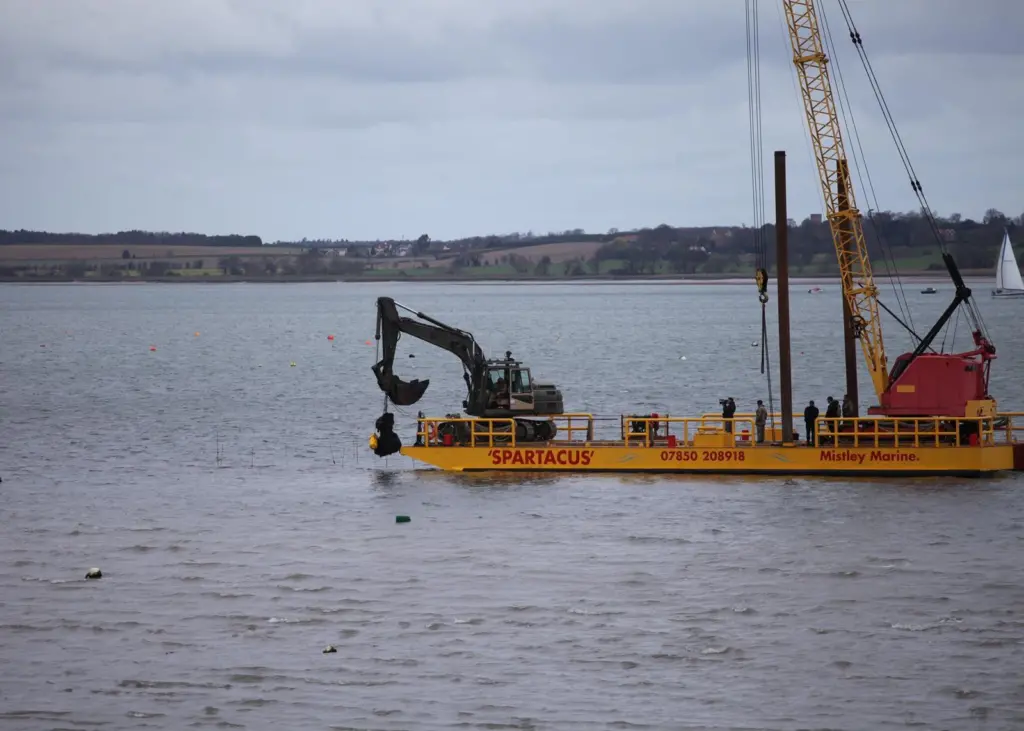
An army team from 33 Engineers Battalion were called in with a bucket grab crane mounted on Mistley Marine’s flat top barge Spartacus to dig away mud around the object, guided by Navy divers standing on the river bed. As the area was cleared the lump of metal came away quite easily, proving to be no more than about 1.25m long. It was landed ashore at the sailing club, whose committee have yet to decide its final resting place.
The supersonic V2 was one of Hitler’s final attempts to dominate Britain towards the end of the war, killing many thousands of victims. The V2’s designer, Wernher Von Braun, defected to the USA and later designed rockets for the American space programme.
By Graeme Ewens

Related Articles
 SPECIAL REPORTS
 TUGS & SALVAGE
 EQUIPMENT