


Shinano Maru – a first for Fukushima
A sophisticated Voith Schneider tractor tug, the Shinano Maru, has been delivered to the Japanese tug owner Fukushima Kisen KK for use in the port of Onahama, Iwaki, Japan.
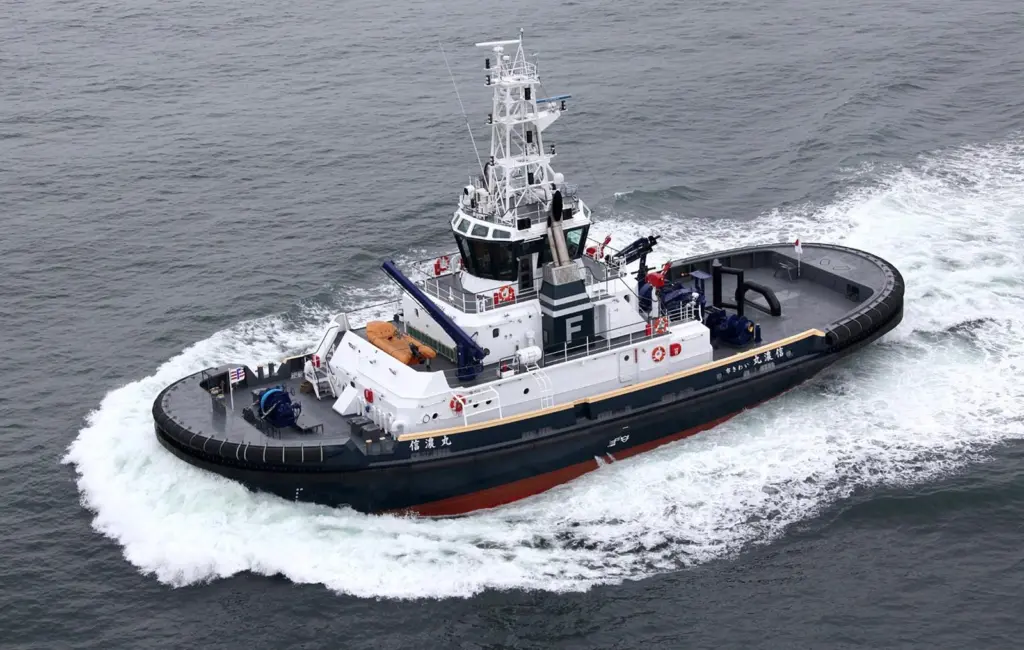
The new tug was constructed by Niigata Shipbulding in Japan to Lloyd’s Register requirements and is intended for a wide range of duties including harbour towage, shiphandling, fire fighting and escort duties in particular.
Fukushima Kisen KK have a large, very modern tug fleet of a dozen or so ASD tugs, many developed specifically for the company’s own purposes. This latest addition is the first vessel to incorporate a Voith Schneider propulsion system. The company’s president Dr Ikusei Nakamura told Maritime Journal that the tug was built to fulfill the need for a large powerful tug to assist LNG carriers at exposed ports or offshore floating LNG terminals. He was impressed by the swift, sensitive, step-less thrust variation in direction and magnitude available using the Voith Schneider propeller.
Shinano Maru was developed by the owners working in close cooperation with the Research and Development department of Voith Turbo Marine at Heidenheim in Germany. Fukushima Kisen requested a long hull to obtain maximum steering forces while working in the indirect towing mode, a rounded underwater shape at the bow, a strong sheer at the foredeck for seagoing operations and a low flat work deck aft for shiphandling operations. The hull form was optimised by Voith with the extensive use of Computational Fluid Dynamic (CFD) analysis. Also incorporated in the design is a ‘Voith Turbo Fin’, a rotating vertical cylinder built into the leading edge of the skeg to enhance ‘lift’ in the indirect towing (escort) mode. The propulsion unit blade profile and propeller guard design, with slots, have been optimised for maximum performance. The end result is a large Voith tractor tug of 39.30m in length overall, with a moulded beam of 13.60m, a depth moulded of 5.24m and maximum draft of 6.45m
Shinano Maru is fitted with two Wartsila 8L26 main engines each rated at 2,650 kW at 1,000 rpm, a total of approximately 7,1808 bhp. Each engine is coupled to a pair of Voith Schneider 32R5EC/265-2 propulsion units via Voith 1150 DTL turbo couplings. The electronic control system for the propulsion units incorporates Voith Active Roll Stabilization (VRS) technology. The latter suppresses the rolling movement of the vessel with rapid thrust variations generated by the blades.
On trials the tug achieved a static bollard pull of 75 tonnes and a free running speed of 14.4 knots ahead and 14.6 knots astern (skeg first). A steering force of 155 tonnes is estimated at 10 knots.
The electrical supply aboard Shinano Maru is generated by two Caterpillar powered auxiliary alternators, each with an output of 250kW, along with a 58kW harbour set.
The fire-fighting system supplied by Fire Fighting Systems (FFS) is to full Fi-Fi 1 standard, with two1,500 cu/m/h monitors, plus water spray protection, supplied by two main engine driven pumps.
A wheelhouse design has been adopted that provides excellent visibility all round the vessel, with few blind spots. The front windows are of particularly strong construction with six pillars and five narrow panes for additional safety while operating in the tractor mode in heavy weather. Two control positions are provided, the one forward for seagoing operations is lower for better comfort in bad weather and the other, for shiphandling operations in ‘skeg first’ mode, is higher for better visibility of the after deck and winch through three large windows. The exhaust casings have been cut off below the lower level of wheelhouse windows to cause minimum obstruction. The bulwarks are also set back to afford all round sight of the fenders while shiphandling.
A Karmoy double drum towing winch has a maximum brake holding capacity of 300 tonnes. The drums accommodate 300m of 80mm diameter synthetic hawser for escort operations and 1,000m of 57 mm diameter steel wire towline for towing astern at sea. A low, wide towing fairlead is designed to minimise heeling forces and improve steering in the escort mode. The outfit of deck equipment also includes a set of Karmoy tow-pins and a Palfinger deck crane.
The tug has been outfitted to a high standrad for a crew of eight persons. All cabins are located above the waterline and arranged to improve the efficiency of the crew. The Officer’s cabins include private en-suite facilities and the remainder share common lavatory/shower facilities. A spacious lounge/mess area is provided and there is a fully equipped modern galley. Very low noise and vibration levels of less than 65 decibel have been achieved in the accommodation and wheelhouse, thanks to flexibly mounted main engines.
Related Articles
 TUGS & SALVAGE
 EQUIPMENT
 MARINE CONSTRUCTION