![MaritimeJournal[Seawork]](https://www.maritimejournal.com/wp-content/uploads/2026/09/MaritimeJournalSeawork.svg)


Dutch invention helps prevent towline failure
The Rotterdam based shipping company Rotortug (KST) BV and ASD Ship Design from Alblasserdam have invented a revolutionary device to prevent towline failures on tugs, due to chafing against a fixed ‘staples’ and fairleads.
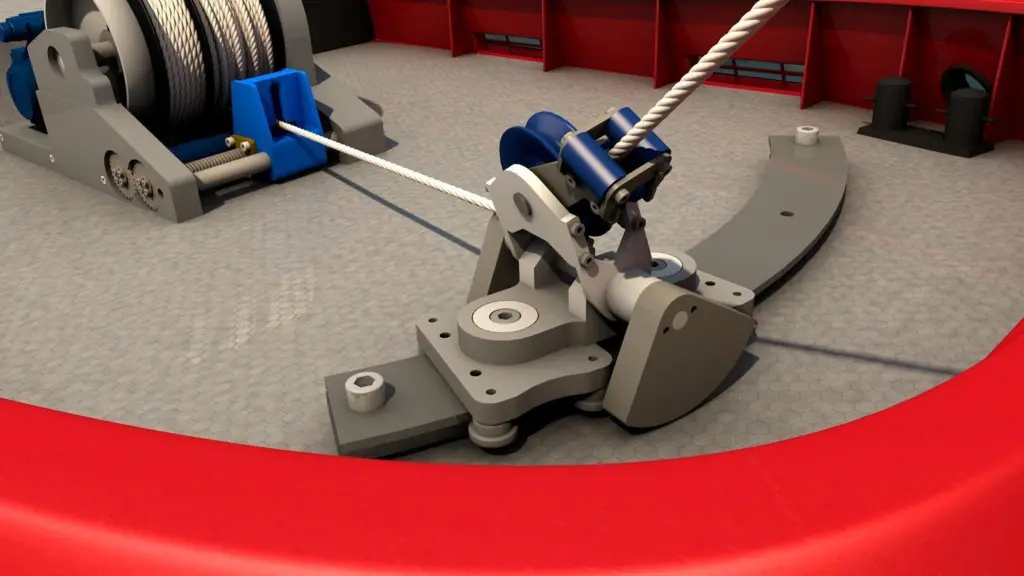
This latest invention by Mr. Ton Kooren of Rotortug and Mr. Arie Aalbers of ASD Ship Design, known as the ‘azimuthal friction free towing point’, was recently unveiled to the towage and salvage industry at the 22nd International Tug, Salvage and OSV (ITS) convention in Barcelona.
Conventional towing point designs are usually fixed staples or fairleads, fitted with polished stainless steel cladding to form the contact areas guiding the towline between the towing winch and the vessel being towed. Using ‘state of the art’ towing winches, towlines are hauled in and out automatically using a maximum preset line force to prevent both dynamic overloads and slack towlines. Synthetic towlines can easily fail due to chafing and friction, with an increased safety risk.
The fast inward and outward movements of a towline, associated with such winches, cause high temperatures, especially in the inner core of synthetic towlines. This is an even bigger issue when operating in high ambient temperatures. Friction and the high resulting temperature cause considerable wear and can result in failure of the towing connection.
Rotortug and ASD Ship Design, in cooperation with the Dutch winch and towing gear manufacturer Ridderinkhof, have developed a rotating sheave (pulley wheel) device to guide the towline without friction. The sheave is attached to a pivoted arm, similar to the traditional ‘righting arm’ used in the past aboard shiphandling tugs. A vertical pivot allows the arm to move to either side in an arc. The arm is kept close to the deck by a track and rollers The length of the arm and its low position is an aid to stability when the towline is on either side of the centreline.
Synthetic towlines are gradually replacing steel wire rope (SWR). They are generally seven times lighter compared to equivalent SWR. In fact, synthetic towlines are so light (and thus easy to handle) they float in water. A downside to synthetic towlines is their sensitivity to chafing and maximum safe working temperatures. The patent on this invention, known as the ‘Azimuthal friction free towing point’, is currently pending.
Together with the Rotterdam based maritime service provider Kotug International and the Rotterdam pilots, Rotortug has developed new methods of assisting seagoing ships. One such method, when using the ‘Rotortug’ type of shiphandling tug, is ‘rotoring’ which improves the handling of objects to be towed and moored in confined spaces. ‘Rotoring’ utilises the Rotor Tug’s ability to exert its full bollard pull in any direction including sideways, enabling indirect towing or pushing against the tow wire at zero speed. The azimuthal friction free towing point enables ‘rotoring’ to be carried out in heavy seas.
Related Articles
 SPECIAL REPORTS
 TUGS & SALVAGE
 EQUIPMENT