


Triple engines for DGzRS’ new rescue boat
The German Maritime Search and Rescue Service (DGzRS) is modernising its fleet.
After 34 years in service, the rescue cruiser Wilhelm Kaisen is to be retired and will be replaced by the Harro Koebke. The 36.5m LOA, 7.8m wide vessel has a top speed of 25 knots. The latest addition to the fleet will be used to rescue people in distress at sea or requiring emergency medical treatment. Based at Sassnitz on the Island of Rügen, its area of operations will be in the Baltic Sea between Cape Arkona and the Island of Greifswalder Oie.
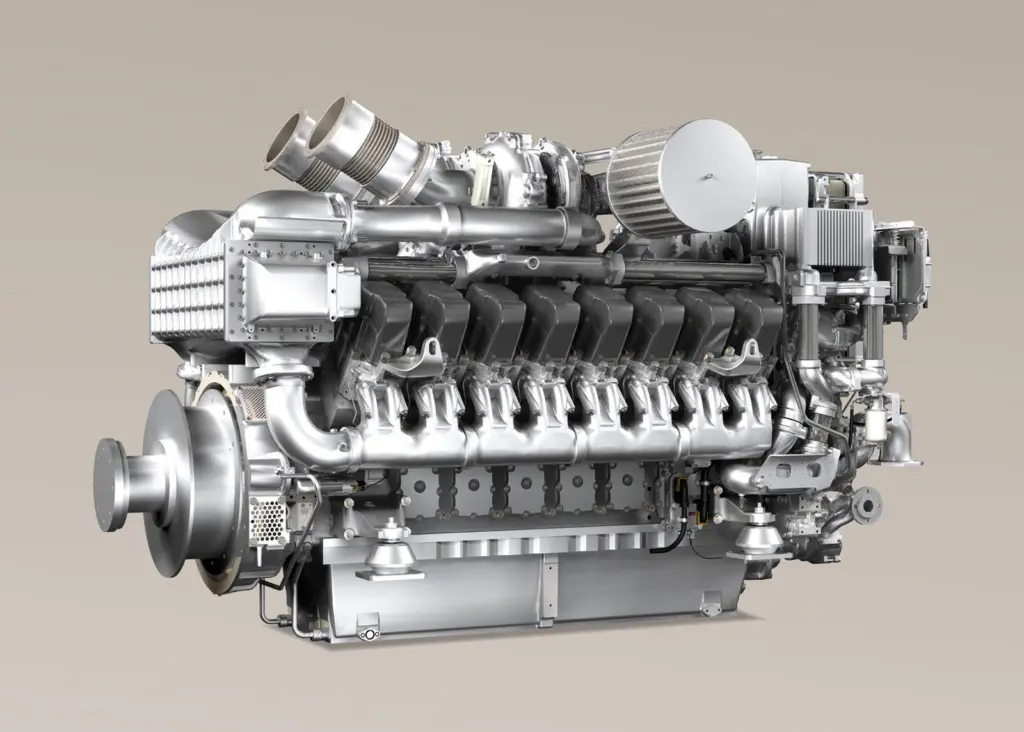
The vessel is powered by three MTU Series 4000 engines, one 16 cylinder engine and two 8 cylinder. The central 16V 4000 M71 unit delivers an output of 2,465 kW (3,352 hp), while the side units, both 8V 4000 M70 engines, each develop 1,160 kW of power (1,577 hp). Each engine is equipped with its own shaft to deliver power to the fixed propeller. A routine exercise is the ideal situation for the MTU engines.
The units are brought up to full power in stages, although this is not possible while the vessel is on search and rescue duty, when full power is needed quickly. This is why the engines are always pre-warmed and are started up when the alarm signal sounds. As soon as the vessel has left the harbour walls behind, the coxswain shifts up to full speed ahead. This requires the MTU engines to be absolutely reliable and to deliver high power immediately.
The Callosum automation system monitors and controls both the propulsion systems and the shipboard systems. Controlling the propulsion systems is particularly important when a high speed start is required for emergency situations. Callosum also matches acceleration and handling optimally to the immediate circumstances and ensures that all shipboard systems, such as the tank, bilge water systems, heating and ventilation systems are fully functional at all times. Two auxiliary diesel engines and one biological wastewater treatment facility complete the engine room equipment. The biological wastewater treatment facility ensures that the DGzRS conform with the increasingly stricter environmental requirements.
The Harro Koebke is the second largest of the 60 vessels that make up the DGzRS fleet. Only the Hermann Marwede, a 46m vessel, is larger. Two MTU 12V 4000 M90 engines and one MTU 16V 4000 M90 engine are installed in the largest rescue cruiser. In total, the DGzRS fleet has 30 MTU Series 396 and 4000 engines in regular service, providing the power for the 23m to 46m classes of vessels.
Related Articles
 POWER & PROPULSION
 VESSELS
 POWER & PROPULSION