

River Rhine tanker runs on gas
A tanker barge built for Deen Shipping is claimed to be the first vessel on European waterways to be powered by a dual fuel system.
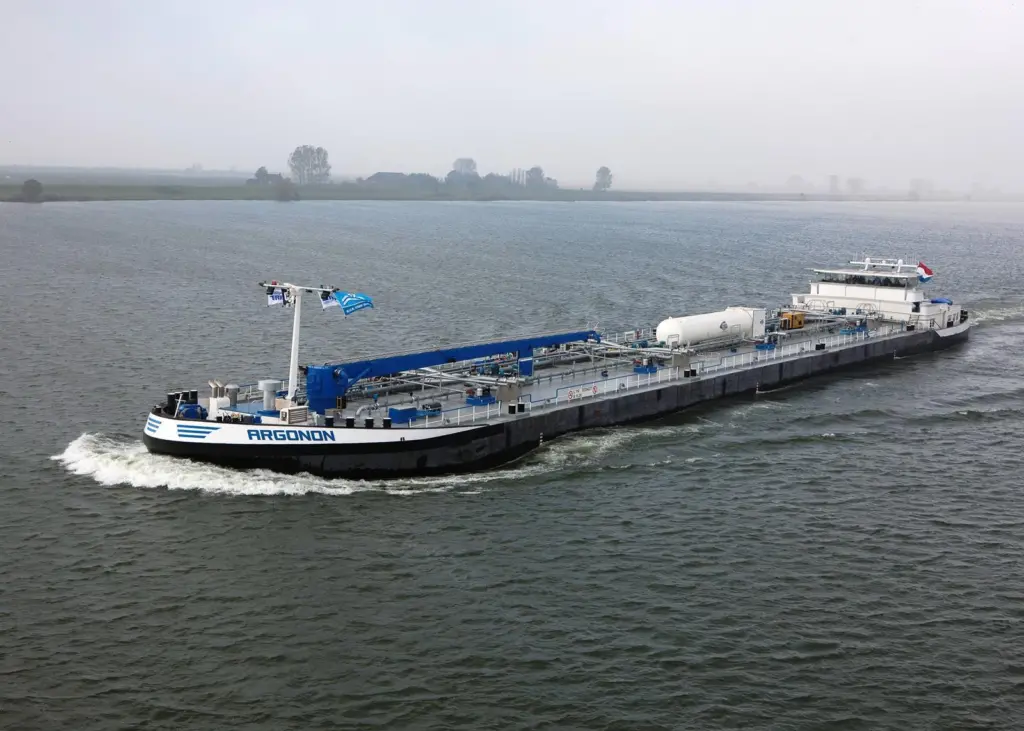
The vessel, Argonon, operates on the River Rhine using a mixture of natural gas and diesel fuel for its main engines and auxiliaries. It is claimed to achieve a significant reduction in emissions and it complies with the requirements of the Central Commission for the navigation on the Rhine.
Dutch operator Deen Shipping teamed up with the Dutch company Pon Power, which is Caterpillar agent in Holland, to develop the engine installation and systems. The main engine is a pair of 1,118 kW Caterpillar D3512 diesels that operate at 1,600rpm and drive through a conventional shaft and propeller system. The vessel operates on the River Rhine from Holland through to Switzerland with the engines running on a mixture of 80% natural gas and 20% diesel oil. The LNG is stored in a 40 m3 tank on deck.
A pioneering installation on board this tanker is a new concept of efficient and clean generators. The 110m long barge has two gas turbine powered generators that not only supply the electrical power but which can also provide the domestic hot water, heating and air-conditioning and they do this whilst generating very low emissions that can exhaust without any treatment to meet the latest stringent regulations.
Pon Power developed this system, which is based on a pair of Capstone C30 gas turbines. These 30 kW turbines are coupled to generators that provide the electrical power. The hot exhaust from the turbine then passed through a heat exchanger which in turn provides the hot water for domestic use and for the heating system. Part of the exhaust heat from the turbine is also fed to an absorption chiller for the air-conditioning. The result is that much of the heat that would normally go into the exhaust is utilised to meet many of the domestic requirements. The heat from the turbine exhaust is also used in the conversion process for changing the low temperature liquid fuel into a gas for combustion.
On this particular installation, the vessel operates on natural gas for both the main and auxiliary engines and the turbines operate very happily of this gas. However, the turbines can also be programmed to operate on most common fuels such as diesel and jet fuels, thus making this turbine system suitable for most requirements. The exhaust from the turbine shows a significant reduction in harmful emissions compared with a normal diesel and the smooth running of the turbine and the low noise levels improve the on board environment and reduce the need for insulation.
American company Capstone, which makes these small gas turbines, currently offer three models producing 30, 60 and 200 kW, which would meet most generator requirements. They are widely used on many land based applications and have been approved by Lloyds Register of Shipping. The turbines are equipped with special bearings that require no lubricating oil, eliminating another possible source of contamination.
There is obviously considerable potential for these generators on a variety of craft, particularly those where high performance and light weight are requirements and, along with the compact size of the units, could add a performance bonus. The available sizes of turbines should meet the auxiliary requirements of most vessels and the quietness, absence of vibration, and low emissions could help to meet crew environment regulations. The Argonon is used to transport bunker fuel for ocean going vessels.
Further information: www.capstoneturbine.com, www.pon-cat.com
By Dag Pike
Related Articles
 POWER & PROPULSION
 VESSELS
 POWER & PROPULSION