




High Volts for Bolt 18’s electric propulsion
A pioneering installation of what is thought to be the first boat electric propulsion system featuring high voltages was launched in September.
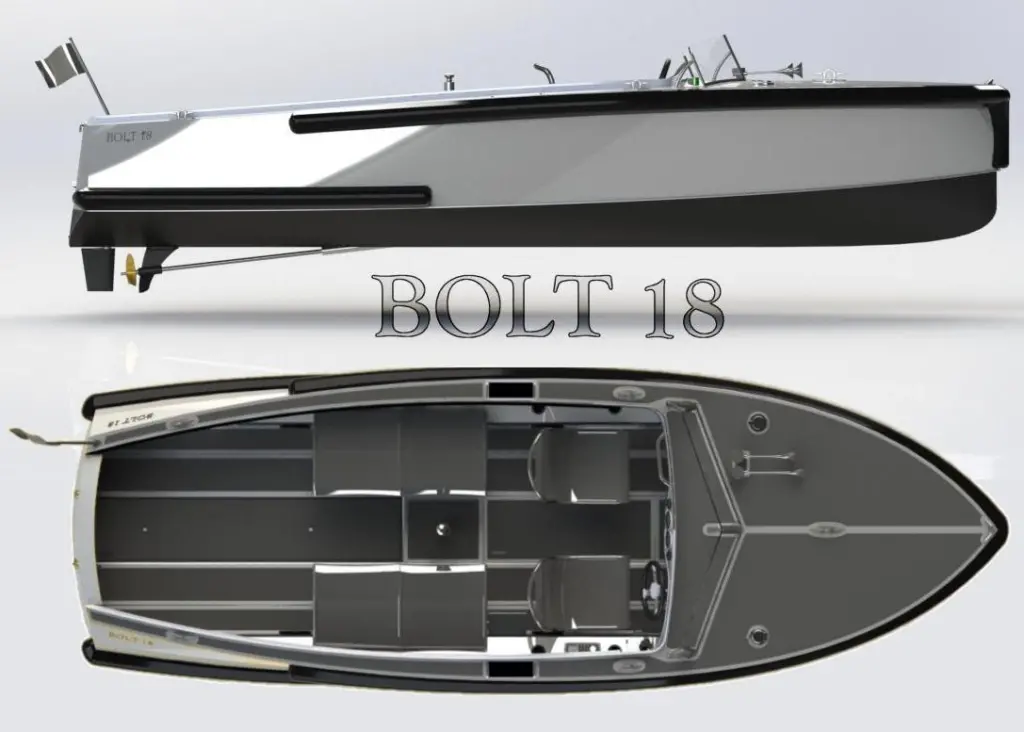
By using a high voltage system many of the problems inherent in low voltage systems can be overcome but of course there remains the perceived danger of having high voltages in a small boat. This first installation has been fitted to a super yacht tender, the Bolt 18, designed by Mylne Designs along traditional lines and speeds of over 30 knots will be possible. The system could make a good solution for harbour craft with charging systems available that can fully charge the batteries in under half an hour.
This new electric propulsion system is designed to operate at 400 volts DC. By using higher voltages the amperage required to produce a certain power is considerably reduced and this can increase the efficiency of the system because there is less heat loss from the system. The designers are claiming a 90% efficiency compared with 80% for low voltage systems. Low voltage systems that currently use motors operating at around 48 volts need to have a sophisticated cooling system built into the motors and generators and very heavy duty wiring is required to connect the system because of the heavy currents involved, which can be 200 amps or more, rather like the systems used for engine starter motors.
With a high voltage system less cooling is required, the motors and generators are much more compact and lighter and the wiring that connects the system can be reduced considerably in size. Because of the high voltage used, great care is necessary in making the connections. On this tender, installation of all of the wiring is sheathed, with the sheathing earthed, and all connections and the motor are fully waterproof.
To obtain the 400 volts on which the system operates, 118 battery cells are required, each cell producing 3.5 volts. These batteries are connected in series to produce the 400 volts and with modern compact lithium ion batteries the weight and space requirements of the batteries are not major issues.
Two versions of the Bolt 18 are being built, one with water jet propulsion and one with a shaft and propeller system. Construction is in aluminium. The boats will be powered by a 100 kW electric motor and the battery capacity has been designed to allow a minimum speed of 20 knots for half and hour. This pioneering electrical system has been developed by Regen Nautic in Florida USA, who are specialists in electric propulsion for both land and marine vehicles.
Another installation being developed using high voltages is on a heavy duty 56 foot displacement vessel. This system will operate at 720 volts, having 60 12 volt lithium ion batteries connected in series to produce the required voltage. On board generators will provide the electrical power for charging and propulsion and the batteries alone can be used for silent running and for providing domestic power.
Further information: www.mylne.com, www.regenautic.com
By Dag Pike
Related Articles
 POWER & PROPULSION
 VESSELS
 POWER & PROPULSION