

LNG power for Canadian ferry
Finland based power solutions provider Wärtsilä has been awarded the contract to supply the gas powered propulsion machinery and corresponding gas storage and handling systems for a new passenger ferry.
The vessel has been ordered by Canadian operator Société des traversiers du Québec (STQ), and will be the first North American ferry to be powered by liquefied natural gas (LNG). The ship is being built by Fincantieri Cantieri Navali Italiani in Italy and will be used on routes crossing the St. Lawrence River. The contract was signed in October and the equipment is due to be delivered in the autumn of 2013, with the vessel scheduled for delivery by the end of 2014.
The ferry is being built to comply with the stringent emission regulations applicable to its area of operation. With the Wärtsilä 34 dual-fuel generating sets, which will provide the main power generation, the regulations will indeed be met. By operating on LNG, nitrogen oxide (NOx) emissions are at least 85% below those specified in the current International Maritime Organisation (IMO) regulations, and the CO2 emissions are some 25% less than those of a conventional marine engine running on diesel fuel. The sulphur oxide (SOx) and particle emissions are negligible at almost 0%. This level of environmental sustainability exceeds the emission reductions mandated by the strict local regulations. The IMO has designated some US and Canadian waters as an Emissions Control Area (ECA). This is in line with the International Convention for the Prevention of Pollution from Ships (MARPOL). The North American ECA became enforceable in August 2012.
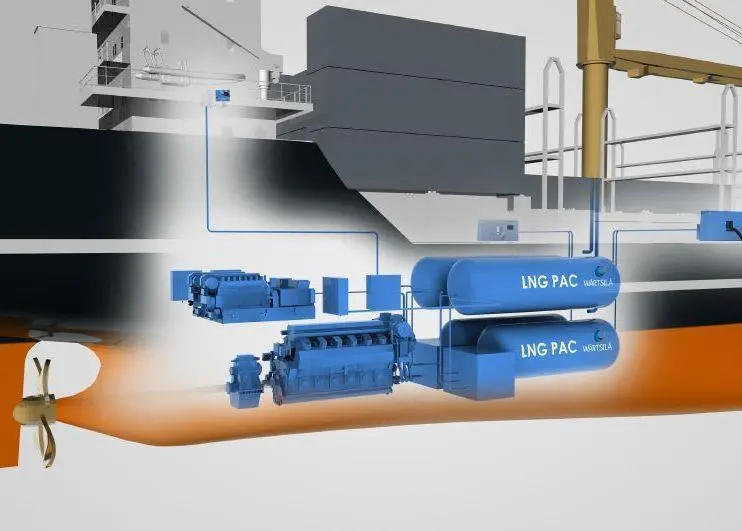
In addition to the four main power generating sets, Wärtsilä will also supply its innovative LNGPac system. Designed and developed by Wärtsilä, the LNGPac comprises onboard LNG bunkering, storage tanks and handling equipment, as well as the related safety control and automation systems. The entire Wärtsilä propulsion solution is designed with a focus on safety and simplicity. All engines can be seamlessly switched to marine diesel oil (MDO) operation should gas not be available, thus full redundancy can be achieved. This ensures that the safety factor is at the highest possible level.
Related Articles
 POWER & PROPULSION
 VESSELS
 POWER & PROPULSION