

‘Sonne’ construction goes back to Meyer Werft
Construction of one of Germany’s biggest hydrographic research ships has been transferred back from subsidiary Neptun Werft to parent firm Meyer just a short time after steel cutting began on the €124.4m newbuilding.
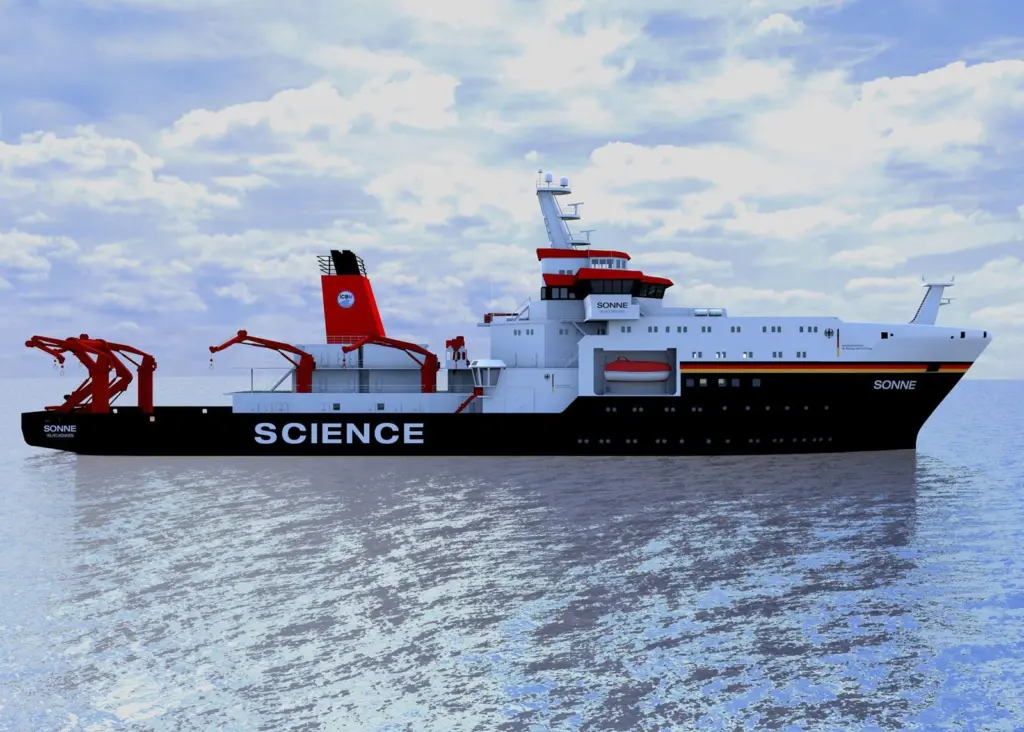
The 115m long Sonne will be one of the biggest and most sophisticated research ships ever built and add enormous clout to Germany’s already impressive fleet of hydrographic workhorses, taking over a range of deep-sea and other duties from a 36 year old namesake in 2014 or early 2015.
Its main areas of operation will be the Pacific and the Indian Oceans and it will be particularly suited for climate change research and for research into deep sea gas hydrates, mineral and oil reserves as well as micro-organisms in depths up to 11,000m. It will also carry out research into gas methane resources on continental shelves.
Sonne, originally earmarked by Meyer for construction at subsidiary Neptun in Warnemünde, has been transferred to Papenburg to help Meyer raise productivity and cut the costs of its cruise ship newbuildings to better compete with foreign, particularly Asian, builders threatening the sector. The yard has orders in hand up to 2015 but needs to better utilise overcapacity.
The transfer also appeared designed to relieve the workload at Neptun, which at last word had 14 inland cruise newbuildings on its books. One of those 135m ships was also being moved to Meyer.
The German Ministry of Education and Research (BMBF) ordered Sonne in 2008 from Tiefseeforschungsschiff GmbH, comprising Meyer Werft and Bremen research ship operator RF Forschungsschiffahrt. Steel cutting started in Papenburg in December and the keel is expected to be laid this year.
Sonne will be 20.6m wide and carry 35 crew as well as 40 scientists and others. It will also have space for 25 TEU and boast working platforms, cranes and winches, diving vehicles and seismic research equipment.
In a rare departure from the usual lack of technical detail on early stage construction of such ships, it has been revealed that Hamburg’s Imtech Schiffbau-/Dockbaubetrieb is designing, building and installing the energy-efficient air conditioning and ventilation system. Imtech said the first components were for delivery this year.
The German Government is paying 90% of the cost of Sonne while the five coastal states; Lower Saxony, Mecklenburg-Vorpommern, Schleswig-Holstein, Hamburg and Bremen are funding the rest.
Sonne is only one of four new research ships joining the BMBF over the next few years at a cost of nearly €850m. A €450m ship will replace Germany’s biggest research ship the 118m long Polarstern from 2017 while a replacement for the old, 97.5m Meteor will cost some €160m and some €110m will be spent to replace the 60.8m Poseidon from 2018. Yards have not yet been named.
By Tom Todd