

First Rolls-Royce Environship delivered
LNG as marine fuel has taken another step forward as Eidsvaag AS took delivery of the first vessel of the Rolls-Royce Environship range this month.
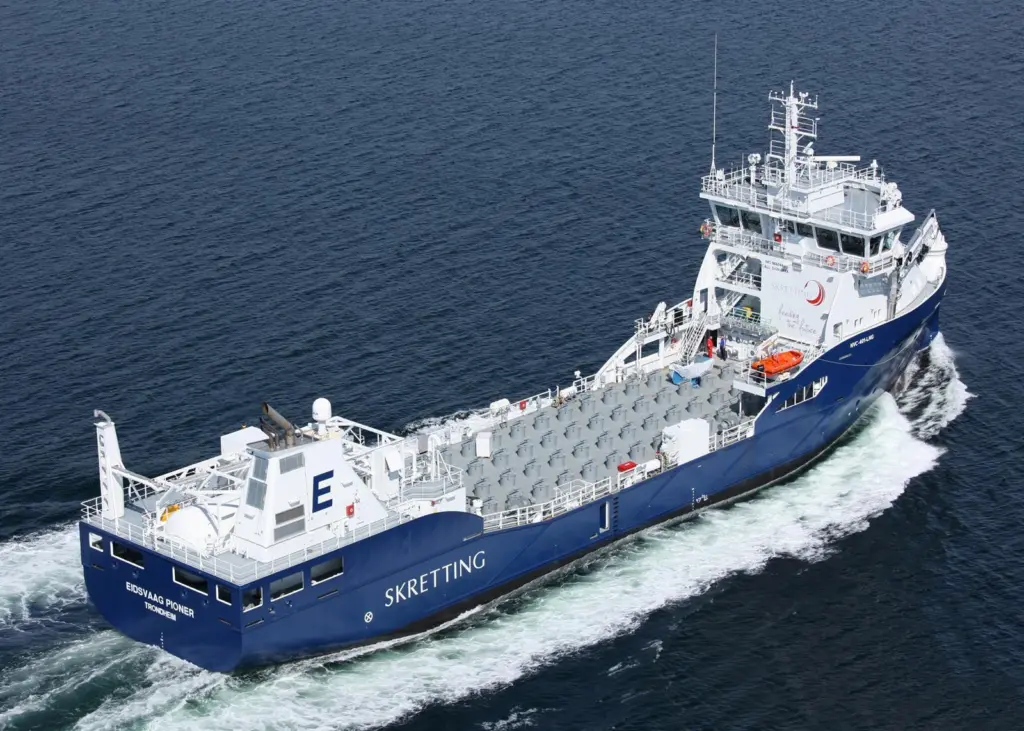
It features a combination of Rolls-Royce design and technologies which reduce CO2 emissions by up to 40% compared to similar diesel powered vessels.
Once in operation the vessel will operate a demanding schedule with a weekly round voyage along the Norwegian coast delivering feed pellets to fish farms regardless of weather conditions. On arrival at the storage location at a fish farm the ship will hold its position using its DP system and the pellets will be delivered by means of a crane operated transfer system over the bow. Up to 1,450 tonnes of feed can be carried in the 62 specially designed tanks on board which are connected to the unloading system. The speed needed to meet the weekly schedule is 15 knots.
The ship is designed with focus on the actual sea conditions experienced in the area in which it will operate. Extensive model testing was carried out in the towing tank and the ocean basin at Marintek. Testing has confirmed that the hull is extremely efficient in both calm waters and heavy seas. A patented bow form reduces hull resistance in waves by up to 10% compared with an optimised conventional bow. This is confirmed by careful benchmarking comparisons in head seas in the towing tank.
On an overall length of 74.7m, the NVC 401 LNG has a beam of 13.6m and a loaded draught of about 5m. The superstructure is located forward, with accommodation for eight people, and the machinery and LNG tank aft, the cargo tanks occupying the main part of the hull.
A Bergen C26:33L9PG gas engine, developing 2,430kW at 1,000 rpm, turns a CP propeller in a Promas solution integrating the propeller, a nozzle and the rudder in an efficient propulsion system.
The high lift rudder is complemented by a 540kW tunnel bow thruster and a similar unit in the stern skeg.
The LNG system supplied by Rolls-Royce has a capacity of about 110m3, which gives a range of around 1,750 nautical miles. Developed in cooperation with Linde Cryo, the result is a system that controls the supply of gas to the engine optimally despite rapid changes in load. Furthermore Rolls-Royce has delivered the engine and thruster controls, an integrated automation system with gas control and monitoring, the DP1 system with joystick, and the electrical system.
All together the propulsion solution will reduce CO2 emissions by 22%, NOx emissons by 92% and SOx emissions by 99%, while emission of particulates are negligible.
Built at the Vard Aukra yard in Norway and owned by Eidsvaag AS, the NVC 401 LNG forage carrier will work for Skretting AS.
Technical specification:
Length overall: 74.7m
Beam: 13.6m
Draught: 5m
Power: Bergen C26:33L9PG
Speed: 15 knots
Related Articles
 POWER & PROPULSION
 VESSELS
 POWER & PROPULSION