




Fibre optics slip ring applications for ROVs
Lincolnshire UK based BGB Engineering Ltd is looking to take its Optilinc range of Fibre Optic Rotary Joints (FORJs) into un-chartered new markets, including ROVs.
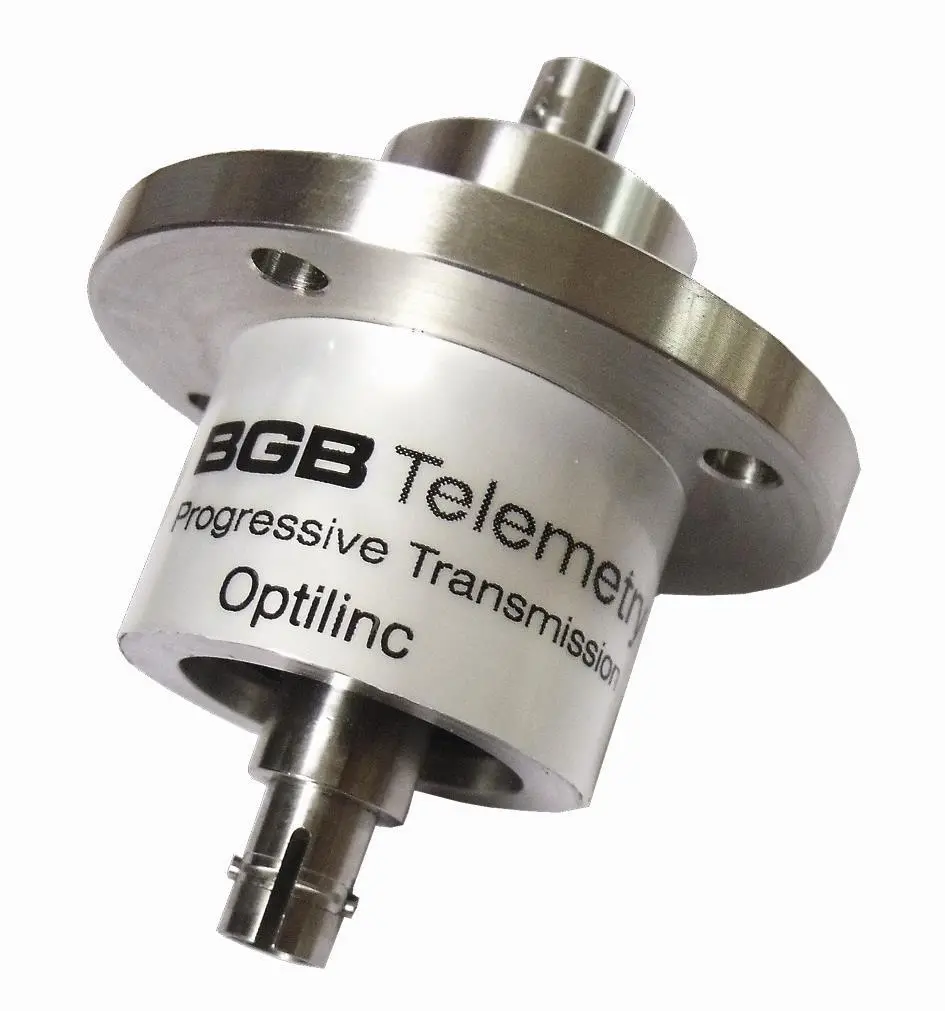
Its BGB Axial Multimode and Singlemode Fibre Optic Rotary Joints, Optilinc, have been rigorously tested by Deutsch UK Ltd to EN2591-601 and to EIA standards.
The Fibre Optic Rotary Joint (FORJ) is the optical equivalent of the electrical slip ring. It allows uninterrupted transmission of an optical signal while rotating along the fibre axis. FORJs’ are widely used in applications where a twist-free fibre cable is essential.
The Fibre Optic Rotary Joint is ideal for high speed data-transfer on many applications, in particular, data transfer from the nacelle of a wind turbine. Constructed in stainless steel, BGB’s ‘Optilinc’ has exceptional durability protecting the unit from dust and water ingress to IP68 and is not influenced by vibration, humidity, heat, magnetism or other typical slip ring disturbances. The unit can transfer bi-directional data at a rate up to, and beyond, 10Gb per second and can be offered with media converters, switches and wavelength division multiplexers (WDMs) to suit users’ protocols and requirements.
Optical fibre is proven to have far wider bandwidth than any other media known such as wireless, copper wire, and sonar. A single strand of optical fibre can easily replace a large bundle of copper wires while boosting system bandwidth.
The basic concept of the FORJ is essentially very simple, although a practical implementation requires considerable expertise and attention to detail. This simplicity does however lead to robust and reliable products that can be adapted to a wide variety of applications.
Combined with electrical slip rings, FORJ’s add a new dimension to traditional rotary joints. BGBs Optilinc FORJ can be combined with existing traditional long standing proven BGB slip ring packages to bridge the gap of older units and to future-proof systems allowing ample bandwidth to the end user.
By providing an optical slip ring together with media converters to suit the customer’s existing data network, the Optilinc FORJ provides a transparent route for the user to extend his bandwidth and data integrity.
BGB have married the high bandwidth of an optical slip ring with their extensive background in power slip rings to offer an integrated unit with power and data transfer as well as an optional shaft position encoder.
BGB maintains the position of strategic supplier to many of the major global wind turbine manufacturers in the supply of wind turbine slip rings and systems used in generators, pitch control, lightning suppression, and shaft grounding applications.
“The growing range of Fibre Optic Rotary Joints have been a major technological step forward for BGB,” says BGB MD David R Holt. “The units expand our already large product offering to many of our industry sectors and will hopefully gain us access to previously un-chartered markets such as medical, military and ROVs.”