




Taming the surface drive
Surface drive propulsion is wonderfully efficient when high speed is required.
It can offer speeds that are 10 to 20% higher than with conventional propulsion when travelling above 40 knots but the penalty comes when manoeuvring in harbour. At best, surface drive manoeuvring can be called brutal because when engaging gear there is a sudden jump in speed as the big propellers bite. Minimum speed may be around seven knots, which can upset a lot of harbour masters. But now there is a new system aimed at taming this brutal performance.
Twin Disc is a major supplier of surface drives with their Arneson units and they have been well aware of the problem. They are also a major gearbox manufacturer and so they have aimed to tackle the problem through the gearbox. First there was the trolling valve, a system that allowed the clutch plates in the gearbox to slip in a controlled manner so that effectively the gear box ratio was increased, allowing the minimum speed to drop to perhaps four or five knots.
This speed was still too fast for controlled manoeuvring and engagement was still quite brutal so Twin Disc looked for a better solution. This was found by using a tapered control valve inside the gearbox hydraulics that allowed the clutch slip to be much more controlled. Instead of being pressure controlled the new system is RPM controlled so that the engine and the propeller shaft speeds are compared and adjusted to meet requirements. This has allowed the propeller shaft to operate at perhaps just one tenth of the engine speed, which in turn allows speeds of just one knot, allowing very controlled manoeuvring when coming alongside.
This new gearbox control also took away the defined clunk when the gearbox was engaged and the boat would leap forward when power was applied. Now acceleration is controlled in a much more subtle way. With this delicate control has come the possibility of using a dynamic positioning system with surface drives. Before, the power application was too brutal to use for the subtle manoeuvring required when trying to hold a fixed GPS position at sea. With the new gearbox control the engagement of the gears is subtle and the position can be maintained with an accuracy of around 5m, mainly dictated by the GPS accuracy.
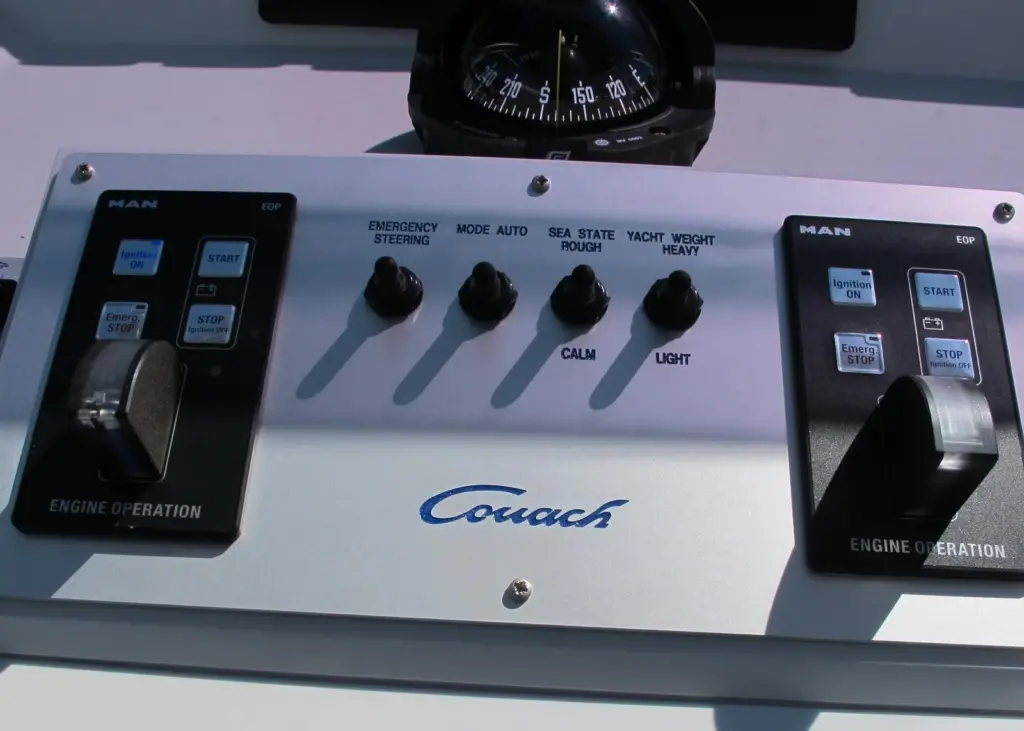
In addition, Twin Disc has introduced an automatic trim system for the Arneson Drive. This not only controls the trim of the drive but is also connected to the flaps or interceptors. This does all the hard work when the boat rises onto plane. One of the first installations was on the new Hornet Tender, which is based on military patrol boat designs from the Couach yard in France. Switch to auto and the boat rises onto plane in a smooth and controlled manner with hardly any change in the angle of trim of the boat. On the dash board are switches that not only allow switching from auto to manual control but which also allow the operator to compensate for rough and smooth seas and for when the boat may be in heavy or light condition.
This automatic trim makes it much more pleasurable driving the boat at 50 knots, allowing the operator to concentrate on where he is going and what is around him rather than on the controls. Before, the operator needed to be something of an octopus to control the flaps, the power trim and the throttles with his left hand whilst keeping his right hand on the steering wheel. The rough/calm and heavy/light switches seem to be very effective in responding to changing conditions.
With this new system the use of the very efficient Arneson Drives becomes much more viable. It can take the often delicate control of the flaps and power trim out of the hands of the operator, who can then concentrate on where he is going. But it also allows him full control if that is what he wants.
Further information: www.twindisc.com
By Dag Pike
.
Related Articles
 POWER & PROPULSION
 VESSELS
 POWER & PROPULSION