


New MTU engines for Severn class Lifeboats
The RNLIs biggest All Weather Lifeboats are being re-engined at South Boats IOW in the UK.
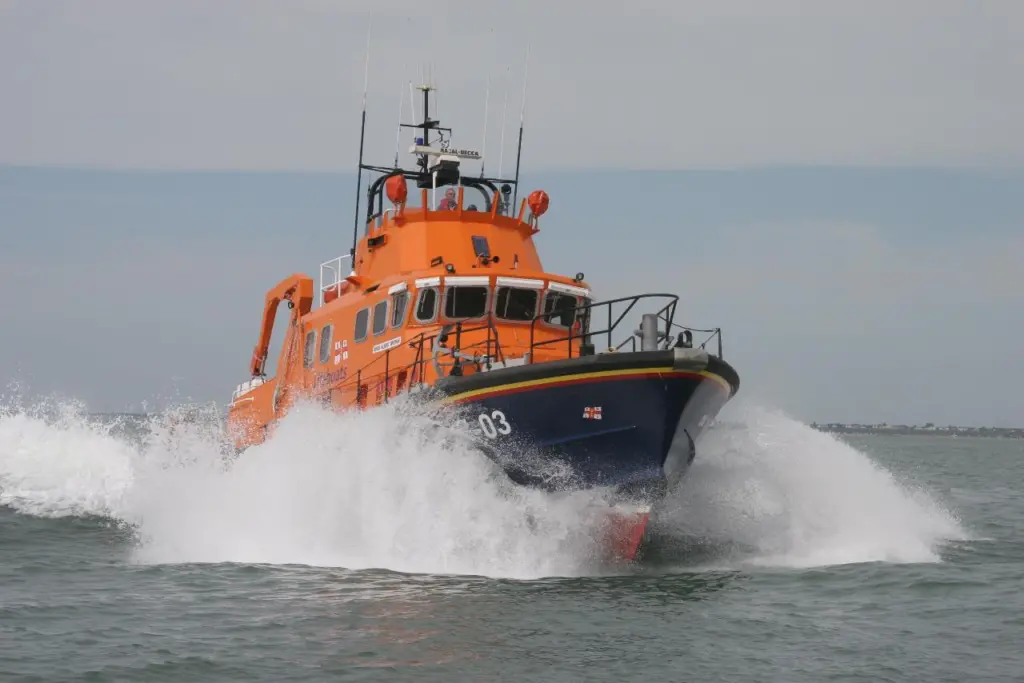
When the RNLI’s Severn class All Weather Lifeboat Albert Brown was returned from South Boats in the Isle of Wight to her station at Harwich towards the end of last year, the original twin CAT diesel engines had been replaced by V10 turbocharged MTU units supplied from the makers, Tognum Corporation in Friedrichshafen, Germany which, following a takeover in January this year, is now known as Rolls-Royce Power Systems.
After 18 years service, the refit of the 17m, 40 tonne boat was part of a planned programme to re-engine the largest boats in the Institution’s fleet. The Albert Brown was the first Severn class boat to be entered into service in 1996 and it has been used on one of the RNLI’s busiest stations, sometimes responding to vessels in distress as far as 50 miles offshore, and often having to rescue commercial vessels much longer or heavier than itself. Apart from exercises and an unsuccessful MOB search, the boat’s first service with the new engines in 2014 was to tow in a beam trawler broken down 20 miles out near busy shipping lanes north of the Sunk pilot station in March this year.
Built at a cost of £2m each, there are 44 Severns in service. The prototype has been sold out of the RNLI, while another was wrecked and written off. The first production boat The Will (17-02 ) has been kept in the relief fleet. All the serving boats are due to be re-engined roughly half way through a life expectancy of 50 years. Severn class boats have a design speed of 25 knots (29 mph; 46 km/h) and with a 5,500 litre (1,200 imperial gallons) fuel capacity they have a range of 250 nautical miles (460 km).
The original Caterpillar 3412 TA diesel engines generated 1250 bhp (932 kW) each. The new engines, which were installed by South Boats IOW at their Cowes yard, have a rated power output of 1600 bhp, at a maximum of 2450 rpm. This would have powered the Severn to a top speed of more than 35 knots but that would have been greater than the design speed of the hull so, in practice, the engines have been de-tuned to run at a maximum of 1300rpm, which delivers approx 80% of full power and takes the boat to its designed hull speed of 26+ knots.
South Boats has had a long-standing relationship with the RNLI stretching back 15 years to refit and repair the all-weather fleet and, under the new company structure, South Boats IOW have had a framework agreement for the past 14 months. There is a dedicated shed at their yard and a team of six people occupied full time on Lifeboats. A normal refit of a Severn takes 12 weeks, and with the MTU engine change, this extends to about 18 weeks. The next to arrive for that operation was due on June 9.
Lifeboat engines are probably unique in being required to go Full Ahead immediately from a cold start. The acceleration rate of the original CAT engines took the Severn from standstill to 26.6 knots in 38 seconds, while the MTU engines take the boat to that speed in 17 seconds. To aid cold starting the engines fire on all 10 cylinders and then reduce to just a single bank of five. Any demand results in all 10 cylinders firing.
The MTU 10V2000 (M94) marine engine is a 22.3 litre, 90-degree V10 common rail diesel, with twin turbochargers and after cooler. Several modifications have been made to meet the requirements of the RNLI. In the event of a capsize, the Severn is designed to right itself within 7 seconds. Inverting a running diesel engine would normally cause engine oil to enter the cylinders through the crankcase ventilation system, causing uncontrolled combustion. To counter this the RNLI’s specified modifications include redesign of the sump and oil pick up. The sumps have been deepened and narrowed to improve oil pick up in rough weather, and the pick up has been lowered. The sump has been fitted with a baffle plate to prevent oil splashing onto the crankshaft during rough weather or a capsize. A bypass valve below the engine water pumps allows the crankcase to vent when the shut off valve is closed.
Those mods were carried out after extensive testing during which MTU design engineers fitted Series 2000 M94 engine to a special-purpose cradle that would rotate it through 360 degrees about its own longitudinal axis in order to study the effectiveness of modifications they made to the design of the crankcase ventilation and oil lubrication galleries.
Most importantly they fitted a valve to the crankcase breather that would close, depending upon the angle of rotation, and would then reopen automatically when the engine was restored to the upright. Subsequently, every M94 engine destined for RNLI installation must pass through final testing on the revolving cradle before it is sent out from the factory.
Other modifications and improvements include replacing and simplifying the sea water cooling system for ease of use and to reduce maintenance. The Tungam pipework has been replaced with Polyethylene. The stern tube valves are also plastic and mounted directly onto the deep seals, making them accessible from the centre walkway.
The original two-into-one exhaust water injection unit has been replaced with a singular unit which gives improved cooling and keeps the unlagged section of the exhaust at a safe temperature. It also gives greater clearance around the deckhead.
The engines use a micropocessor-based, electronic engine control module called ADEC (Advanced Diesel Electronic Control) to provide governing, automatic fuel ratio control, torque rise shaping and control of the cold start operation.
The engines are linked to an electronic throttle control system called MTU BlueLine, in which electronic data transmission is routed via heavy duty Hartlng connectors to link cabling to the various blue control, boxes. The system allows engine control and monitoring to optimise fuel consumption and performance. The fuel consumption is 313 litres per hour.
The five-blade propellers (mounted in tunnels) now have a reduced pitch of 34 inches to accommodate the increased rpm. They also reduce the in-gear idle speed of the boat to 600 rpm.
Routine engine maintenance periods have been reduced, as MTU advise that the first oil and filter change is not needed until after the first 50 hours and then after 500 hours of operation. The crews also appreciate the quieter engine noise, which means they can have a conversation in the wheelhouse without shouting.
Before the engines were ordered, to test performance in operational conditions, modified twin 10-cylinder MTU Series 2000 M94 engines were fitted in October 2008 to the RNLI lifeboat Margaret, Joan & Fred Nye which was taken around RNLI stations to be appraised by coxswains and station mechanics. Such was the success of these extended sea trials, that according to an MTU report, the RNLI decided in 2010 to re-engine more of its ‘Severn-class’ lifeboats with these engines.
The total cost of the refit for each boat has been reported as £600,000 (offset somewhat by re-selling the old CAT engines to private buyers).
MTU Friedrichshafen GmbH is a manufacturer of commercial internal combustion engines co-founded in 1909 by Wilhelm Maybach the technical director of Daimler-Motoren-Gesellschaft (DMG) – a predecessor of Daimler AG. MTU Friedrichshafen remained a subsidiary of DaimlerChrysler until 2006 when it became part of the Tognum Corporation.
In 2011, Rolls-Royce Holdings and Daimler AG launched a takeover and on 9 January 2014, Tognum was renamed Rolls-Royce Power Systems. The decision was made to reflect the industrial ties to Daimler AG and Rolls-Royce Holdings for the company’s large engines, propulsion systems and distributed energy systems.
By Graeme Ewens
Related Articles
 POWER & PROPULSION
 VESSELS
 POWER & PROPULSION