


Mersey Gateway Bridge receives vital funding promise
The announcement in the UK chancellor’s 2014 budget for the commitment of £270m of government funding for the Mersey Gateway Bridge will allow design and construction of the PFI scheme to hit top speed.
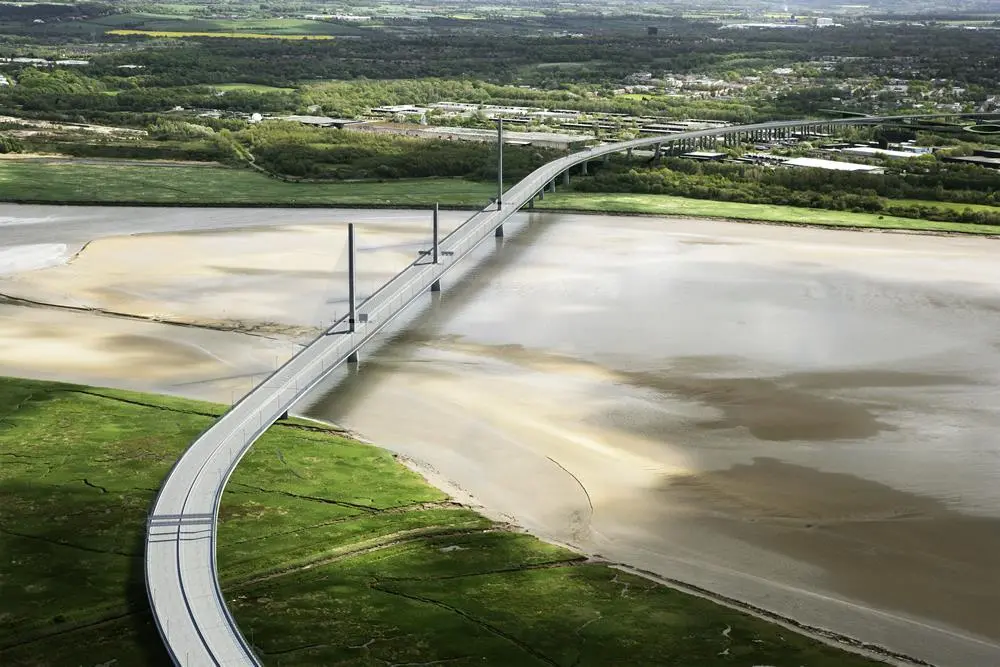
The crossing’s designer, a Flint & Neill and URS joint venture have now been appointed to deliver detailed design consultancy services for the project that will see a cable-stay structure (similar to the second Severn Crossing) but with three towers. The new bridge, around 1.5km to the east of the existing Silver Jubilee Bridge, will link the Liverpool city region, north Cheshire and the north-west to the rest of the country. The tolled crossing, around 1km long, will include three piers in the river carrying two 300m outer spans crossing the naturally occurring deeper water channels of the river at each bank. These will be supported by cable stays attached to towers rising 135m above the river bed. The bridge itself comprises a post-tensioned concrete box supported on a single line of central stays. Mono towers will form the main visual features of the crossing with a shorter central tower, dictated by restrictions on span arrangements across the estuary. Cost of construction and buying land required for the project is put at £600m, set against a predicted project revenue of £2bn to cover all project costs for 30 years (some local residents will benefit from 300 free trips a year across the two bridges). Construction has already commenced with the building of access roads across sensitive saltmarsh environments on both side of the river and the new bridge is scheduled to open to the public in 2017.
Flint & Neill and URS have been appointed by the contractor Joint venture of Samsung C&T Corporation, Kier Infrastructure & Overseas Ltd and FCC Construction SA. Two Spanish consultants also form part of the design joint venture with Fhecor supporting Flint & Neill and Epitsa supporting URS who are responsible for the land activities. The project received welcome recognition recently when it won the ‘Sustainability’ award at the national Ground Engineering Awards in London to add to the ‘Best Practice’ title it was awarded at the North West Chartered Institute of Highways and Transportation Awards.
By Peter Barker
Related Articles
 ENVIRONMENT
 MARINE CONSTRUCTION
 MARINE CONSTRUCTION