

Electrifying Scandinavian ferries
Three ferries under development in Scandinavia will set new standards in ferry operations by being fully electrically powered. All have innovative battery and charging systems that could set the standard for many future ferry systems.
In Sweden a ferry undergoing conversion will be the first to have a newly developed rapid charging system. This will allow the ferry’s batteries to be charged quickly during the short time that the ferry is alongside between trips and this rapid and regular charging will allow it to operate all day under electric power alone.
The innovative propulsion system and charging station technology that is being used by this ferry has been developed by Echandia Marine, a company that was founded with the mission to bring Swedish submarine technology to the surface. Echandia’s CEO, Magnus Eriksson, who has been a submarine designer and engineer and a strong proponent of electric transport, has used his expertise to revolutionise the passenger ferry industry as we know it today. The propulsion system is designed to be equally suitable for both new boats and retrofits and the project is supported by the Swedish Energy Agency.
The owner of this electric ferry is the Swedish company Green City Ferries which operates ferries on routes in the city of Stockholm. Now virtually silent and producing zero emissions, the converted 23-metre vessel carries 100 passengers and it will be able to run for an hour on just ten minutes of charging from a special shore connection. The ferry, named Movitz, is now completing its retrofit and will be operating in fully electric mode in Stockholm’s inner-city waters by August 2014. It will operate on a central route between Solna Strand and Gamla Stan, in the heart of Stockholm’s Old Town. When it is in operation this ferry will be the first supercharged electric passenger ferry in the world. Eriksson commented, ”The launch of this converted ferry will be a momentous occasion for electric transport, for the marine industry and for Sweden.”
Instead of a 250kW diesel engine using 50 m3 of diesel per year which would have emitted130 tons of CO2, 1,5 tons of NOX and 80 kg of particles, the Movitz will have two 125 kW electric motors located under the stern. These are housed in steerable pod drives that have also been developed by Magnus Eriksson and they are fully azimuthing so they will give the ferry excellent manoeuvrability.
The battery system on board used to store the electrical energy will be the latest generation of Nickel-Metal-Hydrid (NiMH) batteries from the Swedish company Nilar. Their capacity is 180 kW and it is claimed that these NiMH batteries can deliver high power instantly and can be charged very quickly. Hans Thornell, the CEO at Green City Ferries, estimates that the ferry will need just 90 kW of power to cruise at 9 knots. Running costs are expected to be up to 30 % lower than for a conventional ferry and there is almost no need for maintenance.
In Norway the planned introduction of the world’s first fully battery powered large ferries in 2015 has led to the development of a shore electrical connection system that could be plugged in quickly for charging the batteries. The two ferries will have just 10 minutes to turn around at each end of the ferry route so the operators wanted an automated connection system for the shore power charging link to allow the maximum time for re-charging the batteries.
The 80 metre long ferries are based on efficient catamaran hulls and there is accommodation on board for 360 passengers and deck space for 120 cars. The ferries will operate on the Lavik to Oppedal route across the Sognefjord and each ferry will make 17 crossing every day. They are powered by two 400 kW electric motors that will give a 10 knot speed when operating on half power. The battery installation weighs in at 10 tonnes.
Not only will the ferries have the automated electric connection system but the ferry berths will be equipped with the MoorMaster system that will allow the vessel to be secured alongside automatically without any ropes. Both the MoorMaster system and the AMP (Alternative Maritime Power electric supply system have been developed and supplied by Cavotec Norge.
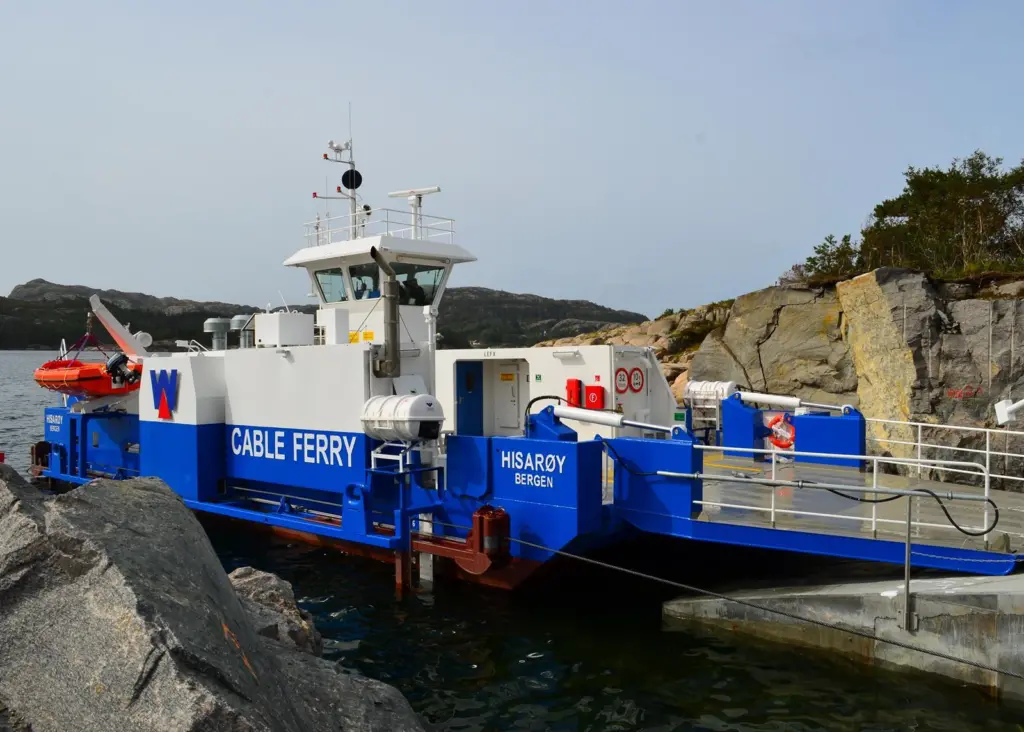
The third ferry operates across a 1 kilometre wide fjord on wires laid across the fjord. This cable ferry is driven by electric/hydraulic winches that pull the ferry across on the wires. The main power on this ferry comes from a large battery pack that has enough power for around three crossing and which is recharged at the terminal at one end. An auxiliary diesel powered generator provides power for a back up system. This 35 metre long ferry has a beam of 8.6 metres and can carry up to 8 cars and 49 passengers.
These electric ferries are all part of an expanding interest in electric power to reduce emissions and offer better fuel economy.
By Dag Pike
Related Articles
 POWER & PROPULSION
 VESSELS
 POWER & PROPULSION