![MaritimeJournal[Seawork]](https://www.maritimejournal.com/wp-content/uploads/2026/09/MaritimeJournalSeawork.svg)





Action where it’s needed
It is not so much about just getting people to and from offshore structures, now it’s also about the tools for the job says Arjan Boezeman of Ulstein Idea.
And while there are a number of solutions being built, he believes some are fighting the wrong battle.
“Crew access onto wind turbine towers or other offshore structures used to be the main issue, but the weather window has been substantially widened by motion compensated gangways,” he says: however the next bottleneck is the limitation on how much equipment people can hand carry, putting the tool load well under 100kg.
So, there’s been a growing need for motion compensated handling systems to get the cargo across. Mr Boezeman points out that when you are looking to adjust for vessel motion you have three potential areas to intervene: most obvious are the pedestal or the crane’s existing pivot points.
However, although many recent solutions tend to focus on these two areas, both have certain inherent problems.
“Firstly compensating on the crane pedestal means you have to take the entire crane weight, this takes a extremely robust construction and a lot of steel, further it is more difficult to control and so accuracy is more difficult.” But even if you intervene higher up by using the crane pivots “you still need to run the system against the inertia of the crane’s own components, and these are still much heavier than the load”.
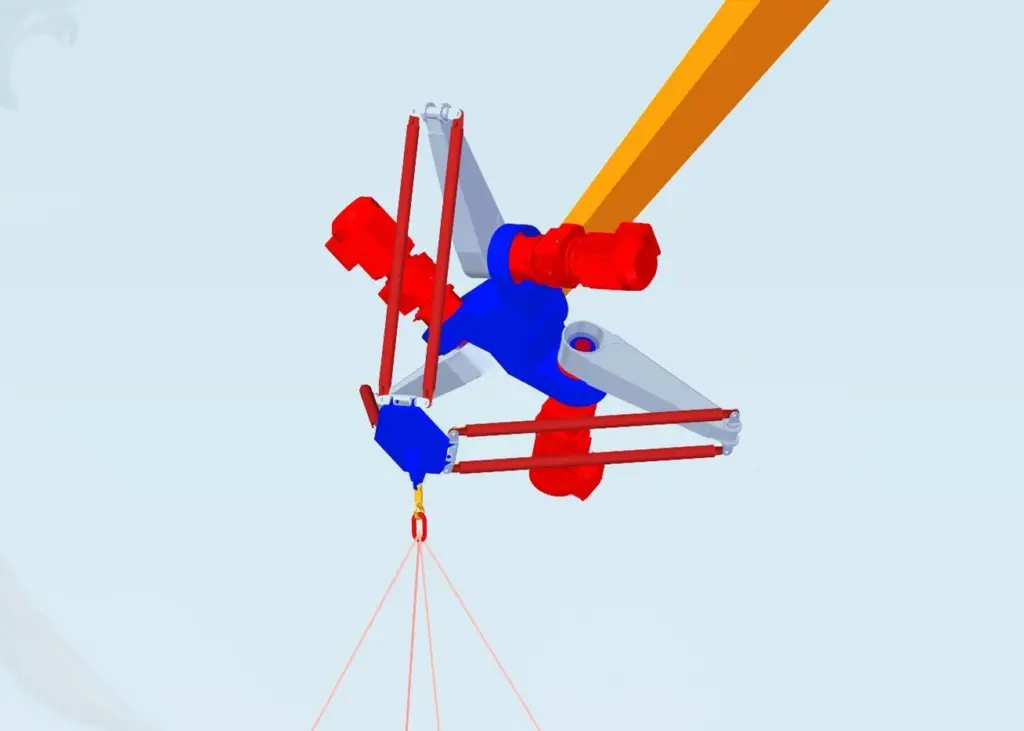
This leaves the crane tip, “by far the simplest option” says Mr Boezeman. So, the Colibri (meaning ‘hummingbird’ in Norwegian and Dutch) has been developed and patented – in collaboration with National Oilwell Varco – to perch at the very end of the boom with a base plate. A motion reference unit helps to establish “the exact reverse” of any movement and signals are transferred to three jointed arms that are each activated by an independent electric motor. “Simple,” says Mr Boezeman, “and better than normal active heave compensated cranes which still leave the horizontal motion of the crane tip to cause the load to swerve”.
So, despite the wider motion and higher velocities inherent in having the compensation on the far end of the outreach, the system gains by only dealing with the load, not the weight of the crane or components.
The other very interesting element to this says Mr Boezeman: “is that it can be simply fitted onto a standard crane, either new or as a retrofit”.
The system, along with a heave compensated gangway, is presently being installed on a new support vessel presently under build: it is expected to join its sister – Siem Moxie – on both wind and oil & gas operations.
By Stevie Knight
Related Articles
 OTHER NEWS
 ACCESSORIES & EQUIPMENT
 ACCESSORIES & EQUIPMENT