![MaritimeJournal[Seawork]](https://www.maritimejournal.com/wp-content/uploads/2026/09/MaritimeJournalSeawork.svg)





Container feeder barges
Increasing road congestion at many container ports has led a German company to develop a new concept of feeder barge. The aim of this powered barge is to provide a method of moving containers to new port locations which can provide reduced congestion at the main ship terminals and speed up the transfer of containers to inland shipping.
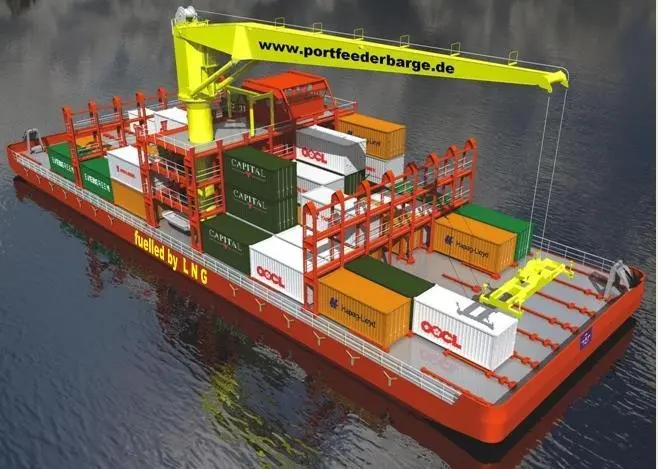
The barge, built by Port Feeder Barge GMBH, is based on a pontoon shaped hull with a length of 64 metres and a beam of 21 metres. The deck of the barge is rectangular but underwater the ends have been fined away to reduce the resistance. A central superstructure block provides accommodation for the crew and is topped by the control centre and bridge. This leaves the container storage space at each end of the barge where containers can be stacked three high with cell slots provided for the inboard stacks of containers.
To make the barge self sufficient a Liebherr crane is installed on the opposite side of the superstructure to the control station. This crane has a capacity of 49 tonnes at 27 metres outreach, reducing to 39 tonnes at 29 metres.
The propulsion comprises four rudder-propeller units located at each corner of the barge and operating within the depth of the hull. These propulsion units are electrically driven with power being supplied by Caterpillar generators. Each propulsion unit is 280 kW and this installation provides exceptional manoeuvrability and a speed of 7 knots. Provision is made in the design for the vessel to be powered using LNG as a fuel.
The barge was developed after tank testing and is classed by GL for both inland waters and for sea-going operations. The normal loaded draft is 2.00 metres but for inland waters this is increased to 3.10 metres. This is equivalent to a deadweight of 1000 tonnes as a seagoing vessel and 2500 tonnes for inland waters and harbours.
The design allows it to be self-sustaining when transferring containers around a port. These transfers can be made either between terminals in a port or direct from a ship terminal to an inland waterway vessel. The capacity of the feeder barge is similar to that of an inland waterways vessel and the crane allows the transfer of the containers to be made directly to the inland vessel. Alternatively the barge can operate on a regular basis between terminals or from ships at anchor depending on demand.
Originally developed as a means of reducing road congestion within the Port of Hamburg this feeder barge operation could provide a solution in many ports where container and cargo transfer is required. The ability to operate in sea-going mode could extend the type of transfer operation carried out and demonstrates the flexibility of the concept.
By Dag Pike
Related Articles
 OTHER NEWS
 ACCESSORIES & EQUIPMENT
 ACCESSORIES & EQUIPMENT