![MaritimeJournal[Seawork]](https://www.maritimejournal.com/wp-content/uploads/2026/09/MaritimeJournalSeawork.svg)




Deep water development
While “there have historically been industry questions” around the uses of fibre rope, Jorn Boesten of DSM Dyneema said this has been answered by developments in both rope and winch technology – and by approaching the system as a whole.
“Five or ten years ago the winch companies just used to ask the fibre rope manufacturers to come up with a solution. Now the belief has changed,” said Mr Boesten.
“The big difference is that people recognise you have to look at the system in its entirety,” he said: “If you see it as an integrated whole then you’ll be able to design a system that will work, even with a few thousand metres of synthetic line.”
This has lead to shared projects such as the one between Deep Tek, Lankhorst Ropes and DSM Dyneema. Working closely together, the three companies have developed a system based on Deep Tek’s drum winch technology for deploying and recovering payloads in even the deepest waters. Rather than one element being left (literally) to take the strain “there are changes to the crane, changes to the winch and adaptations to the fibre rope”, he told MJ.
Deep Tek for example has developed and patented a spooling pattern that allows multiple layers of synthetic fibre rope to be wound onto a load bearing winch drum with no risk of cutting in. It’s very different from the standard wire rope pattern; instead of being laid in parallel throughout the layers, a deliberate angle is introduced leading to a chevron pattern “which gives you perfect spooling even when 3km of rope means you can end up with nine or 10 layers on the drum” explained Mr Boesten.
But the project couldn’t have been taken forward without the development of fibre rope itself. One of the biggest issues for rope to overcome has been Cyclic Bending Over Sheave (CBOS) action which causes internal friction and heat build up, leading to a sharply decreased life expectancy.
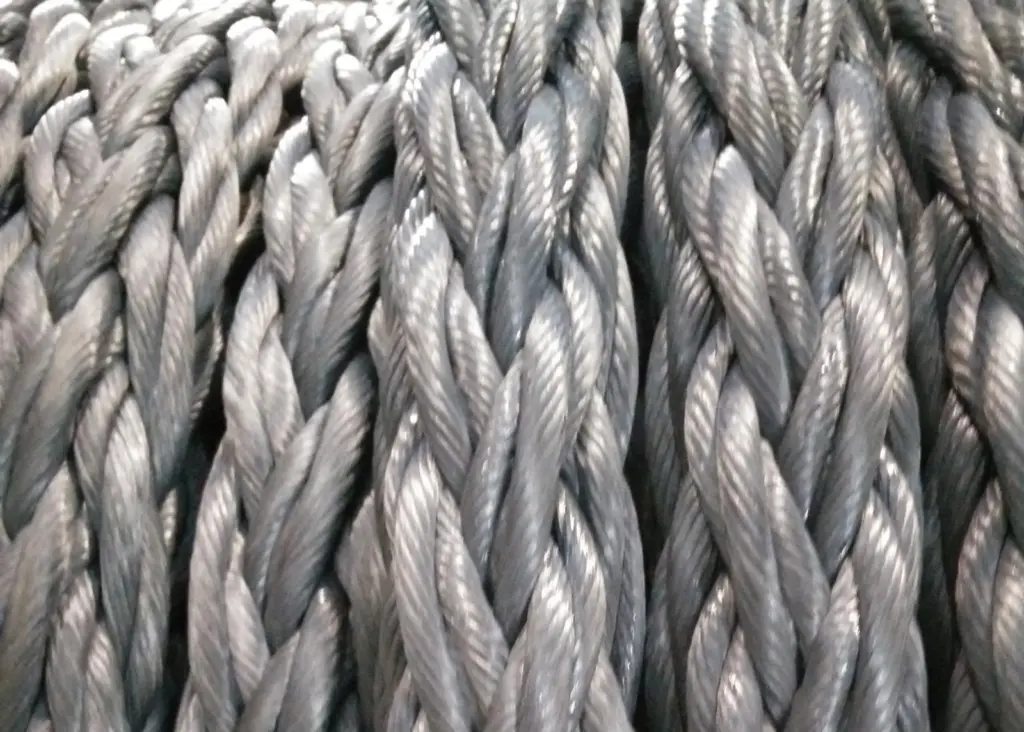
However, Mr Boesten said that the last few years have seen major improvements on every level: on the fibres, at the rope design level and on the coatings which reduces the problematic friction caused by the induced bending. For example, this particular project called for Lankhorst to create a new 76mm rope based on DSM Dyneema’s DM20 XBO fibre and a proprietary coating technology.
More is possible. Mr Boesten added that technology advances “have enabled our customers to design ropes that are as good as steel wire on CBOS performance, not only on the smaller diameters, but also on the larger diameter ropes significantly over 120mm diameter, as used in heave compensated installation systems with payloads of 500 tonnes plus”.
By Stevie Knight
Related Articles
 OTHER NEWS
 ACCESSORIES & EQUIPMENT
 ACCESSORIES & EQUIPMENT