![MaritimeJournal[Seawork]](https://www.maritimejournal.com/wp-content/uploads/2026/09/MaritimeJournalSeawork.svg)



Maasvlakte 2 gets into full swing
The container terminals are ready, tankers are transferring oil between each other and the world’s biggest ship has arrived – Port of Rotterdam Authority’s flagship development Maasvlakte 2 is ready for service
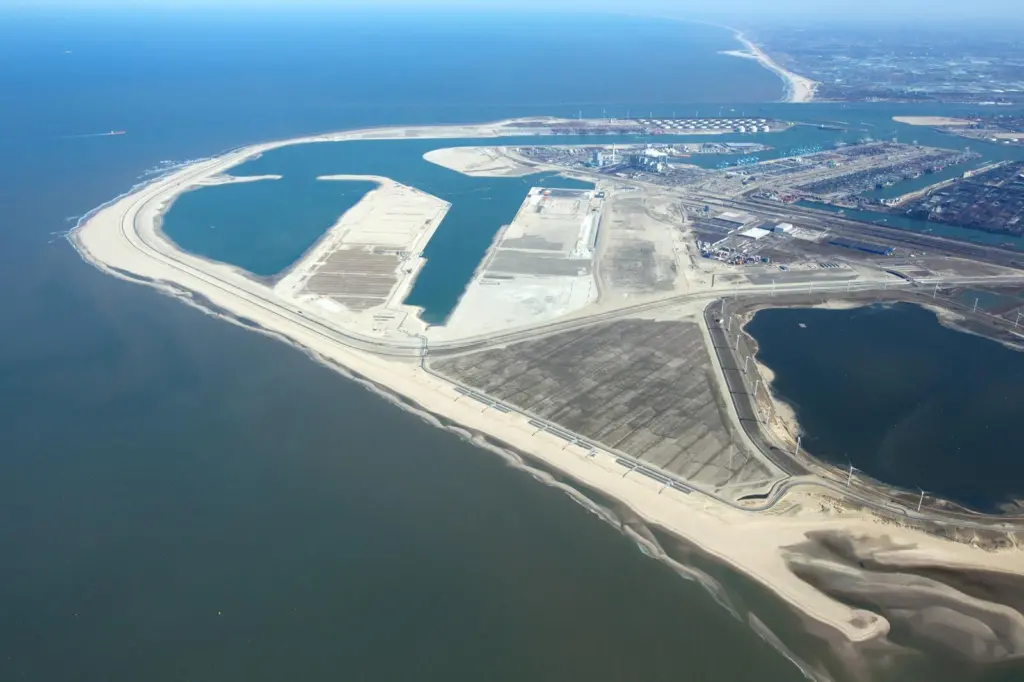
MJ has been reporting on progress with the construction of Maasvlakte 2 since early 2009 and as important as these latest developments are, they are just one step of a journey which, if images of the finished product are reflected upon will see the story continuing until at least 2030. The two recently completed container terminals should be viewed in the context of just part of the whole 2,000ha site behind a 4km long seawall.
Rotterdam World Gateway’s (RWG) first container cranes were delivered ready assembled to Prinses Amaliahaven in November 2013, less than a year later the terminal boasted eleven deepsea quay cranes, three barge/feeder cranes, two rail cranes, 50 automated stacking cranes and 59 automated guided vehicles. Testing is now all but complete, commercial services due to commence by April or May 2015.
Also in 2013, APM Terminals (APMT) commenced assembly on-site of their own gantry cranes. The eight ship-to-shore cranes are described as among the largest and most technologically advanced in the world, operated remotely with no one actually in the cabs, an industry first. With all the equipment electrically powered, and supplied entirely by green energy APMT’s Maasvlakte 2 facility will be free of all CO2 and NOx particulate emissions.
The demand for cargo handling efficiency brings pressure on ports and terminal operators and with ships getting bigger the industry is seeing increasing numbers of alliances in the quest to ensure the new ultra-large container ships are filled to capacity. This trend is borne out by PRA figures indicating increasing cargo volumes but slightly fewer vessel calls or fuller ships per call. Ship owners demand their vessels are turned around in as short a time as possible however and terminal operators are answering the challenge to achieve maximum productivity.
A record was set recently for the port and ECT’s Delta Terminal (Maasvlakte 1) when 10,557 containers were handled in a single visit from Evergreen Line’s Thalassa Pistis, berth productivity of 150 container moves per hour achieved during the visit. Both APMT and RWG are adopting state-of-the-art cargo handling technology to achieve maximum productivity along with investment to reduce environmental impacts of the operation.
A timely consequence of the starting of terminal operations will be the contribution to easing port congestion that has resulted in delays and diversions recently in northern European ports. There are differing opinions as to the causes but additional capacity will certainly help ease the problem. Global economics can change trading patterns virtually overnight, it takes many years however for ports to respond to such trends.
In November 2014 APMT began 24/7 landside operations and an important feature with Maasvlakte 2 is what is known as ‘modal shift’ where the share of onward movement of containers by rail and inland barge is gradually increased with decreasing volumes arriving and leaving by road. The goal is to reduce container transport by road haulage from 47% to 35% between 2003 to 2033 with rail and inland shipping’s share increasing from 13% to 20% and 40% to 45% respectively over the period.
At the end of December, in a gradual build up to full operations the 4,360 TEU Sealand Eagle made the short journey from APMT’s nearby terminal at Maasvlakte (1) to reposition empty containers and early in January the Triple-E class Marstal Maersk became the first ultra-large container ship to use their new terminal.
CHANGING HORIZONS
In 2009, your correspondent stood at PRA’s Futureland information centre, almost as far west as one could venture without getting your feet wet while 3km offshore a steady stream of dredgers were busy depositing sand that was to become Maasvlakte 2. The open sea cannot be seen now from the same vantage point: container terminals, the outer perimeter roads, rail tracks and suitably high seawall with the soft and hard sea defences now dominating the view.
Construction commenced in 2008 and the vision for 2030 shows the area occupied by terminals and industry. PRA have made it clear however that development will only take place as and when firm commitments from new tenants are secured. Much therefore depends on the state of health of various industry sectors.
It is important to note therefore that when the access channel in Yangtzekanaal was cut through in 2013 (following earlier closure of the outer seawall) it marked completion of the construction phase. In effect the new peninsular complete with infrastructure making future developments a case of building on the new land, a technique very familiar to the Dutch.
Figures do not adequately describe the scale of the project but include: around 1,000ha of industrial ground and 2,000ha of land reclaimed (larger than Schiphol Airport or Disneyworld), 25,000ha of seabed protection area created, 240m m3 of sand dredged for new land, over 5.5m tonnes of rock shipped in from Norway along with nearly 20,000 forty tonne blocks from the existing Maasvlakte seawall reused for the new 3.5km long hard seawall.
Maasvlakte 2 is a long-term project and as far back as 2006, long before the first grain of sand was dredged PRA received five proposals from companies and consortiums to operate container terminals. Two operating agreements were subsequently agreed with APMT (who have a terminal at Maasvlakte 1) and RWG, a consortium consisting DP World and four shipping companies, G6 Alliance (MOL, Hyundai and APL) and CMA CGM. Proposed locations for the terminals were in what became known as Prinses Amaliahaven. These agreements involving world class operators provided early justification for Maasvlakte 2 which became Europe’s largest port construction project.
APMT’s terminal covers 86ha with a 500m barge quay and 1,000m deepwater quay along with a dockside rail terminal comprising four 750m tracks. A total annual throughput of 2.7m TEU is expected. RWG’s terminal is of similar scale with a 550m barge/feeder quay and 1,150m deepwater quay. Six 750m rail tracks will serve their rail-freight operation with annual throughput stated as 2.35m TEU.
BUOYS AND TANKERS
For their part, PRA have been busy preparing the nautical elements of the project. Navigational aids including buoys are now marking the route past Euromax container terminal in the Yangtzekanaal with procedures now formalised to integrate the area into the existing port management systems. Provision has been made for attendant service craft including tugs, customs, police, boatmen and PRA vessels with substantial pontoons provided in Prinses Margriethaven along with inland barge moorings.
The container terminals are not the first commercial activities to provide an income from Maasvlakte 2 however. As the remainder of the new land will only be developed when required, the deepwater area to the northwest (23.65m NAP) has provided the opportunity for STS (ship-to-ship) transhipment facilities serving both dry goods and liquid cargo.
STS operations are an important business sector for Rotterdam with safety benefits from transferring oil cargoes between tankers in the port’s sheltered waters. PRA have invested €9m in heavy-duty mooring piles allowing two STS operations to take place simultaneously for ships up to 350m length. Tankers carrying out cargo transfers are now a regular sight in this sheltered area.
Another more high-profile opportunity for use of the large semi-enclosed area designated Prinses Alexiahaven recently arose. Pipelaying vessels of Allseas Engineering are regular callers at Rotterdam and when their €2.4bn newbuild platform installation/decommissioning and pipelay vessel Pioneering Spirit was built in Korea a sheltered area for completion of the 382m long, 124m wide twin-hulled giant was required.
Pioneering Spirit is designed to lift offshore platforms up to 48,000 tonnes and the 65m long topside lift system beams have been shipped from their construction site in Italy to be installed on the vessel in Rotterdam, a special pit has been dredged to accommodate the vessel at its deepest draught of 26m. Allseas and PRA have reportedly signed a long-term agreement to use Prinses Alexiahaven as a base for Pioneering Spirit so this remarkable vessel, described as the world’s largest ship will become a regular sight in Rotterdam.
Looking further ahead, PRA have entered into an agreement with E.ON, Evides Industriewater, Stedin and Vopak to create an 80ha ‘plug & play’ area on Maasvlakte 2 (reserved for chemical industries) offering mains services to businesses wishing to set up in a bio-based cluster planned there. Bio fuels, bio energy and the bio chemical industry are business areas seeing steady expansion in Rotterdam.
By Peter Barker
Related Articles
 OTHER NEWS
 OTHER NEWS
 FEATURES & VIDEOS