![MaritimeJournal[Seawork]](https://www.maritimejournal.com/wp-content/uploads/2026/09/MaritimeJournalSeawork.svg)





New German daughtercraft lifeboat system
Nearing completion in the Fassmer shipyard in Germany is a new design of lifeboat. Destined for the German Lifeboat Association, the DGzRS, this new lifeboat will be a replacement for their Berlin Class that has been in service for the past 30 years.
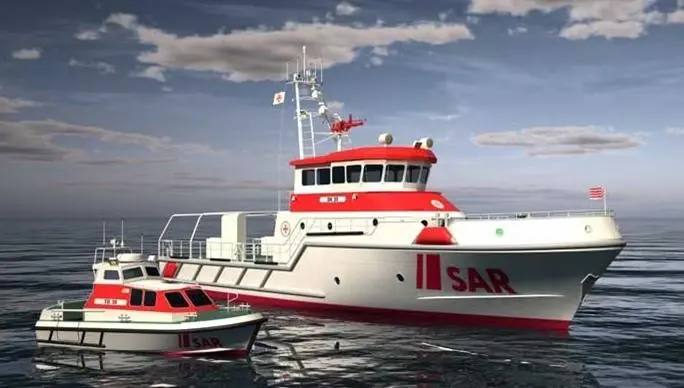
This prototype, which is currently nearing completion, is scheduled for its handover and official christening this summer, which will also mark the 150th anniversary of the DGzRS.
The DGzRS is unique amongst lifeboat organisations in that it operates a fleet of large cruising lifeboats with lengths up to 40 metres. Although these are based at specific locations they have the ability to cruise at sea for several days if required. For rescue work they carry a daughtercraft in a launching ramp at the stern and the new 28 metre lifeboat will follow this design philosophy. The new lifeboat will be based at their Amrun lifeboat station in the busy area of the German Bight.
This new lifeboat is based on a semi-displacement hull design with a skeg that allows the propellers to operate within the depth of the hull. It features the heavily flared bow that has been a feature of German lifeboat designs which combines fine underwater lines with wider topsides. The enclosed raised wheelhouse allows the lifeboat to be self-righting in the event of a capsize and construction is entirely in aluminium.
The lifeboat will be powered by a pair of MTU 16V 2000 M72 diesels which will produce a combined output of 2880 kW and this will give a top speed of 24 knots. These MTU diesels are the Rough Kit version of the engine that feature a deeper oil sump with bulkheads and modified crankcase breathers and control systems to cope with operation in severe weather conditions when the vessel movements can be extreme.
The engines are coupled to fixed pitch propellers and there is a 75 kW bow thruster to aid manoeuvrability. The fuel tanks hold 20 cubic metres of fuel which will allows a range of 600 miles at full speed, extending to 800 miles at the 16 knots cruising speed. The machinery is monitored and controlled by the MTU Blue Vision system.
The forward section of the hull is given over to accommodation for the four man crew and for survivor facilities including a hospital. The lifeboat is equipped with a rescue zone and a towing hook as well as fire-fighting equipment that can deliver 4000 litres per minute.
The 8.2 metre daughter boat is also designed to be self-righting. It is carried in a stern ramp that is fitted with the DGzRS designed automatic connection and release system that features an endless chain into which the hull connects automatically when entering the stern ramp.
By Dag Pike
Related Articles
 OTHER NEWS
 ACCESSORIES & EQUIPMENT
 ACCESSORIES & EQUIPMENT