![MaritimeJournal[Seawork]](https://www.maritimejournal.com/wp-content/uploads/2026/09/MaritimeJournalSeawork.svg)





Innovative software brings fair winds to hybrid vessel
A team of scientists at the Fraunhofer Center for Maritime Logistics and Services (CML) has developed a new weather routing module for an ambitious proposed hybrid merchant vessel for sustainable sea transport which is powered by wind and LNG.
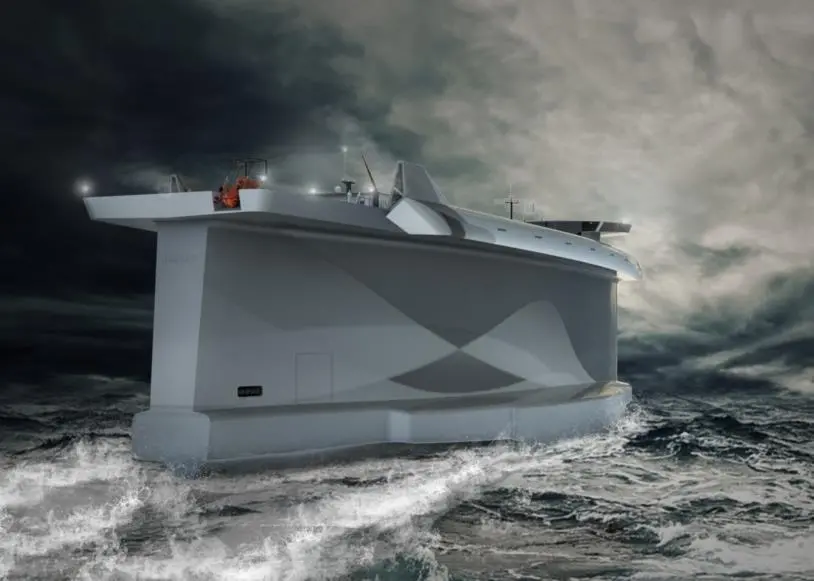
The main purpose of the new weather routing module for Vindskip is to support the developers of the Vindskip vessel, Norwegian company Lade AS, to identify and utilise winds that are more favourable for propulsion during deep sea voyages.
As Claudia Bosse, Press and Media Manager at CML explains, fuel costs account for a ‘major percentage of costs in the shipping industry,’ meaning that fuel economy is the key to achieving ‘cost efficient and sustainable sea transport.’ However, the fact that current software-based routing programs are designed for use with ships that run on ‘conventional’ fuel means that they are only of limited use for the Vindskip.
“Existing weather routeing algorithms need to be augmented to account for the aerodynamic lift generated by the wind as a propulsive force,” says Bosse.
METEOROLOGICAL DATA
In order to create a system that is more suitable for fully or partly wind powered vessels, CML developed software that uses information gathered from meteorological forecasts for wind, waves and currents (Gridded Binary, or GRIB, data used for weather forecasting), as well as data related to Vindskip’s wind resistance curves, propulsion curves, fuel consumption curves and stability. The output will be an optimised route plan for the ship to follow that will be compatible with the forthcoming IEC 61174 standard to enable direct import into future ECDIS systems.
For Bosse, a benefit of the new module is that the watch-keeping officer on board will have a tool at his or her disposal with which they will be able to optimise the route of the ship themselves, ‘instead of having to rely on recommendations from shore-side service providers.’
“But the major benefit will be that this tool is specially designed to meet the specific requirements of the Vindskip, thus it is custom-made for the purpose of this ship. The financial benefits are directly connected to the fuel savings which can be achieved by this ship compared to a conventional one,” she adds.
According to Bosse, the new software module is a ‘tailor-made solution’ for the requirements of the Vindskip vessel, and there are not yet any concrete plans for further commercial development in other applications. Having said that, she highlights the fact that existing tools providing weather routing assistance for conventional vessels, or for the broader ‘offshore industry,’ do leave some ‘room for improvement’ and she admits that they may ultimately be able to benefit from CML’s experience in this field of research.
By Andrew Williams
Related Articles
 OTHER NEWS
 ACCESSORIES & EQUIPMENT
 ACCESSORIES & EQUIPMENT