![MaritimeJournal[Seawork]](https://www.maritimejournal.com/wp-content/uploads/2026/09/MaritimeJournalSeawork.svg)





Capacity: a fundamental issue
“Today more than ever the cost aspect is high on the agenda,” said Martijn Peter de Jongh of Rolls-Royce Marine AS, but finding the balance between price and capability can be tricky.
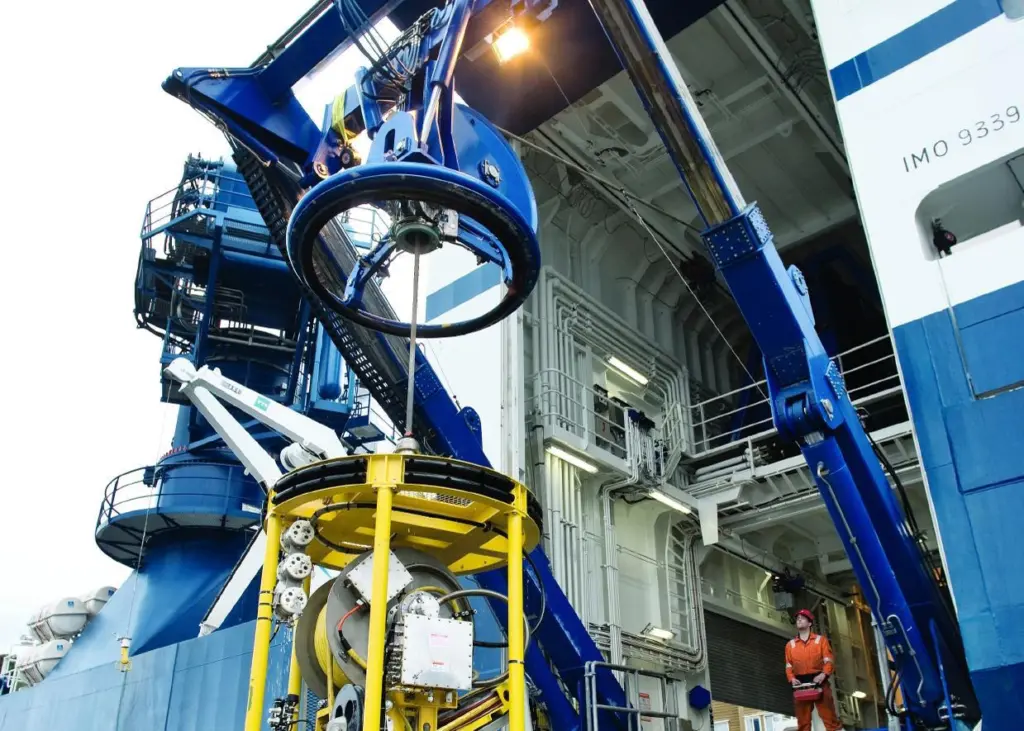
He explained that one way of holding down costs is by standardising equipment, but when it comes to Launch and Recovery Systems this isn’t as easy as you might think. However the issue isn’t the physical connection: this is simply a matter of tailoring the docking plate “and in general we find we can handle different types of ROV from all round the world” said Mr de Jongh.
The big issue is more fundamental: standardisation with a lifting system implies a certain capacity, but what level do you aim at? The answer, for Rolls-Royce at least, has been ‘pretty high’.
To start with, the company has aimed its LARS at deploying not just the observation ROVs (which tend to have their payload limited to cameras), but the tooled up, heavier work ROVs which has meant giving the units a 12 tonne capability. Next came the winch motors: “We have about 650kW of power on the motors to cope with both speed and acceleration forces,” he added.
The second point is that RR is using the latest technology: permanent magnet motors. These consist of a rotor with a ring of magnets and a stator equipped with coils so that during operation torque is transferred to the central shaft. “That means we have minimum of losses in the system,” he said, “A standard electrical motor running at 1,800 rpm needs a whole lot of energy just to stop it whereas Rolls-Royce’s permanent magnet winch motor only runs at 600 rpm, enabling it to brake and accelerate in both directions efficiently.”
Last but not least, Mr de Jongh explained that talking with the ship designers gains important benefits. Firstly, layout: “A ROV system often consists of a tool skid at the bottom, but then there’s the ROV itself, plus the tether management system (TMS) on top: the total height of this comes to a typical maximum of 5.2m – so that’s what we have to handle inside the hangar. If a ship designer can accommodate this on one single deck level instead of two it means maximising the use of the other levels, for say cabins or offices.”
Lastly, seeing the deck equipment and the ship as an integrated whole results in operational savings: “As we are using frequency converters to run the motors, there’s potential to take regenerated power from the lowering of the ROV and run it back into the ship the vessel’s overall power system.”
By Stevie Knight
Related Articles
 OTHER NEWS
 ACCESSORIES & EQUIPMENT
 ACCESSORIES & EQUIPMENT