![MaritimeJournal[Seawork]](https://www.maritimejournal.com/wp-content/uploads/2026/09/MaritimeJournalSeawork.svg)




URAG takes the green road
German tug owner Unterweser Reederei GmbH (URAG) has reported on its measures to join the current drive in the tug world aimed at reducing fuel consumption and lowering emissions.
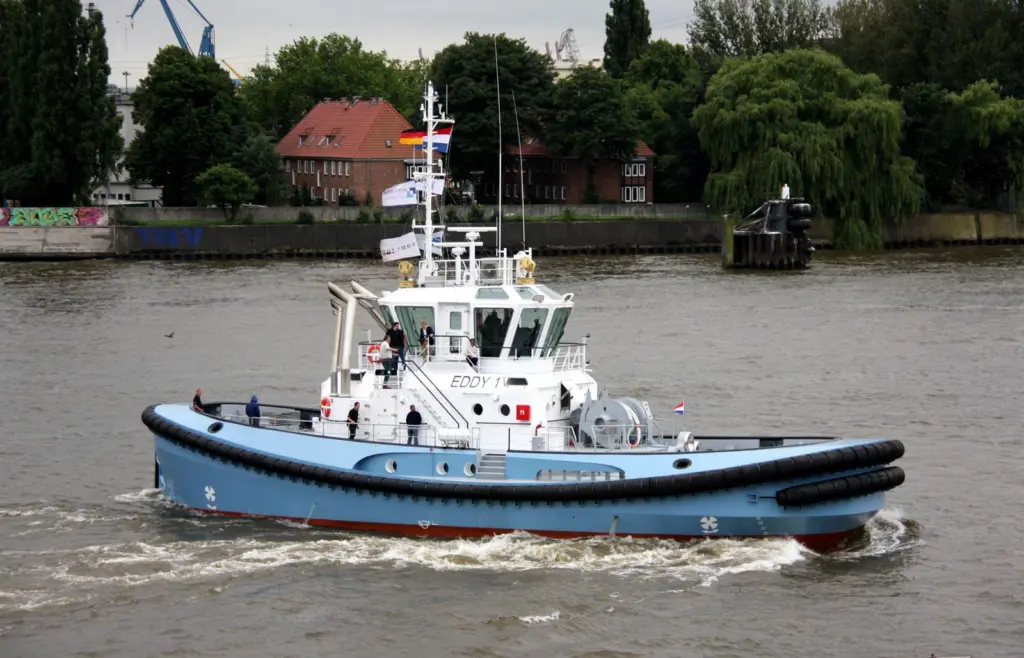
URAG, a wholly owned subsidiary of Lütgens & Reimers of Hamburg, are based at Bremerhaven on the river Weser and operate a diverse fleet of ship-handling and anchor-handling multipurpose tugs. This includes an AHTS with their history recording active involvement in the North Sea jack-up rig sector. URAG’s current fleet is dominated by Voith Water Tractors and complemented by two Rotor Tugs along with their current involvement in development of the revolutionary EDDY Tug.
The desire to reduce emissions is particularly important given URAG’s operational proximity to built-up residential areas of Hamburg and Bremen and is part of the reason for their in-depth review of the current operating profile and fleet provision resulting in initiation of a 3-step approach.
THREE STEPS TO GREEN
Continuous improvement with performance of the existing tug fleet forms Step 1 and comprises three elements starting with building awareness within the captains and engineers through meetings and simulator training emphasising the importance of fuel economy and emission control.
Next came improving operational pre-planning; instead of “racing” to jobs at the last minute at full speed, transit times are now allowed to be slightly longer using lower engine RPM and higher pitch. Making this happen includes improved communication with other stakeholders in the ports including pilots, traffic management and clients.
The third element (of Step 1) involved installation of fuel measurement systems. Adoption of such technology increased crew awareness and has resulted in a 15-20% relative fuel cost reduction and cuts in noxious emissions since the start of the programme in March 2013. As Michael Staufeldt, COO and managing director of URAG observed: “The old saying still holds true – what gets measured, gets done.”
Step 2 went further, re-evaluating future tug requirements with interesting changes taking place. URAG’s previous approach had been to operate multipurpose tugs capable of operating in port and offshore environments but now a new focus was introduced. For pure harbour operations such as at Hamburg, tugs would ideally need to be lighter, with high speed engines and azimuth drives.
The decision was subsequently taken to order two Damen ASD 2411 tugs to be named Perfect and Brake. They were built at Damen’s Vietnam facilities and shipped to Rotterdam as deck cargo and preparation for delivery to their new owners, URAG stating “Fuel consumption and emission for these new tugs are up to 40% less than before.”
INTRODUCING EDDY
Step 3 involved an even more radical approach. URAG management had long been in contact with Holland Shipyard at Hardinxveld-Giessendam, intrigued by the revolutionary EDDY tug design. Their engineers and inspectors had been engaged in intensive exchanges of ideas and best practise procedures during final construction of the tug Eddy 1. In December 2014 following trials, URAG became the first serious operator of the tug in the demanding and harsh environment of the port of Bremerhaven.
A feature of Bremerhaven is the requirement for tugs capable of operating in the confines of locks in the enclosed dock system. In such an environment Eddy 1 was seen as ideally suited, capable of handling large, vehicle carriers with the ability to provide full power and manoeuvrability in all directions.
At the Stromkaje container terminal, exposed to the North Sea with currents running at speeds up to 5 knots and strong winds tugs are required to cover long distances to attend ships at the terminal. Transit is carried out in diesel-electric mode, a profile which according to URAG achieves a “real life” fuel consumption of only 150 l/hour.
Overall the programme towards a “green footprint” has yielded a reduction of fuel and noxious emissions of 23% with Niels Roggemann, managing director of URAG commenting: “The challenge remains to introduce “greener” technology without ignoring economic realities – in these time we cannot afford to finance any pipedreams.”
By Peter Barker
Related Articles
 SPECIAL REPORTS
 TUGS & SALVAGE
 EQUIPMENT